Capital Expenditures vs Operating Expenses Explained
“Capital expenditures vs operating expenses” is one of the most important distinctions in business finance because it affects profitability, taxes, cash flow, valuation, budgets, and investor reporting.
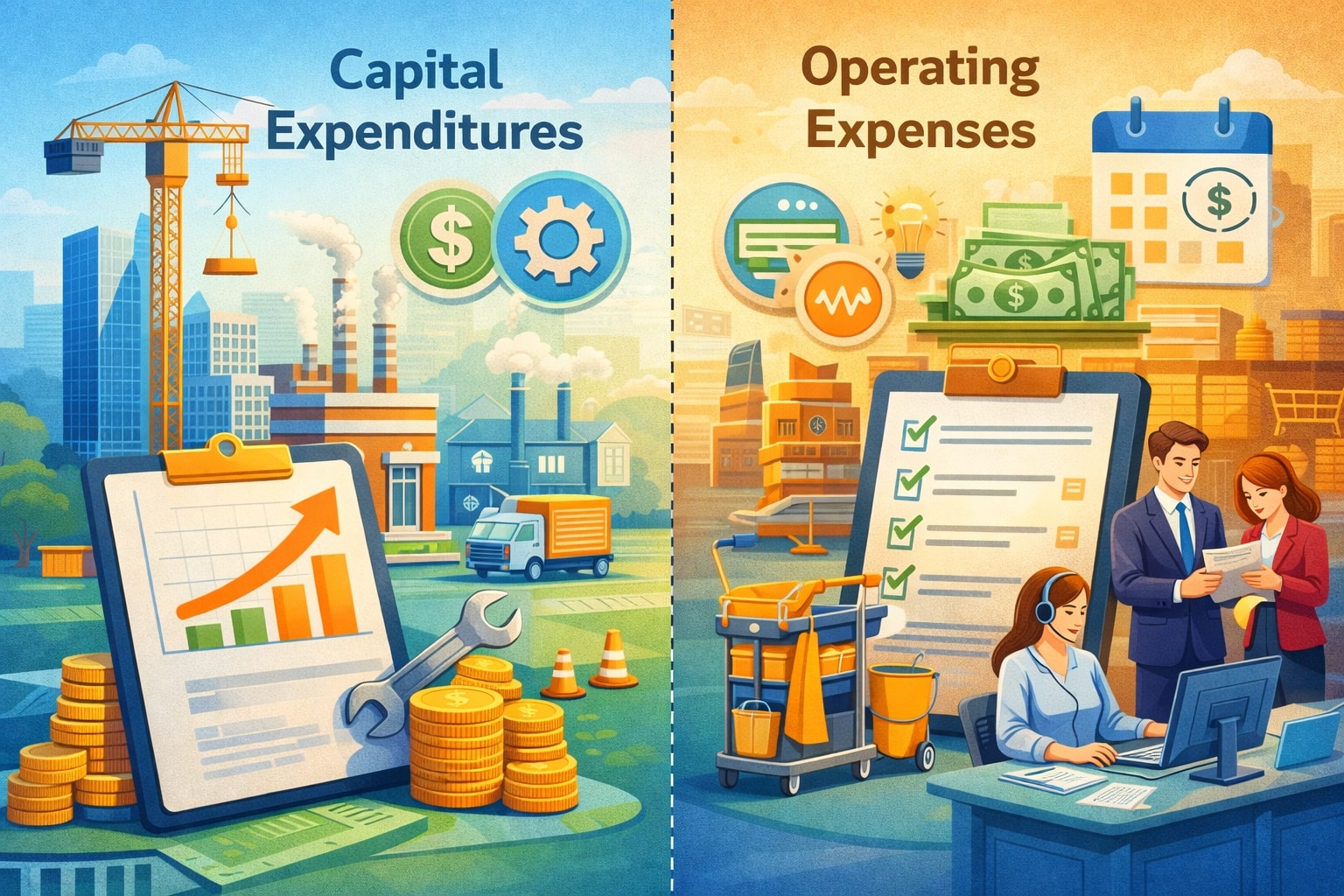
At a high level, capital expenditures (CapEx) are usually long-term investments in assets that help the business over multiple years, while operating expenses (OpEx) are the ongoing costs of running the business day to day.
But real-world decisions aren’t always obvious—especially with cloud services, subscriptions, leases, bundled contracts, and fast-moving technology.
In practical terms, the capital expenditures vs operating expenses decision changes how costs show up on the financial statements. CapEx generally lands on the balance sheet first and then flows into the income statement over time through depreciation or amortization. OpEx typically hits the income statement immediately in the period it’s incurred.
Why this matters: a company can spend the same dollars but report very different results depending on whether those dollars are CapEx or OpEx. That’s why CFOs, controllers, bookkeepers, founders, and department heads all need a consistent, well-documented policy.
Investors and lenders also scrutinize capital expenditures vs operating expenses because it changes margins, EBITDA, operating cash flow, and the “quality” of earnings.
This guide breaks down definitions, accounting treatment, tax impacts, common examples, gray areas, decision frameworks, industry-specific scenarios, and future trends—so you can classify costs confidently and build a cleaner financial story.
Understanding Capital Expenditures (CapEx)

Capital expenditures (CapEx) are costs incurred to acquire, upgrade, or extend the life of long-term assets that support operations over multiple accounting periods.
In the capital expenditures vs operating expenses framework, CapEx is generally associated with future benefits—meaning the purchase is expected to contribute to revenue generation or cost savings beyond the current year.
Common CapEx categories include property improvements, machinery, vehicles, technology hardware, and certain software development costs. The core idea is that the business is building capacity: increasing output, improving efficiency, reducing unit costs, or enabling new services.
From an accounting view, CapEx is capitalized, meaning it’s recorded as an asset on the balance sheet rather than being fully expensed immediately.
Over time, the asset’s cost is recognized through depreciation (for tangible assets like equipment) or amortization (for intangible assets like certain software). This creates a smoother expense pattern across the asset’s useful life.
However, CapEx isn’t automatically “large purchases.” A small item can be CapEx if it meets capitalization policy thresholds and has multi-year benefits.
Likewise, a large payment can still be OpEx if it’s for routine operations (like a big annual software subscription). That’s why capital expenditures vs operating expenses classification relies on useful life, ownership/control, and benefit period, not just dollar amount.
When organizations get CapEx right, they produce financial statements that reflect reality: assets on the balance sheet, expense recognition over time, and a clearer picture of operational performance.
Understanding Operating Expenses (OpEx)

Operating expenses (OpEx) are the recurring costs required to run the business and generate revenue in the current period. In the capital expenditures vs operating expenses comparison, OpEx is typically associated with immediate consumption: the value is used up quickly, and the benefit is primarily within the current month, quarter, or year.
OpEx includes payroll for non-capital projects, rent, utilities, insurance, marketing, professional services, routine maintenance, travel, shipping, merchant fees, office supplies, and most subscriptions. These costs generally hit the income statement in the period incurred, reducing operating profit right away.
OpEx is also central to performance metrics. Many managers watch OpEx closely because it directly impacts operating margin. In budgeting, OpEx is often more flexible: teams can pause campaigns, reduce discretionary travel, renegotiate vendor contracts, or change subscription tiers.
But OpEx is not “bad.” In many modern businesses, especially service and software-heavy models, OpEx reflects productive spending like customer acquisition, product support, security monitoring, and recurring cloud infrastructure.
The capital expenditures vs operating expenses conversation becomes especially important when leadership tries to optimize for profitability. Cutting OpEx can boost short-term earnings, but it can also harm growth, security, and customer satisfaction if done blindly.
A strong finance function doesn’t just label items OpEx; it creates clarity on which OpEx is growth OpEx (fueling revenue expansion) versus run-rate OpEx (keeping the business stable). That distinction improves forecasting and helps decision-makers spend with intent.
The Core Accounting Difference: Capitalize vs Expense

The heart of capital expenditures vs operating expenses is timing—when costs appear on the income statement. With OpEx, expense recognition is immediate. With CapEx, expense recognition is spread over time.
When a cost is capitalized, it enters the books as an asset. That asset is then expensed gradually through depreciation or amortization. This matters because it can make profits appear higher in the near term (since the full cost isn’t expensed at once), while increasing assets on the balance sheet.
When a cost is expensed, it reduces profit immediately. That can make a period look weaker even if the spending supports long-term outcomes. This is why investors and lenders look beyond net income and examine cash flow and CapEx levels to understand how sustainable earnings are.
In the capital expenditures vs operating expenses framework, accountants rely on standards and policy:
- Does it create or improve an asset you control?
- Does it extend useful life or increase capacity?
- Is the benefit likely to last beyond the current year?
- Is it material enough to capitalize under policy thresholds?
This is also where organizations must be consistent. If one department capitalizes upgrades while another expenses similar purchases, the financial statements become noisy and harder to compare over time.
Strong capitalization policies define thresholds, useful-life guidelines, and documentation requirements—reducing subjectivity while staying compliant.
Financial Statements Impact: Income Statement, Balance Sheet, Cash Flow

To fully understand capital expenditures vs operating expenses, you need to see how each classification flows through the three major financial statements.
Income statement:
- OpEx reduces operating income in the period incurred.
- CapEx usually appears as depreciation/amortization expense over time, not as the upfront purchase price.
Balance sheet:
- OpEx typically doesn’t create a long-lived asset (though there can be prepaid expenses).
- CapEx increases fixed assets or intangible assets and then decreases gradually through accumulated depreciation/amortization.
Cash flow statement:
- OpEx cash payments are generally included in operating cash flow.
- CapEx cash payments show up under investing cash flow as purchases of property/equipment or capitalized software.
This difference is why a company can show strong net income but weak cash flow if it’s investing heavily, and vice versa. In capital expenditures vs operating expenses, analysts often track:
- CapEx as a % of revenue
- Free cash flow (operating cash flow minus CapEx)
- EBITDA vs net income (since EBITDA excludes depreciation/amortization)
When leadership understands these mechanics, they can communicate more clearly with lenders, investors, and stakeholders—and avoid accidental “profit illusions” caused by aggressive capitalization.
Taxes and Deductions: Why Classification Affects Tax Strategy
The capital expenditures vs operating expenses decision can influence taxable income timing. Generally, OpEx is deducted in the year incurred, while CapEx is deducted over time through depreciation/amortization—unless accelerated tax rules apply.
Under federal rules administered by the IRS (in the United States), businesses may be able to deduct certain capital investments faster using provisions such as Section 179 (electing to expense qualifying property up to limits) and bonus depreciation (allowing large first-year deductions for qualifying assets, subject to phase-down rules).
These incentives can make CapEx more tax-efficient in the short term, even though it’s capitalized for book reporting.
Important nuance: book accounting and tax accounting can differ. A cost might be capitalized for financial statements but deducted more quickly for taxes, creating deferred tax assets/liabilities for companies that report them.
In the capital expenditures vs operating expenses lens, planning often includes:
- Timing purchases near year-end
- Evaluating whether repairs are deductible or must be capitalized
- Structuring contracts to separate service (OpEx) from deliverables (potential CapEx)
- Coordinating tax elections with cash flow needs
Because tax rules and thresholds can change, businesses should align with a qualified tax professional. The biggest win is not “forcing” everything into OpEx or CapEx, but classifying correctly and using available incentives ethically and consistently.
Common CapEx Examples Across Industries
Seeing real examples makes capital expenditures vs operating expenses easier to apply. CapEx typically includes purchases or improvements that create lasting value.
- Facilities and property: building acquisition, major renovations, HVAC replacements, warehouse build-outs, parking lot resurfacing (when it materially extends life), security systems, significant electrical upgrades.
- Equipment and vehicles: manufacturing machines, commercial ovens, forklifts, delivery vans, specialized tools above capitalization thresholds, and major upgrades that increase output or useful life.
- Technology: servers and networking gear, point-of-sale hardware, security appliances, and certain internally developed software costs (when they meet capitalization criteria).
- Intangibles: patents, certain licenses, acquired software, and implementation costs that qualify under applicable guidance.
A key part of capital expenditures vs operating expenses is distinguishing “asset creation” from “maintenance.” If spending simply restores an asset to its prior condition, it’s often not CapEx. If it increases performance, capacity, or useful life, it often is.
Companies should keep standardized categories in the chart of accounts and enforce documentation requirements: vendor invoices, business purpose, asset location, responsible department, and expected useful life. Good discipline here reduces audit risk and improves forecasting accuracy.
Common OpEx Examples: What Usually Gets Expensed
OpEx is broad because it covers ongoing operations. In the capital expenditures vs operating expenses framework, OpEx generally includes costs that don’t create a controlled, multi-year asset.
Typical OpEx buckets include:
- Payroll and contractor costs for routine operations
- Rent, utilities, internet service
- Insurance premiums
- Marketing and advertising
- Payment processing fees and bank charges
- Office supplies, small tools, consumables
- Customer support tools and help-desk services
- Routine repairs and maintenance
- Legal/accounting fees related to ongoing operations
- Travel, meals (subject to policy), and training
- Most SaaS subscriptions and cloud usage fees
Even when an OpEx item has long-term benefits—like marketing that builds brand value—it’s usually still expensed because it doesn’t create a separable asset the business controls.
That’s a subtle but critical point in capital expenditures vs operating expenses: “future benefit” alone is not enough; the benefit must generally be tied to an identifiable asset under the rules your financial reporting follows.
Strong OpEx tracking helps managers control burn rate and measure efficiency. Many businesses also break OpEx into fixed vs variable components for forecasting, since variable OpEx often scales with revenue while fixed OpEx doesn’t.
Gray Areas and Real-World Traps: Repairs, Upgrades, and Bundled Contracts
Where capital expenditures vs operating expenses gets tricky is in the gray areas—especially repairs vs improvements, software costs, and vendor bundles.
- Repairs vs improvements: Fixing a broken component is typically OpEx. Replacing a system in a way that increases capacity or extends life can be CapEx. For example, patching a roof leak is often OpEx; replacing the entire roof may be CapEx.
- Technology bundles: A vendor may sell “hardware + installation + support.” Some portions might qualify as CapEx (hardware, certain implementation) while others are OpEx (support, monitoring, training). If you don’t separate them contractually, you may be forced into a conservative classification or create audit exposure.
- Implementation and setup: Some setup costs are expensed, but others can be capitalized depending on the nature of the project and accounting guidance. This is a hot zone for mistakes because teams assume “setup = CapEx,” which is not always true.
- Leases: Lease accounting can create right-of-use assets and lease liabilities, which can confuse non-accountants. Even with those balance sheet entries, the classification still matters in operational reporting and budgeting—another reason capital expenditures vs operating expenses policies must be explained clearly to department leaders.
The fix is process: require purchase requests to include purpose, expected useful life, deliverables, and whether the cost is a replacement, upgrade, or routine maintenance. Then apply a consistent decision tree.
A Practical Decision Framework for Classifying Costs
If you want a repeatable approach to capital expenditures vs operating expenses, use a structured decision framework. This reduces “debates by opinion” and makes approvals faster.
Step 1: Identify the deliverable
Are you buying a service, a consumable, or an asset you control? If it’s primarily a service (support, consulting, usage fees), it’s usually OpEx.
Step 2: Determine the benefit period
Does the benefit substantially extend beyond the current year? If yes, it may lean CapEx—if it also meets asset criteria.
Step 3: Assess whether it creates or improves an asset
Does it create a new asset, increase capacity, materially improve performance, or extend useful life? If yes, it leans CapEx. If it maintains current condition, it leans OpEx.
Step 4: Apply capitalization thresholds and policy
Many organizations set minimum dollar thresholds for capitalization. Below that, they expense for simplicity—unless the item is part of a larger project that must be capitalized together.
Step 5: Document and separate bundles
Split invoices into components where appropriate (asset vs service). This step is a major driver of accurate capital expenditures vs operating expenses classification.
The goal is consistency, not perfection. A well-run finance team chooses a defensible policy, trains staff, and reviews edge cases regularly—especially as technology spending evolves.
CapEx vs OpEx in Technology and Cloud: The New Frontier
Modern tech spending is the biggest reason capital expenditures vs operating expenses has become harder. Businesses increasingly rent compute, storage, and tools instead of owning servers and software.
Historically, buying servers was clear CapEx. Today, many companies use cloud services where costs are usage-based and treated as OpEx. That shift affects reported margins and cash flow patterns.
It can also change how leadership thinks about scale: instead of large upfront investments, teams can ramp spending in smaller increments.
Software is another challenge. Acquired software licenses might be capitalized, but SaaS subscriptions are usually OpEx. Implementation can be mixed—some configuration and development may qualify for capitalization under certain rules, while training and ongoing support are typically OpEx.
In the capital expenditures vs operating expenses landscape, CFOs now focus on “FinOps” practices—governance around cloud usage, tagging, chargebacks, and efficiency metrics. That’s because cloud OpEx can quietly balloon without procurement guardrails.
A future-facing finance team creates clarity by:
- Separating one-time implementation from recurring subscription
- Requiring cloud tagging standards to allocate spend
- Tracking “committed use” contracts as strategic obligations
- Forecasting usage-based OpEx with scenario modeling
This is where classification meets management: even if cloud is OpEx, it can behave like capacity investment—so it needs investment-grade oversight.
Budgeting, Forecasting, and KPI Impacts
The capital expenditures vs operating expenses choice directly affects how budgets are built and how performance is judged.
CapEx often goes through a formal approval process because it ties up cash and impacts long-term planning. Organizations build annual CapEx plans tied to strategic goals: adding locations, upgrading equipment, hardening security, or increasing production capacity. CapEx is also evaluated with payback period, ROI, IRR, and operational impact.
OpEx budgets are often departmental and recurring. Managers monitor OpEx monthly for variance and cost control. But many businesses make a mistake by treating OpEx as “bad” and CapEx as “good.”
Overspending CapEx can still destroy cash flow, while smart OpEx (like customer support staffing or security monitoring) can protect revenue and reduce risk.
Key KPIs influenced by capital expenditures vs operating expenses include:
- EBITDA (CapEx reduces it slowly via depreciation; OpEx reduces it immediately)
- Operating margin (sensitive to OpEx)
- Free cash flow (sensitive to CapEx timing)
- Asset turnover (changes with capitalized assets)
- Return on invested capital (ROIC)
Good forecasting separates maintenance CapEx (keeping operations stable) from growth CapEx (expansion), and separates run-rate OpEx from discretionary OpEx. This approach tells a more accurate story to lenders and investors.
Compliance, Controls, and Audit Readiness
Strong controls make capital expenditures vs operating expenses defensible. Without documentation, companies risk inconsistent reporting, tax exposure, and audit findings.
Best practices include:
- A written capitalization policy with thresholds and useful-life ranges
- Standard categories for asset classes (IT, furniture, vehicles, leasehold improvements)
- Required fields in purchase requests (asset location, business purpose, project code)
- Approval workflows based on amount and type
- Periodic fixed-asset inventory and impairment review
- Vendor contract review for bundled components
Auditors often focus on capitalization because it can be used to “manage” earnings—capitalizing too much reduces current expenses and inflates profit. On the other hand, expending true CapEx can understate assets and distort operational performance.
In the capital expenditures vs operating expenses world, you want a policy that is conservative, consistent, and aligned with your reporting framework. The payoff is credibility: clean books improve financing terms, simplify due diligence in acquisitions, and reduce surprises when leadership needs to make fast decisions.
Future Predictions: Where CapEx and OpEx Are Headed
The future of capital expenditures vs operating expenses will be shaped by how businesses buy technology, how accounting guidance evolves, and how investors value cash flow.
Subscription economy continues to push OpEx higher
More vendors are shifting from licenses to subscriptions, moving costs into OpEx and smoothing vendor revenue. Companies will respond by building stronger vendor management and renewal governance.
“Asset-light” models will keep expanding
Many businesses prefer flexibility over ownership. Expect more outsourcing, cloud infrastructure, and usage-based pricing. That makes OpEx management a competitive advantage.
AI spend becomes a new classification battleground
AI tools often show up as subscriptions (OpEx), while AI infrastructure investments can be CapEx. Companies will need clearer policies for AI implementation projects, data pipelines, and model development costs.
ESG and energy efficiency drive targeted CapEx
Upgrades that reduce energy usage and improve resilience (HVAC efficiency, fleet electrification, building improvements) will increase strategic CapEx planning, especially where incentives exist.
Investors emphasize free cash flow quality
As markets focus on durable cash generation, businesses will track CapEx discipline and OpEx efficiency more tightly. In capital expenditures vs operating expenses, the story won’t be “which is better,” but “which spend generates measurable returns.”
The companies that win will treat classification as a management system—linking spending to outcomes, risk reduction, and long-term strategy.
FAQs
Q.1: What is the simplest way to remember capital expenditures vs operating expenses?
Answer: A simple mental model for capital expenditures vs operating expenses is: CapEx builds or improves long-term assets, while OpEx runs the business today. If you buy something that lasts and supports operations for years, it leans CapEx. If you’re paying for ongoing services, consumption, or routine running costs, it leans OpEx.
That said, the best “simple rule” is consistency plus documentation. Many mistakes happen when teams rely on price tags instead of useful life and asset control. Also remember that some costs can be prepaid (like annual insurance) and still be OpEx, just recognized over time as the prepaid is used.
If you want accuracy, use a decision tree: identify deliverable, benefit period, asset creation/improvement, then apply capitalization threshold. That approach keeps capital expenditures vs operating expenses classification stable even when business models change.
Q.2: Can the same type of purchase be CapEx sometimes and OpEx other times?
Answer: Yes—and this is why capital expenditures vs operating expenses can be confusing. For example, work on equipment could be OpEx if it restores the equipment to its prior condition, but CapEx if it materially upgrades capacity or extends useful life.
Software is another example: a monthly SaaS subscription is usually OpEx, while certain acquired software or qualifying development costs may be capitalized. Even within one vendor invoice, support might be OpEx while hardware is CapEx.
The key is to break out components and document the purpose. A consistent policy prevents one team from capitalizing “upgrades” that another team expenses, which creates reporting noise.
Q.3: Do CapEx and OpEx affect cash the same way?
Cash is cash, but the statements show it differently—this is central to capital expenditures vs operating expenses. If you pay $50,000, cash decreases by $50,000 regardless of classification.
The difference is where that cash outflow is reported on the cash flow statement (operating vs investing) and how expenses are recognized on the income statement (immediate vs spread out).
This is why a company can show rising profits while cash is tight if it is investing heavily in CapEx. Leadership should watch free cash flow and liquidity, not just net income, when making spending decisions.
Q.4: Are leases CapEx or OpEx?
Answer: Leases are a common source of confusion in capital expenditures vs operating expenses. Many leases create a right-of-use asset and lease liability on the balance sheet, but the expense recognition and internal budgeting treatment depend on lease type and policy.
From a management perspective, businesses still distinguish “investment-like” spending from “run-rate” spending. A leased asset might feel like OpEx in budgeting because it’s a recurring payment, even if accounting rules put certain lease items on the balance sheet.
The best approach is to align finance, accounting, and operations on a shared language: what is being financed, what is the cash commitment, and what KPI impacts matter most.
Q.5: How can I reduce mistakes in capitalization decisions?
Answer: To reduce errors in capital expenditures vs operating expenses, implement controls: a written capitalization policy, standardized asset categories, clear thresholds, purchase request templates, and contract review for bundles. Train department managers so they understand the “why,” not just the rule.
Also do periodic reviews of capitalization entries—especially IT and facility costs—to ensure classification matches policy. Finally, require vendors to separate line items for hardware, implementation, training, and support. Clean invoices lead to clean accounting.
Conclusion
Understanding capital expenditures vs operating expenses is not just an accounting exercise—it’s a business performance tool. CapEx represents investment in assets that drive future capability, while OpEx represents the ongoing engine that powers daily operations.
The right classification improves the accuracy of financial statements, strengthens tax planning, clarifies cash flow, and makes budgeting more meaningful.
The best companies don’t try to “game” the outcome by forcing costs into CapEx or OpEx. Instead, they build a consistent policy, document decisions, separate bundled vendor contracts, and use classification to support smarter leadership choices.
As the economy continues shifting toward subscriptions, cloud infrastructure, and AI-driven tools, capital expenditures vs operating expenses will only become more important. Businesses that master the distinction will forecast more reliably, communicate more credibly, and invest with greater confidence.