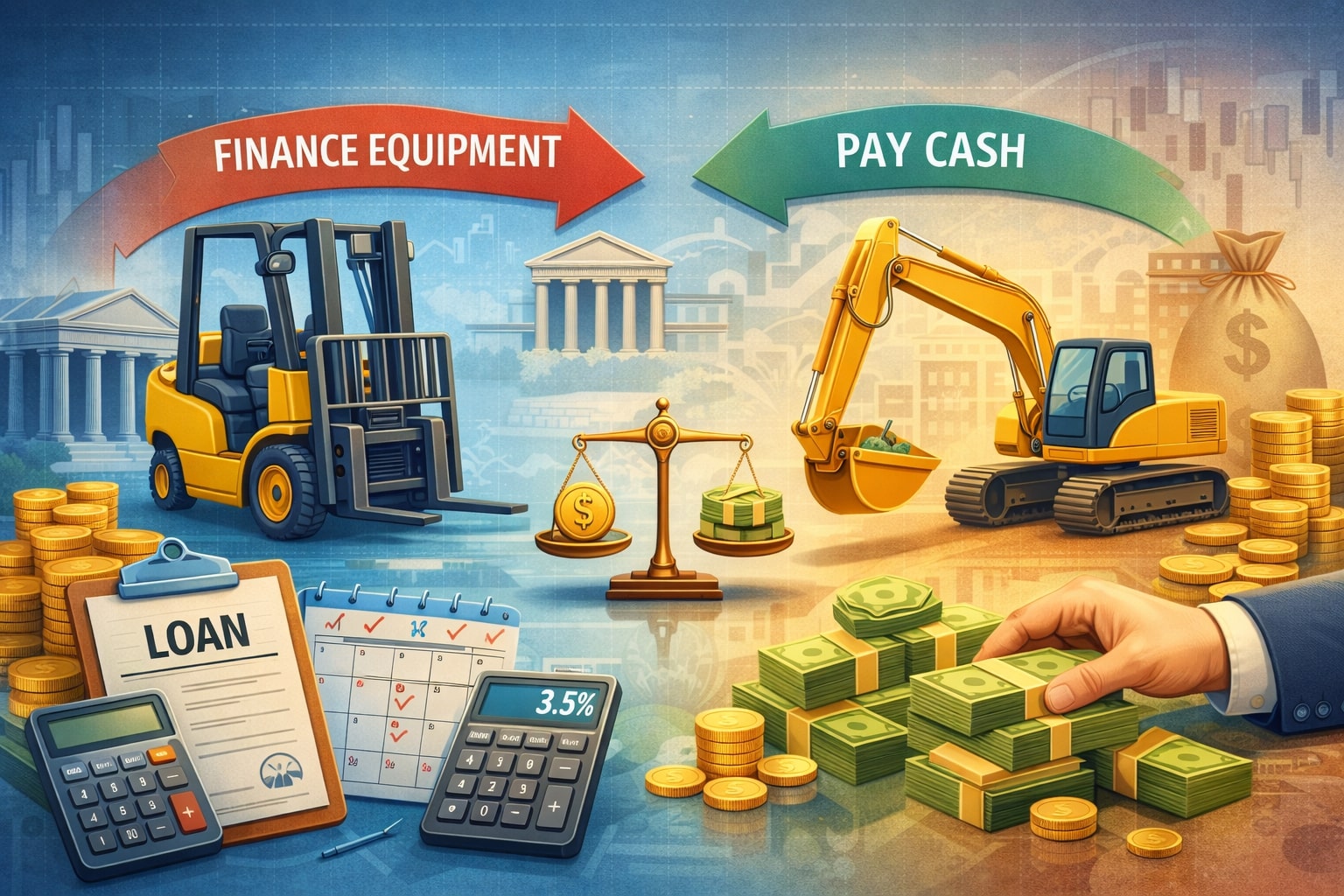
When to Finance Equipment vs Pay Cash
Buying a new truck, POS system, CNC machine, medical device, commercial oven, or software-hardware bundle can feel like a simple choice: either pay cash and be done, or finance equipment and keep cash in the business.
In real life, the best answer depends on cash flow timing, how fast the equipment produces revenue, how quickly it loses value, and what your tax situation looks like this year versus next year.
The “right” choice is rarely about the lowest total dollars on paper—it’s about risk, flexibility, and keeping your business resilient when sales dip, customers pay late, or unexpected expenses hit.
A smart “finance equipment vs pay cash” decision starts with one truth: cash is not free. Cash has an opportunity cost because it can fund marketing, inventory, payroll, hiring, renovations, deposits, and emergencies.
On the other hand, financing is not free either; interest, fees, collateral requirements, and lender covenants can add friction and reduce flexibility. The goal is to choose the option that protects working capital while still keeping your total cost reasonable.
This guide walks you through how to decide when to finance equipment vs pay cash using clear business logic, lender realities, and updated tax rules. It also includes future-facing predictions so you can plan purchases more confidently.
The Core Decision: What Problem Is the Equipment Solving?

Before you compare monthly payments to a cash price, define the business problem the equipment solves. If the purchase directly increases capacity, reduces labor, improves quality, or shortens turnaround time, then finance equipment can be a growth tool rather than a cost.
If the equipment is “nice to have,” has unclear ROI, or won’t be used heavily, paying cash (or delaying the purchase) may be the safer move.
Start by separating need from timing. Sometimes the business truly needs the equipment, but the timing is flexible. When timing is flexible, you can shop more aggressively, negotiate better, and choose the least risky structure—whether that’s paying cash, financing equipment, or doing a hybrid (bigger down payment + smaller loan).
When timing is not flexible (breakdown, compliance requirement, major contract waiting), finance equipment often wins because speed matters more than theoretical savings.
Also, define the “return window.” If the equipment can pay for itself quickly—through higher revenue, fewer chargebacks, reduced downtime, or lower labor costs—then finance equipment can be rational even if interest is higher than you’d like. If the return window is long and uncertain, pay cash only if it won’t weaken your working capital.
A final layer: consider whether the equipment is strategic or commodity. Commodity equipment is easy to replace and price-shop; strategic equipment can be hard to source, hard to integrate, and expensive to maintain. Strategic equipment decisions benefit from keeping flexibility—often a reason to finance equipment rather than drain cash.
The Working-Capital Rule: Protect Cash That Keeps You Alive

Working capital is what keeps operations stable between today and when customers actually pay you. If you pay cash for equipment and it leaves you thin, one slow month can turn into missed payroll, delayed vendor payments, late fees, or emergency debt at terrible rates. That’s why many operators choose to finance equipment even when they technically “could” pay cash.
A practical rule many CFOs like: don’t spend cash you can’t replace within 60–90 days without pain. If paying cash would reduce your ability to cover payroll, rent, insurance, fuel, marketing, chargebacks, and inventory, then finance equipment is usually the safer play.
This matters even more if your revenue is seasonal, project-based, dependent on large invoices, or sensitive to economic swings.
Another working-capital lens is the “cash conversion cycle”: how long it takes to buy inputs, deliver the product/service, invoice, and collect. The longer your cycle, the more valuable liquidity becomes. In long-cycle businesses, finance equipment often protects your ability to operate while you wait to get paid.
Finally, cash gives you negotiating leverage. If paying cash today prevents you from taking vendor discounts, buying inventory at the right time, or jumping on growth opportunities, then paying cash may be expensive in hidden ways.
In that scenario, you can finance equipment and keep cash ready for opportunities that produce faster returns than the financing cost.
When Paying Cash Makes Sense (And How to Do It Safely)

Pay cash when it meaningfully reduces risk and cost without endangering operations. Paying cash tends to be strongest when the equipment price is small relative to your reserves, your revenue is stable, and your business already has strong liquidity after the purchase.
Pay cash can be the smarter move when:
- You already have excess cash that isn’t needed for growth, payroll buffers, or inventory.
- The equipment has a short useful life and you don’t want to keep paying after it’s outdated.
- The financing options available are overpriced (high APR, big origination fees, strict covenants).
- You can secure a steep discount for cash or fast payment that beats the expected financing cost.
- You want to avoid liens and lender controls, especially if you may refinance, sell, or restructure soon.
Even when paying cash is the plan, smart businesses still treat the purchase like an investment. Build a mini “equipment plan” that includes maintenance, training, installation, downtime, insurance, and replacement timelines.
Cash buyers sometimes underestimate total cost because there’s no monthly payment reminder—so costs quietly show up as repairs, wasted labor, and downtime.
A strong “pay cash” strategy also includes a liquidity floor. Decide the minimum cash you refuse to go below—often 2–6 months of operating expenses depending on volatility. If paying cash crosses that floor, reconsider and explore finance equipment.
The cash price may feel psychologically satisfying, but the business risk can be higher than the interest cost you were trying to avoid.
When to Finance Equipment for Growth, Speed, or Flexibility
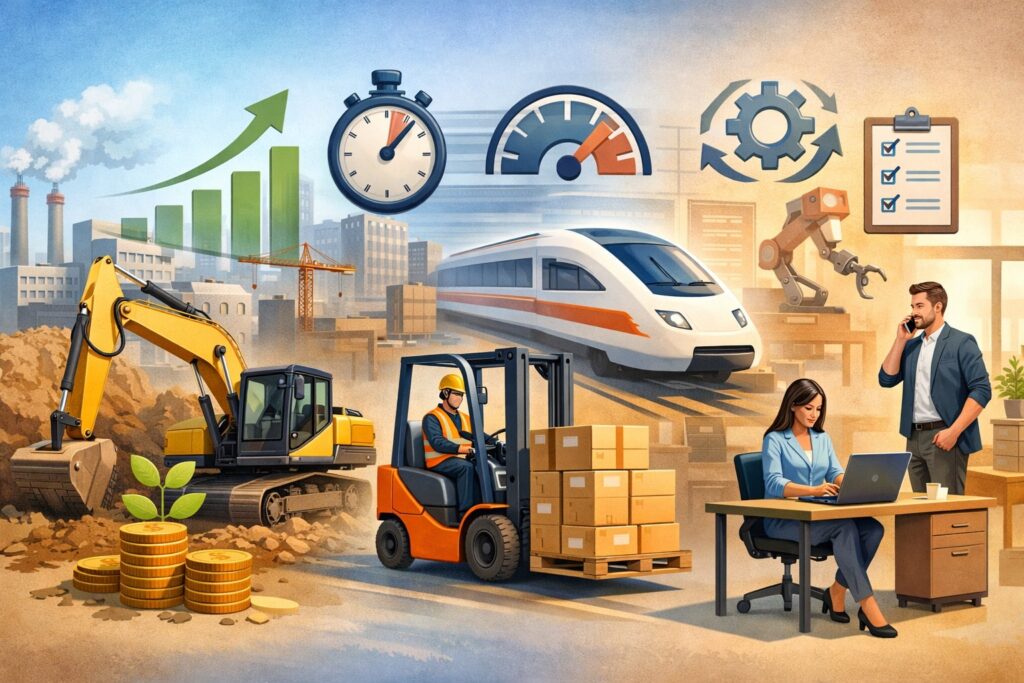
Finance equipment when you need to preserve cash, match cost to revenue, or move fast. Most businesses choose to finance equipment not because they love debt, but because it keeps the business agile: the equipment creates value now while you pay over time from the cash it helps generate.
Finance equipment tends to be the smarter choice when:
- The equipment produces revenue immediately (new capacity, new services, faster throughput).
- You’re protecting a cash buffer for payroll, inventory, marketing, and emergencies.
- The purchase prevents downtime that would cost more than interest.
- You want to upgrade regularly (technology, systems, POS hardware, specialized tools).
- You’re scaling and need multiple assets across locations or teams.
- You have better uses for cash that likely earn a higher return than the financing rate.
Financing can also reduce concentration risk. Paying cash concentrates risk into a single moment: you spend a large sum, and if the market shifts right after, you’ve lost flexibility. When you finance equipment, you spread the commitment over time. That can be valuable if your industry is volatile or if customer demand is shifting.
One more factor: finance equipment can create predictable budgeting. Fixed monthly payments are easier to plan than irregular repair bills from older equipment. In many operations, predictability is worth paying for, as long as the total deal is clean.
Equipment Financing Options and How to Choose the Right Structure
Not all financing is the same. The best finance equipment structure depends on how the asset is used, how quickly it depreciates, and whether you want ownership, upgrade flexibility, or a lower payment.
Common ways to finance equipment include:
- Term loans: You borrow a lump sum and repay over a fixed period. Good for assets with long useful lives.
- Equipment loans (secured): The equipment serves as collateral. Often offers better pricing than unsecured credit.
- Leases: Payments for use, sometimes with end-of-term buyout options. Helpful when you upgrade frequently.
- Vendor financing: Offered by manufacturers or dealers. Can be convenient but should be compared carefully.
- Lines of credit: Useful for smaller, repeat purchases, but can float with rate changes.
When comparing structures, match the term length to the asset’s “value life.” If the equipment is likely to be outdated in 3 years, a 7-year finance equipment term can become a trap: you’re paying for something that no longer helps you compete.
Conversely, if the asset is a long-term producer (heavy machinery, durable commercial equipment), longer terms can keep monthly payments comfortable while the equipment keeps generating revenue.
Also watch fees and hidden terms: origination fees, documentation fees, insurance requirements, prepayment penalties, and blanket liens. A “low payment” isn’t always a low-cost deal. The cleanest finance equipment deals are transparent, match the equipment’s working life, and allow flexibility if you want to pay off early.
The Tax Angle That Can Tip the Decision in 2025–2026
Tax rules can materially change the math when deciding whether to finance equipment vs pay cash. The key point: tax deductions don’t make equipment free, but they can lower the after-tax cost, especially when you’re profitable and timing matters.
Two major tools often come up:
- Section 179 expensing, which can allow an immediate deduction of qualifying equipment up to annual limits. Recent published guidance notes a $1,250,000 limit for 2025 and a higher figure discussed for 2026, with phase-out thresholds that reduce the benefit for very large total purchases.
- Bonus depreciation, which allows accelerated depreciation on qualifying assets. Multiple tax-industry sources report major changes in 2025 tied to legislation that restored 100% bonus depreciation for qualifying property placed in service after a mid-January 2025 cutoff date.
Why this matters for “finance equipment vs pay cash”:
- If you can expense more upfront, you may prefer to buy or place equipment in service during a year when profits are high.
- The deduction often depends on when the equipment is placed in service, not just ordered—so delivery and installation timing matters.
- If 100% bonus depreciation is available for your situation, the after-tax cost of purchasing (cash or financing) may drop, making it easier to justify finance equipment while still keeping liquidity.
Important: tax outcomes vary by entity type, profitability, and state conformity rules. But at a planning level, updated depreciation rules can be a strong reason to time purchases carefully and compare “finance equipment vs pay cash” using after-tax cash flow, not sticker price alone.
The Real Math: Compare After-Tax Cash Flow, Not Just Total Cost
Many people decide based on a simple question: “Will I pay more with financing?” That’s incomplete. The better question is: What does each option do to monthly cash flow, operational risk, and after-tax cost?
To compare finance equipment vs pay cash correctly, model:
- Cash purchase impact
- Immediate cash reduction
- Lost opportunity to use that cash elsewhere (inventory, marketing, hiring)
- Lower ongoing fixed obligations
- Immediate cash reduction
- Financing impact
- Monthly payment (principal + interest)
- Fees and down payment
- Cash preserved for operations and growth
- Potential interest deductibility depending on business circumstances
- Monthly payment (principal + interest)
- Tax timing
- Whether you can expense upfront using available depreciation tools
- Whether the deduction reduces taxes in the year you need it most
- Whether you can expense upfront using available depreciation tools
- Risk and flexibility
- Ability to survive a slow quarter
- Ability to upgrade or replace if the asset underperforms
- Ability to survive a slow quarter
Often, finance equipment “costs more” in total dollars but reduces operational risk and increases growth capacity. Paying cash “costs less” but can raise risk if cash gets tight. The right answer is the one that keeps the business healthy while still being cost-effective.
Situations Where Financing Is Usually the Better Call
Here are high-probability scenarios where finance equipment tends to beat paying cash:
- High ROI equipment: If the asset directly drives revenue—new service line, more output, faster delivery—finance equipment aligns cost with the revenue it generates.
- Seasonal or volatile cash flow: If you have big swings in revenue, cash is a shock absorber. Finance equipment helps you avoid draining that buffer.
- You need redundancy to avoid downtime: Downtime is expensive. If equipment failure would stop operations, finance equipment to add redundancy can be cheaper than lost revenue.
- You’re building credit and relationships: Strategic borrowing and clean repayment can strengthen your financing profile, improving future options.
- You expect to upgrade: If the equipment becomes outdated quickly (tech stacks, POS hardware, specialized tools), finance equipment can keep you modern without a huge upfront hit.
In these cases, financing isn’t just a payment method—it’s a business continuity and growth strategy.
Situations Where Paying Cash Is Usually the Better Call
Now the cases where paying cash often wins:
- Small purchase relative to reserves: If paying cash doesn’t meaningfully reduce your safety buffer, it may be the simplest and cheapest.
- Uncertain utilization: If you’re not sure the equipment will be used heavily, avoid locking into finance equipment payments.
- Short-life or fast-obsolete assets: If the equipment becomes outdated quickly, a long finance equipment term can leave you paying for yesterday’s tool.
- High-cost financing offers: If the only offers are expensive (high APR, large fees), cash can be the better “return.”
- You need maximum flexibility: If you anticipate a sale, a pivot, or a restructure, paying cash avoids liens and restrictions that can complicate transactions.
Paying cash can be a powerful move—when it doesn’t weaken the business’s ability to operate.
Credit, Underwriting, and Documentation: What Lenders Actually Look For
When you finance equipment, lenders typically focus on your ability to pay and the quality of the collateral. Expect underwriting to evaluate:
- Time in business and industry stability
- Revenue consistency and cash flow coverage
- Credit profile (business and/or personal depending on structure)
- Existing debt obligations
- The equipment’s resale value and useful life
- Bank statements, tax returns, and sometimes invoices or contracts
A common mistake is shopping financing only after choosing equipment. You can often get a better finance equipment deal if you’re prepared: clean financials, clear equipment quote, explanation of use case, and a story that shows how the asset supports revenue. Lenders like predictable cash flow and equipment that holds value.
Also know that not all approvals are equal. Some approvals include blanket liens, strict insurance requirements, or limitations on future borrowing. Those terms matter as much as the rate. The “best” finance equipment offer is the one that is transparent, affordable, and doesn’t handcuff your next business move.
Future Prediction: How Equipment Buying Decisions Are Likely to Change
Looking forward, the “finance equipment vs pay cash” decision is becoming more data-driven and less emotional. Here’s what’s trending:
- More dynamic underwriting: Lenders increasingly use real-time bank data, payment processing trends, and automated cash flow analytics to price deals faster. This can make finance equipment approvals quicker for strong operators, but it can also make weak cash-flow months more visible.
- Shorter technology cycles: Equipment tied to software, automation, and integrated systems will likely become obsolete faster. That pushes many businesses toward finance equipment structures that allow upgrades rather than long-term ownership locks.
- Tax planning becomes more tactical: With major depreciation rules changing and policy risk always present, businesses will likely plan purchases more around placed-in-service timing and profitability windows. The restoration of 100% bonus depreciation reported for property placed in service after mid-January 2025 is a good example of why timing matters.
- Interest-rate sensitivity stays high: As financing costs move with macro conditions, more businesses will use hybrid strategies—bigger down payments, shorter terms, or refinancing when conditions improve—rather than always paying cash or always financing.
In short: finance equipment will remain popular because flexibility is valuable, but smarter buyers will demand cleaner terms and better matching between asset life and loan structure.
FAQs
Q1) Is it smarter to finance equipment or pay cash?
Answer: It depends on liquidity and ROI. Pay cash when it doesn’t strain working capital and financing is overpriced. Finance equipment when the asset produces revenue quickly, prevents downtime, or keeps cash available for payroll, inventory, and growth. The best answer is the option that keeps your business stable while the equipment pays for itself.
Q2) Does financing equipment still let me claim depreciation deductions?
Answer: In many cases, yes—deductions generally relate to ownership and the equipment being placed in service, not whether you used cash. Updated depreciation tools like Section 179 and bonus depreciation can influence the timing and size of deductions.
Q3) What’s the biggest risk of paying cash for equipment?
Answer: The biggest risk is draining working capital. If a slow month hits or a surprise expense appears, you may need emergency financing at worse terms than a planned finance equipment deal would have offered.
Q4) What’s the biggest risk of financing equipment?
Answer: The biggest risk is committing to payments that outlast the equipment’s usefulness or that reduce flexibility. Bad terms—fees, liens, prepayment penalties—can make a finance equipment deal far more expensive than it looks.
Q5) How do I decide the right loan term?
Answer: Match the term to the equipment’s value life. If the equipment will be outdated in 3 years, avoid 6–7 year finance equipment terms. If it’s durable and produces value for many years, longer terms can be fine.
Q6) Are there recent tax changes that can affect the decision?
Answer: Yes. Multiple tax-industry sources report that 100% bonus depreciation was restored for qualifying property placed in service after a mid-January 2025 cutoff date, which can materially change after-tax economics in some cases.
Conclusion
The “finance equipment vs pay cash” decision becomes easy when you stop treating it like a personality test and start treating it like risk management. Paying cash is best when you can do it without weakening operations and when financing options are expensive or restrictive.
Finance equipment is best when the equipment drives revenue, prevents downtime, or protects the working capital that keeps your business resilient.
Use this checklist before you decide:
- Will paying cash drop you below your safety buffer?
- Will the equipment generate measurable revenue or savings quickly?
- Does financing keep you flexible and protect operations?
- Are you matching loan terms to the asset’s useful life?
- Have you evaluated after-tax cash flow using current depreciation rules?
- Are the financing terms clean (fees, liens, prepayment rules)?