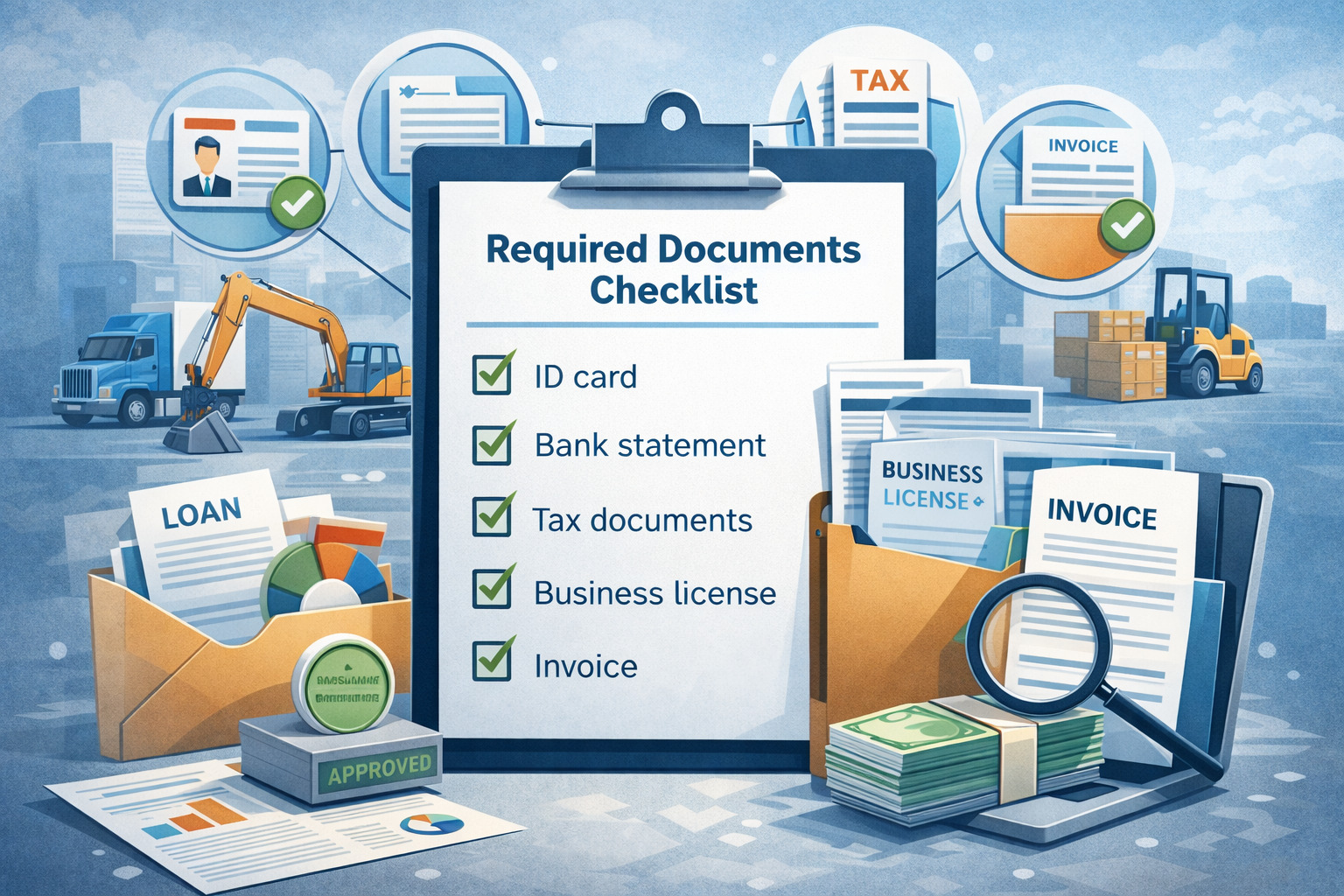
Required Documents Checklist for Equipment Financing (2026 Updated Guide)
Equipment financing moves fast when your paperwork is clean. Lenders and lessors don’t just “want documents”—they use documents to verify identity, confirm the business is real, measure repayment ability, validate the equipment, and perfect their collateral rights.
If even one item is missing, an underwriter can’t complete the risk file, which often means delays, extra conditions, or a decline.
This required documents checklist for equipment financing is written to help you prepare a complete file the first time. It covers what most financing companies request for common structures like equipment loans, equipment leases, vendor programs, and “soft-cost” bundles (installation, freight, software, training).
It also reflects how underwriting has evolved: more digital verification, stronger fraud controls, and faster approvals when documents match what automated systems can validate.
Use this guide as both a required documents checklist for equipment financing and a practical playbook. You’ll see what each document proves, why it matters, what mistakes trigger re-requests, and how to assemble a lender-ready package that protects your rate and timeline.
What “Required Documents” Really Means in Equipment Financing
When a lender says “required documents,” they usually mean “required to make a credit decision and fund.” That’s different from “nice to have.” In modern equipment financing, underwriting is a mix of automated rules and human review.
Automated checks confirm business identity, banking patterns, and basic affordability. Human underwriters verify edge cases: inconsistent addresses, unusual deposits, new entities, or specialized equipment.
A strong required documents checklist for equipment financing supports four underwriting goals:
- Borrower verification: confirm the applicant is the real business (and authorized signer) using ID, business registration, and ownership proof.
- Ability to repay: evaluate cash flow through bank statements, tax returns, and financials—especially when the equipment is expensive or the business is young.
- Equipment validation: confirm the asset exists, is priced correctly, is insurable, and is eligible collateral (serial numbers, quotes, invoices, condition reports).
- Collateral & compliance: ensure lien/lease documentation is correct, and filings (like a UCC-1 in many cases) can be completed properly as notice of a security interest.
If you want the quickest approvals, build your application around this logic. Every document on a good required documents checklist for equipment financing is there to answer a specific underwriting question.
Equipment Financing Programs and How Documentation Changes

A single required documents checklist for equipment financing won’t look identical for every deal because the product structure changes what the lender must verify. The most common programs include:
- Equipment loan: You own the equipment at funding. The lender files its lien/security interest and you repay principal plus interest. Expect heavier financial review for larger amounts and higher risk profiles.
- Equipment lease (true lease or lease-to-own): The lessor owns the asset during the lease term. Documentation often emphasizes vendor invoices, acceptance certificates, insurance, and end-of-term options.
- Vendor financing: The equipment seller helps arrange financing. Documentation may be streamlined if the vendor is approved, but expect strict quote/invoice rules and proof of delivery.
- Start-up or early-stage equipment financing: Expect deeper personal documentation (ID, bank statements, personal financial statement, sometimes personal tax returns) because the business lacks history.
- High-dollar / specialized equipment: Underwriters focus on valuation, condition, and resale liquidity. More third-party inspection, appraisal, and insurance detail may be required.
A modern required documents checklist for equipment financing adapts to risk. The more complex the deal—newer business, higher amount, used equipment, weaker credit—the more documentation is needed to close cleanly.
Core Borrower Identification Documents
Every lender must confirm “who is applying” and “who is signing.” That starts with identity and authorization. Your required documents checklist for equipment financing should include a clean, readable set of borrower ID documents before you submit anything else.
Common identity items include:
- Government-issued photo ID for each owner/guarantor (driver license or passport).
- Proof of address if the ID address is outdated (utility bill, lease statement, or bank statement page).
- EIN confirmation (IRS EIN letter if available) for business entities.
- Business phone/email confirmation that matches public listings (consistency matters for fraud prevention).
Why this matters: lenders use identity documents to meet internal fraud controls and to confirm the signer has legal authority. If the ID is expired, blurry, or mismatched to the application name, the file stalls immediately.
To reduce friction, ensure the application name exactly matches ID and formation documents (no abbreviations unless legal). A tight required documents checklist for equipment financing treats identity as a “zero-defect” item—because underwriters do.
Business Formation and Legal Entity Documents
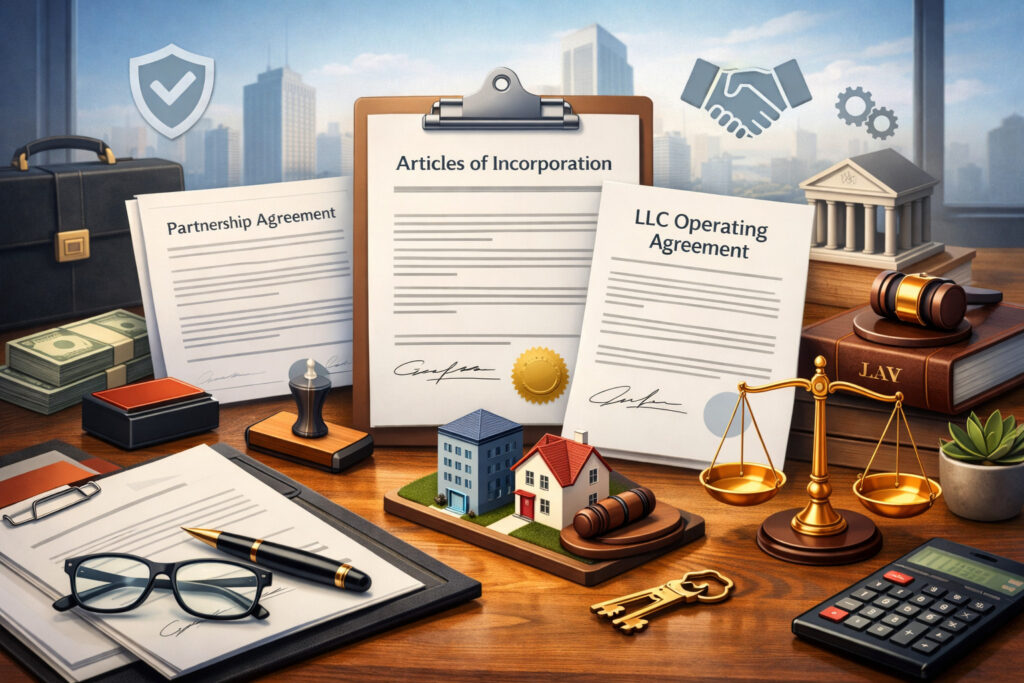
The next layer of the required documents checklist for equipment financing is proving your business legally exists and is in good standing. The exact documents depend on your entity type, but lenders typically request:
- Articles of Organization / Incorporation (LLC or corporation formation documents).
- Operating Agreement (LLC) or Bylaws (corporation), especially when multiple owners exist.
- Certificate of Good Standing (requested more often for larger transactions or when the entity is newer).
- DBA / Fictitious name filing if you operate under a trade name.
- Business license if your industry or locality requires it.
Underwriters compare these documents to the application: legal name, DBA name, addresses, and ownership. If your quote/invoice shows a DBA but your financing app uses the legal name, the lender may require a DBA filing before funding.
This is also where authorized signer rules appear. If your Operating Agreement says two members must sign, the lender will require both signatures. A complete required documents checklist for equipment financing includes the right authorization pages so there’s no last-minute scramble.
Ownership and Beneficial Ownership Documentation

Most equipment finance companies must understand who owns and controls the business. This helps manage fraud, satisfy lender policy, and support compliance with financial-crime controls. In practical terms, a lender may request:
- Ownership breakdown (names, % ownership, roles).
- SSN/ITIN for guarantors (collected securely, usually on an application form).
- Personal IDs for anyone with significant ownership/control.
- Entity org chart if there is a holding company or layered ownership.
You may also hear about beneficial ownership reporting. In 2025, FinCEN issued an interim final rule narrowing beneficial ownership information (BOI) reporting requirements under the Corporate Transparency Act, focusing reporting on entities previously defined as “foreign reporting companies,” and removing BOI reporting requirements for many domestic companies and persons under that rule framework.
What this means for your required documents checklist for equipment financing: even if BOI reporting rules change, lenders can still request ownership information for underwriting and fraud prevention. Don’t confuse “government reporting” with “lender file requirements.” Your funding speed still depends on clean, consistent ownership documentation.
Business Bank Statements (The Fastest Approval Lever)
If you want faster equipment financing, bank statements are one of the most powerful documents on any required documents checklist for equipment financing. Many approvals are based primarily on bank cash-flow patterns—especially for small and mid-sized transactions.
Typical request:
- Most recent 3–6 months of business bank statements (all pages, including blank pages).
- Sometimes 12 months for higher amounts or seasonal businesses.
What underwriters look for:
- Average daily balance and end-of-month balance trends
- Deposit frequency and concentration risk (one customer vs many)
- NSF/overdraft patterns
- Large unexplained cash deposits or reversals
- Payment stacking from other lenders
Common issues that trigger re-requests:
- Screenshots instead of PDFs
- Missing pages
- Personal bank statements submitted when business statements are required
- Statements that don’t show the business name or account number
A modern required documents checklist for equipment financing should treat bank statements as “primary proof of life.” Clean statements can reduce the need for deeper tax-return analysis and often improve terms.
Business Tax Returns and IRS Transcripts
For larger amounts, longer terms, or credit-challenged files, tax returns become essential. Lenders use tax returns to validate revenue quality and confirm the business has sustainable earnings beyond what a short bank-statement window shows.
Common request:
- Last 2 years of business tax returns (and sometimes personal tax returns for guarantors).
- YTD profit & loss to bridge the gap since the last filed return.
- In some cases, lenders ask for IRS transcripts to confirm filing authenticity (varies by lender).
If your business is newer than two tax years, lenders may request what exists plus strong bank statements and a detailed explanation of operations.
On a strong required documents checklist for equipment financing, tax returns are not “just paperwork.” They’re a credibility test. Discrepancies between application revenue and tax revenue are one of the top reasons for delays. Align your story: if revenue grew recently, show it with YTD financials and a short, clear explanation.
Financial Statements: Profit & Loss, Balance Sheet, and Cash Flow
Financial statements give underwriters a structured view of the business. The bigger the transaction, the more likely financial statements appear on the required documents checklist for equipment financing.
Common requirements:
- Year-to-date profit & loss statement (P&L)
- Most recent balance sheet
- Prior year-end P&L and balance sheet (sometimes two years)
- Occasionally a cash flow statement or management-prepared cash flow summary
Underwriters analyze:
- Gross margin stability
- Operating expenses and profit trend
- Liquidity (current ratio, cash on hand)
- Existing debt and leverage
- Capacity to absorb the new payment (coverage)
If your accounting is cash-basis and the business is seasonal, tell the lender. Underwriters don’t mind seasonality—they mind surprises. A complete required documents checklist for equipment financing includes a brief context note when the numbers could be misunderstood (for example: “Large Q4 revenue due to annual contracts”).
Accounts Receivable and Accounts Payable Aging Reports
For many service, B2B, and project-based businesses, AR/AP schedules can influence approval because they show near-term cash flow pressure.
A lender may request:
- Accounts receivable aging (current, 30/60/90+ days)
- Accounts payable aging
- Major customer list (sometimes top 5 or top 10)
Why this lands on the required documents checklist for equipment financing: AR aging reveals whether revenue is collectible. If most receivables are 90+ days, your cash flow is weaker than your sales suggest. AP aging shows whether you’re behind on vendor obligations.
To improve approval odds, include short notes for anomalies. Example: “Two invoices aged 90 days are disputed and excluded from projections.” This transparency can reduce conditions and speed funding.
Existing Debt Schedule and Lease List
Underwriters want to understand your current obligations, especially if your business already uses equipment financing.
Common request:
- Debt schedule listing lender, payment, balance, maturity, and collateral
- Existing lease list (including equipment leases, vehicles, software leases)
- Payoff letters if refinancing or consolidating
This is an underrated part of the required documents checklist for equipment financing. It helps the lender avoid “payment stacking” risk and ensures accurate debt-to-income or coverage calculations.
If you’re refinancing equipment, be ready with the 10-day payoff and the lender’s wiring instructions. Missing payoff letters can delay funding even after approval, because the new lender must confirm the payoff amount and lien release process.
The Equipment Quote, Invoice, and Purchase Order (PO)
No equipment financing closes without clear proof of what is being purchased. For most transactions, the required documents checklist for equipment financing must include:
- Vendor quote with itemized pricing
- Invoice (often required closer to funding)
- Purchase order if your business uses POs internally
- Vendor contact details (name, phone, email)
Quotes should include:
- Make/model and detailed description
- Serial numbers if available (or “TBD” if new inventory)
- Condition (new/used/refurbished)
- Delivery date estimate
- Taxes, shipping, installation, and any soft costs clearly separated
Underwriters and funding teams use the invoice/quote to confirm the lender is financing eligible items and that the total matches approval. Any mismatch triggers a revised approval or new documents.
A lender-ready required documents checklist for equipment financing always includes the latest version of the quote and ensures the business name matches formation documents.
Used Equipment Documentation and Condition Proof
Used equipment financing often requires extra documentation because condition and value drive collateral strength. Expect additional items on the required documents checklist for equipment financing such as:
- Seller bill of sale (especially for private-party sales)
- Serial number verification
- Photos and videos of the equipment
- Maintenance records and service history
- Third-party inspection report (common for heavy machinery)
- Appraisal for high-value or specialized assets
Lenders want confidence the asset exists, isn’t stolen, and can be insured. If the equipment is older, underwriters may reduce term length or require a larger down payment.
To avoid delays, gather used-equipment condition proof early. A complete required documents checklist for equipment financing for used assets should include documentation that supports both ownership chain and operational readiness.
Insurance Documents: COI, Loss Payee, and Coverage Requirements
Insurance is a funding condition for many equipment finance deals. The lender needs proof the asset is protected from loss, damage, or liability exposure.
What you may need:
- Certificate of Insurance (COI) listing the equipment and coverage
- Loss payee / additional insured endorsement naming the lender/lessor
- Proof of premium payment in some cases
- For titled equipment (vehicles), a policy meeting state minimum requirements
This belongs on every serious required documents checklist for equipment financing because missing insurance is one of the most common “approved but not funded” issues.
Tip: Ask the lender for the exact loss payee language. One word off can cause re-issuance. Also confirm whether the lender requires “replacement cost” coverage vs “actual cash value,” especially on new equipment.
UCC Filing and Lien Documentation
Many equipment loans use a UCC-1 filing to provide notice of the lender’s security interest in collateral. A UCC-1 is commonly described as a creditor’s notice of a lien on the borrower’s personal property. Under Article 9, the filing system is designed for notice, and proper filing affects priority among creditors.
What you may be asked for:
- Correct legal name and address of the debtor entity (must match formation records)
- Collateral description (often includes “equipment” and may include specifics)
- Existing UCC search results in complex deals (more common in larger transactions)
For your required documents checklist for equipment financing, the key is accuracy. If your legal name is wrong, the lender’s filing may be ineffective, and the lender will pause funding until it’s corrected. Expect heightened scrutiny when there are multiple entities, DBAs, or recent legal-name changes.
Personal Financial Statement for Owners and Guarantors
When the deal relies on personal support—common in small businesses, young entities, or larger transactions—lenders may request a personal financial statement (PFS). SBA programs, for example, use SBA Form 413 as a personal financial statement to assess an applicant’s financial situation.
Even outside SBA lending, a PFS helps underwriters evaluate:
- Net worth and liquidity
- Contingent liabilities
- Real estate ownership
- Personal debt obligations that could pressure cash flow
For a complete required documents checklist for equipment financing, prepare a PFS if your business has limited time in operation or the financing amount is significant. The faster you provide it, the less likely an underwriter will add conservative conditions.
Personal Bank Statements and Proof of Liquidity
If your equipment financing requires a down payment, or if the business is thinly capitalized, lenders may request proof you have the cash to close.
Common request:
- Most recent 1–3 months of personal bank statements (for guarantors)
- Proof of funds for down payment (bank letter or statement showing available balance)
- Source of funds explanation if money was recently transferred in
This shows up on the required documents checklist for equipment financing most often in start-up or challenged-credit situations. Underwriters want to confirm the down payment is real and not borrowed in a way that increases hidden risk.
Keep it simple: provide clean statements and highlight the available balance. If the funds came from a sale, bonus, or investment transfer, include a short note and supporting page.
Business Plan, Project Narrative, and Use-of-Equipment Explanation
Not every deal needs a business plan. But when the lender can’t easily understand how the equipment drives revenue, they may request a narrative.
A strong package might include:
- Short business overview (what you do, who you serve, how you get paid)
- Why this equipment (capacity increase, cost reduction, compliance, replacement)
- Revenue impact (new contracts, faster throughput, lower downtime)
- Implementation plan (delivery, training, installation timeline)
This portion of the required documents checklist for equipment financing is about clarity. Underwriters don’t want long essays. They want a credible “why now” story that matches the financials.
If the equipment is specialized—medical devices, CNC machines, commercial trucks, industrial refrigeration—include a few bullets on utilization and demand. This can improve confidence and terms.
Vendor Due Diligence and Payment Instructions
Lenders must verify the vendor they’re paying. Funding teams follow strict controls to reduce invoice fraud and misdirected wires.
Expect items like:
- Vendor W-9 (common request)
- Vendor banking details for ACH/wire (submitted securely)
- Invoice matching (invoice must match quote and approval)
- Proof vendor is legitimate (website, business registration, or established relationship)
Your required documents checklist for equipment financing should treat vendor details as a critical path. Even after approval, missing vendor payment instructions can delay disbursement.
If you’re buying from a private seller, the lender may require additional steps: identity verification of seller, bill of sale, and sometimes escrow-style funding procedures.
Delivery, Installation, and Acceptance Documents
Funding usually requires proof the equipment was delivered or is ready to be delivered. This protects the lender from paying for assets that never arrive.
Common documents:
- Delivery receipt or shipping confirmation
- Installation completion documentation (when applicable)
- Borrower acceptance certificate confirming equipment is received and acceptable
- Proof of serial number and asset tagging
This part of the required documents checklist for equipment financing is often overlooked. Businesses focus on credit approval but forget funding requirements. If you need same-week funding, coordinate delivery and acceptance documents early with the vendor.
For progress payments (common in construction/large installations), lenders may release funds in stages. In those cases, keep milestone documentation clean and consistent.
Industry-Specific Documents That Frequently Appear
Some industries need extra proof due to regulation, risk profile, or revenue patterns. A robust required documents checklist for equipment financing anticipates these variations.
Examples include:
- Trucking/transport: CDL, DOT/MC authority, insurance for commercial auto, driver roster, dispatch or contract proof
- Construction: contractor license, bonding capacity, project pipeline, equipment list
- Medical/health services: facility licensing, provider credentials, service contracts (if relevant)
- Restaurant/food service: health permits, lease documents, POS or vendor agreements
- Manufacturing: major customer list, purchase orders, production plan, quality certifications (if relevant)
The goal is not to overwhelm the file. It’s to include what underwriters need to verify that cash flow is stable and operations are legitimate. When you tailor the required documents checklist for equipment financing to your industry, you reduce follow-up requests.
Lease vs Loan Documentation Differences You Should Expect
Even with the same equipment, a lease and a loan may require different closing documents. Understanding the difference helps you assemble the correct required documents checklist for equipment financing.
Loan closings commonly include:
- Promissory note
- Security agreement
- UCC authorization language
- Insurance with lender listed appropriately
Lease closings commonly include:
- Master lease agreement + schedule
- Acceptance certificate
- Insurance listing lessor as loss payee/additional insured
- End-of-term purchase option language (if applicable)
Lease approvals can be fast, but only if the equipment details are exact. Under a lease, the lessor owns the equipment during term, so they care deeply about delivery confirmation and insurability.
If you are comparing offers, ask which product structure is being used. Your required documents checklist for equipment financing should match the structure to avoid a “surprise document chase” near funding.
Common Document Mistakes That Delay Funding
Most delays aren’t caused by “strict lenders.” They’re caused by documents that can’t be validated. A practical required documents checklist for equipment financing includes a quality control step.
Frequent issues:
- Mismatched business name across quote, bank statements, and formation docs
- Missing statement pages or cropped screenshots
- Outdated IDs or unreadable scans
- Quotes without itemization (soft costs mixed into one line)
- Vendor invoice changes after approval without notifying the lender
- Inconsistent addresses (physical vs mailing vs registered agent confusion)
- Unexplained large deposits or reversals on bank statements
Fixes are simple:
- Use PDFs whenever possible
- Keep one “master” business name and address set
- Ask vendors to include full details on quotes
- Provide short explanations for anomalies upfront
The fastest approvals come from borrowers who treat the required documents checklist for equipment financing like a submission package, not a casual email attachment pile.
How to Organize a Lender-Ready Equipment Financing Document Package
The easiest way to speed approval is to submit in an underwriter-friendly order. A strong required documents checklist for equipment financing package often looks like this:
- Application + ownership breakdown
- IDs for owners/guarantors + proof of address if needed
- Formation docs + DBA filing (if applicable)
- Bank statements (3–6 months, all pages)
- Tax returns (if requested) + YTD financials
- Debt/lease schedule (if requested)
- Equipment quote/invoice + vendor contact info
- Insurance COI requirements (or proof you can bind quickly)
- Used equipment condition docs (if used asset)
- Any special items (licenses, contracts, AR aging)
This structure helps underwriting flow: identity → entity → cash flow → obligations → collateral → funding conditions. Several equipment financing checklist guides highlight that documentation requirements are similar across many equipment categories and emphasize statements, IDs, and equipment details as core items.
2026 Underwriting Trends: What’s “New” About Document Requirements
Equipment financing is increasingly digital, but “digital” doesn’t mean “less documentation.” It often means faster verification and stricter matching.
Trends shaping the required documents checklist for equipment financing:
- Bank connectivity and instant verification: Many lenders prefer secure bank links, but still accept PDF statements. Expect quicker decisions when banking data is verified electronically.
- Fraud detection: More lenders verify invoices, vendor legitimacy, and identity signals. This can increase vendor document requirements.
- Data cross-checking: Underwriters cross-check public records, business registrations, and address histories. Any mismatch triggers conditions.
- Asset eligibility policies: Lenders refine what they will finance (age limits, usage limits, certain manufacturers). This increases quote/invoice precision.
- Smarter collateral filing controls: More emphasis on legal name accuracy for filings and lien perfection concepts under Article 9.
Future Predictions: How Equipment Financing Documents May Evolve
The next few years are likely to reshape the required documents checklist for equipment financing in ways that benefit prepared borrowers.
What to expect:
- More “permissioned data” and fewer PDFs: Secure connections to banking, accounting platforms, and payroll providers may reduce repeated statement uploads. Borrowers who maintain clean bookkeeping will win on speed.
- Real-time asset verification: For certain equipment categories, lenders may integrate vendor inventory systems and telematics data (hours, maintenance, location) to price risk more precisely—especially for fleets and heavy equipment.
- Dynamic pricing and conditions: Better data may lead to more customized terms. Strong cash flow could reduce documentation; weaker signals could increase conditions automatically.
- More standardized e-sign and closing packages: Closing docs will become more consistent, but the lender will still require the same core proof: identity, cash flow, and equipment details.
- Compliance-driven ownership checks: Even if government reporting requirements shift, lenders will continue to request ownership/control information to manage risk and fraud, as seen in ongoing regulatory attention around beneficial ownership topics.
A future-ready required documents checklist for equipment financing means keeping your business records organized year-round, not just when you need funding.
FAQs
Q.1: What is the minimum required documents checklist for equipment financing for most small businesses?
Answer: For many straightforward approvals, the minimum required documents checklist for equipment financing includes: a completed application, government-issued ID for the signer/guarantor, business formation documents (or EIN confirmation), 3–6 months of business bank statements, and an itemized equipment quote/invoice. Used equipment often adds photos, serial number proof, and a bill of sale.
Q.2: Do I always need tax returns for equipment financing?
Answer: Not always. Some lenders approve smaller transactions primarily with bank statements and credit. But tax returns become common for larger amounts, longer terms, lower credit profiles, or when bank statements don’t clearly support the requested payment.
If asked, providing the last two years quickly strengthens your required documents checklist for equipment financing submission.
Q.3: Why do lenders insist on “all pages” of bank statements?
Answer: Because missing pages can hide negative information (overdrafts, reversals, or account details). Underwriters often reject partial statements. A complete required documents checklist for equipment financing includes PDF statements with every page—even blank or “intentionally left blank” pages.
Q.4: What documents are different for used equipment financing?
Answer: Used equipment financing commonly adds condition and ownership chain proof: bill of sale, serial number verification, photos/videos, maintenance records, inspection reports, and sometimes an appraisal. The lender is protecting collateral value, so your required documents checklist for equipment financing must show the asset is real, functional, and insurable.
Q.5: Will I need a UCC filing for equipment financing?
Answer: Often, yes for loans (and sometimes for leases depending on structure). A UCC-1 financing statement is commonly used as notice of a creditor’s security interest/lien on personal property collateral. Your lender typically handles filing, but you must provide accurate legal name and entity details.
Q.6: What’s the fastest way to get approved?
Answer: Submit a complete required documents checklist for equipment financing package upfront: clean IDs, correct formation docs, complete bank statements, and a detailed quote/invoice that matches your legal name. Most delays come from mismatches, missing pages, and vague equipment descriptions.
Q.7: Do startups need different documents?
Answer: Yes. Startups often provide more personal documentation because business history is limited. Expect personal ID, personal bank statements, personal financial statements, proof of experience, and a strong equipment-use narrative.
A startup required documents checklist for equipment financing is usually heavier, but you can still move fast if everything is organized.
Conclusion
A strong required documents checklist for equipment financing is less about paperwork volume and more about underwriting clarity. Lenders fund quickly when they can verify identity, confirm the legal entity, validate cash flow, and match the equipment quote to an insurable, eligible asset.
When documents are consistent—same business name, same address logic, complete bank statements, clear invoices—approvals accelerate and conditions shrink.
For 2026 and beyond, equipment financing is becoming more digital and more precise. Automated systems are faster, but they are also less forgiving of mismatches. The smartest move is to keep your core documents current: formation docs, ownership records, clean financials, and vendor-ready quoting.
If you treat this required documents checklist for equipment financing as an ongoing business habit—not a last-minute scramble—you’ll protect your timeline, your terms, and your ability to grow on demand.