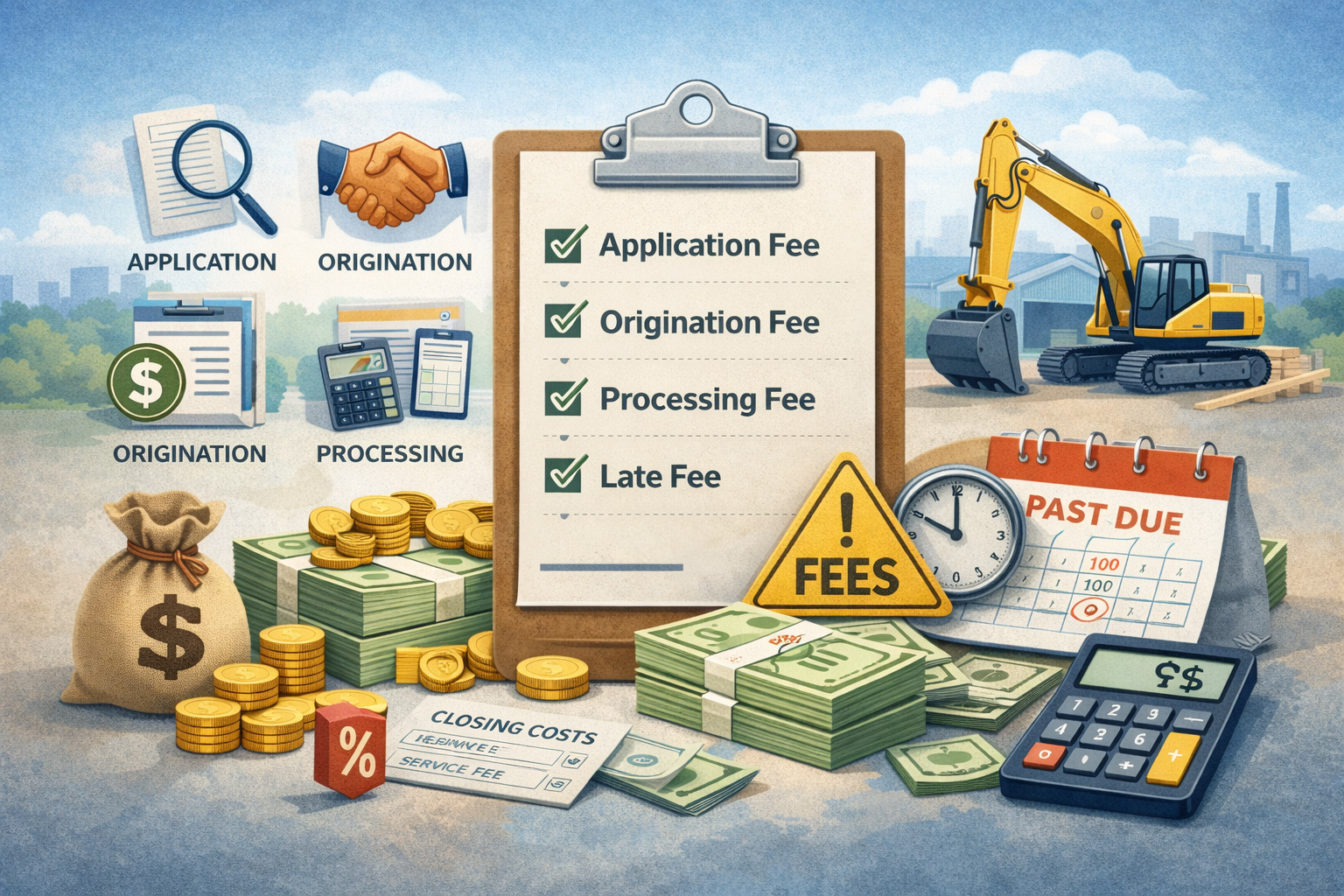
Common Fees in Equipment Financing Explained (2026 Guide)
Equipment financing can be one of the fastest ways to add revenue-producing assets—trucks, POS systems, CNC machines, medical devices, kitchen equipment, construction gear—without draining working capital.
But the sticker rate rarely tells the whole story. The real cost shows up in equipment financing fees: charges that appear at approval, at funding, during repayment, and sometimes at the end of a lease or payoff.
This guide breaks down the most common equipment financing fees, why they exist, what “normal” looks like, and how to spot fee stacking that quietly raises your total cost. You’ll also learn how to compare offers apples-to-apples, what to negotiate, and what changes to expect as lenders lean further into automation and transparency.
Throughout, keep this rule in mind: equipment financing fees aren’t automatically “bad,” but they must be predictable, disclosed, and tied to real work or real third-party costs. When fees are vague, duplicated, or impossible to explain in plain language, the deal deserves a second look.
How Equipment Financing Fees Really Work (And Why They Exist)

Equipment financing is priced in two layers: the rate (interest or implicit lease yield) and equipment financing fees (fixed or conditional charges). Lenders use fees to cover underwriting, documentation, fraud checks, funding logistics, collateral perfection, and servicing. Some fees are legitimate pass-through costs. Others are pure revenue.
The tricky part is that equipment financing fees can change the economics more than the stated rate—especially on smaller ticket deals or shorter terms. A $500 doc fee matters a lot more on a $15,000 piece of equipment than on a $500,000 machine. This is why borrowers sometimes feel “bait-and-switched” even when the rate matches the quote.
Another reason fees feel confusing: equipment financing can be structured as a loan, a $1 buyout lease, a fair market value lease, or a lease with early buyout features. Each structure has different administrative steps and end-of-term mechanics, so the equipment financing fees you see may vary even for the same borrower and equipment.
Finally, not all fees hit your bank account directly. Some are financed into the amount (raising your payment), while others are taken from proceeds at funding (reducing cash you receive). Always ask which equipment financing fees are “paid upfront” versus “rolled in.”
Fee vs. Rate: What Impacts Your Total Cost Most
Rates are easy to compare because they’re a percentage. Equipment financing fees are harder because they’re fixed, conditional, and sometimes triggered later. But fees can raise your effective cost dramatically—especially if you refinance, prepay early, or miss a payment once.
A practical way to think about equipment financing fees is to split them into three buckets:
- Transaction fees (origination, doc, UCC filing, wire) that happen once.
- Behavioral fees (late, NSF, default, modification) that happen only if something goes wrong.
- Lifecycle fees (buyout, end-of-lease return, early termination, purchase option) that happen when you exit.
The first bucket affects your effective APR the most because it’s almost guaranteed. The second bucket is avoidable but can be punishing. The third bucket is where many borrowers get surprised—because end-of-term equipment financing fees are often buried in lease language.
If you want a clean comparison, request a fee schedule and a sample amortization/payment schedule that includes all mandatory equipment financing fees. Then compare total dollars paid under each offer—not just the headline rate.
Loan vs. Lease: Why Equipment Financing Fees Change By Structure
Loans and leases both fund equipment, but they behave differently. In a loan, you borrow money and pledge the equipment as collateral. In a lease, you’re paying for the right to use the asset under contract terms, and ownership depends on the lease type.
This structural difference drives equipment financing fees:
- Loans commonly involve lien filings, occasional titling, and payoff quotes.
- Leases often include end-of-term rules, purchase options, return conditions, and early termination formulas—each with possible equipment financing fees.
For example, a fair market value lease may look cheaper monthly, but can carry bigger end-of-term equipment financing fees if you return equipment with wear, miss notice deadlines, or require an appraisal to establish value.
A $1 buyout lease can feel simpler at the end, but may carry larger upfront equipment financing fees depending on the provider.
The smart move is to choose the structure that matches how long you’ll keep the asset. If you know you’ll own it long-term, optimize for predictable exit terms and minimize uncertain equipment financing fees.
Cash Flow, Accounting, and Tax Timing: The Hidden Fee Angle
Even “small” equipment financing fees can matter because of timing. Many lenders collect certain fees at funding, which reduces day-one cash. Others finance fees into the deal, which increases monthly payments. Either way, fees change your cash conversion cycle.
From an accounting standpoint, some nonrefundable origination-type fees can be treated differently depending on how the transaction is structured. Separately, early termination and buyout events can alter how you treat the asset and remaining obligation.
If you’re scaling equipment purchases across locations, the pattern of equipment financing fees can materially affect EBITDA and cash planning.
Tax timing also plays a role. Some fees may be deductible as business expenses, while others may need to be capitalized as part of the asset cost depending on circumstances. Because the treatment can vary by facts, it’s wise to keep equipment financing fees itemized and categorized (lender fee vs. third-party pass-through vs. government filing).
Common Upfront Equipment Financing Fees (What You Pay Before or At Funding)
Upfront equipment financing fees are the charges you’ll encounter during application, underwriting, and closing/funding. These fees matter because they either reduce the cash you receive or raise the total amount financed. Upfront fees are also the easiest to compare across lenders—if you force itemization.
The most common confusion is “what’s mandatory” versus “what’s optional.” A broker may call a fee “standard” that’s actually discretionary. A lender may bundle multiple charges into one “admin” line. Your goal is to turn the quote into a simple checklist: fee name, amount, when it’s charged, refundable or not, and what triggers it.
Also note that some lenders use equipment financing fees to offset lower advertised rates. Others use higher rates with fewer fees. Either approach can be fair—what matters is your total cost and your exit flexibility.
Application, Origination, and Commitment Fees
An application fee is charged to submit your request. An origination fee is charged to set up and fund the deal. A commitment fee may be charged when a lender reserves capital or locks terms.
In equipment lending, the most common upfront equipment financing fees show up as an origination fee (often a percentage of the amount financed) or as a flat “facility” charge. These fees are frequently nonrefundable once underwriting is complete.
Here’s how to evaluate them:
- What does it cover? Underwriting, verification, fraud checks, document prep, and funding operations are legitimate reasons.
- Is it duplicated elsewhere? If there’s an origination fee plus a large doc fee plus a “processing fee,” ask what each one does. Stacked equipment financing fees are a red flag.
- Is it paid upfront or financed? Financing fees increases the total paid over time.
A reasonable lender can explain the origination/commitment logic in plain language. If you hear “that’s just our standard fee” without a clear explanation, treat it as negotiable or shop the deal.
Documentation (Doc) Fees and Administrative Fees
Doc fees are among the most common equipment financing fees because they’re easy to justify: pulling credit, preparing agreements, validating invoices, verifying vendor details, arranging filings, and shipping documents. Many lenders also fold pass-through items into doc fees, like UCC filings or delivery charges.
Industry commentary often places doc fees in a broad range; one equipment finance source notes doc fees “generally range” roughly from $150 up to $750 depending on provider and deal size. That range isn’t a rule—just a signal that doc fees vary widely and should be scrutinized.
How to handle doc and admin equipment financing fees:
- Ask whether the doc fee includes third-party costs (UCC filing, wire, overnight shipping).
- Ask for a separate line for pass-through items whenever possible.
- Negotiate a cap, especially if you plan repeat purchases.
- Watch for “doc fee” plus “contract fee” plus “processing fee” all at once.
A clean deal either uses a single doc/admin fee with clear scope, or itemizes each charge so you can validate it.
Down Payment, Advance, First/Last Payment, and Security Deposits
Not all upfront costs are labeled as equipment financing fees. Some are structural cash requirements that behave like fees because they reduce immediate liquidity.
Common examples:
- Down payment (loan) or advance (lease): often required for higher-risk credit or specialized equipment.
- First and last payment upfront: can reduce lender risk but increases your upfront cash burden.
- Security deposit: sometimes refundable, sometimes applied to end-of-term obligations depending on the contract.
Even though these aren’t always called equipment financing fees, they affect your true “cost to get funded.” If you’re comparing two offers, one may look cheaper monthly but require heavier upfront cash through deposits and advance payments.
Also look for how the lender treats the deposit. Is it held in a non-interest account? Is it refundable if you buy out early? Is it automatically applied to any late charges? These details determine whether the “deposit” becomes a stealth source of equipment financing fees later.
Appraisal, Inspection, and Site Visit Fees
Some equipment—especially high-value, used, specialized, or mobile assets—may require an appraisal, inspection, or field verification. These are common equipment financing fees when collateral risk matters. A lender may need confirmation that the equipment exists, matches the invoice, and has resale value.
In broader lending compliance discussions, fees like appraisal reviews and inspections are commonly referenced as fee categories that may or may not be included in finance charge/APR calculations depending on context.
In equipment deals, the practical takeaway is simpler: if an appraisal or inspection is required for approval, treat it as a mandatory equipment financing fee and demand clarity on amount and vendor.
Best practices:
- Ask who selects the inspector/appraiser and whether you can use a qualified third party.
- Confirm whether the fee is refunded if the deal doesn’t fund.
- Clarify timing: some vendors must be paid upfront.
If the lender can’t explain why the inspection is necessary—or requires repeated inspections without a reason—treat it as a sign of process inefficiency that could spill into other equipment financing fees later.
Ongoing Equipment Financing Fees During the Repayment Term
Ongoing equipment financing fees are charges that can occur monthly or sporadically while the financing is active. Some are predictable (like a monthly servicing fee). Others are triggered by behavior (late payment, failed ACH) or events (insurance lapse, contract modification).
The best way to protect yourself is to ask for a “servicing fee schedule” before you sign. Many borrowers only focus on approval and funding, then discover mid-term equipment financing fees when something small goes wrong—like a bank account change that causes an ACH to fail.
Also, ongoing fees matter more for operationally busy businesses. If you run multiple locations, have seasonal cash flow, or rotate managers, you want a structure that minimizes “gotcha” equipment financing fees for simple admin issues.
Late Payment Fees, Default Interest, and Grace Period Rules
Late fees are common equipment financing fees, but the real cost can be the combination of late fee + default interest + compounding effects. Some contracts have short grace periods, others have none. And the trigger may be “received by 5 p.m.” rather than “posted.”
To evaluate late-related equipment financing fees, look for:
- Late fee amount (flat vs. percentage of payment)
- When it triggers (days past due, business days vs. calendar days)
- Default interest (higher rate applied after a delinquency)
- Cure period (time to fix the issue before harsher remedies)
A lender that wants long-term relationships usually keeps late fees reasonable and focuses on automatic payments. A lender that relies on penalties may price deals low and profit from equipment financing fees tied to delinquency.
Operational tip: set up autopay, maintain a payment buffer account, and implement internal reminders. Preventing even one late incident can save significant equipment financing fees across multiple contracts.
NSF, Failed ACH, and Payment Method Fees
Failed payment fees (NSF or returned ACH fees) are among the most frustrating equipment financing fees because they often happen from simple timing mismatches—especially in businesses with weekend sales spikes and weekday debits.
Common triggers include:
- Bank account changes not updated in time
- Insufficient funds due to payroll, tax drafts, or merchant account holds
- ACH debit attempts on a bank holiday schedule mismatch
Some lenders also charge small convenience fees for alternative payment methods or for expedited payments. These may be legitimate but should be disclosed clearly.
To reduce these equipment financing fees:
- Keep a dedicated operating account for debt service.
- Align draft dates to your cash inflow cycle.
- Ask the lender whether they offer a “retry window” without extra fees.
- Confirm whether they charge per phone payment or per expedited payment.
If a lender stacks NSF fees with late fees for the same missed debit, that double-dip is a major equipment financing fees concern and should be negotiated or avoided.
Servicing, Statement, and Account Maintenance Fees
Some providers charge ongoing account fees—monthly servicing fees, paper statement fees, or maintenance fees. These equipment financing fees are typically small per month, but they add up, and they can be unnecessary if the lender uses modern servicing systems.
Evaluate this category by asking:
- Is there a fee for online payments?
- Is there a fee for changing payment dates?
- Is there a fee for sending payoff statements or duplicate invoices?
A transparent lender will show these equipment financing fees on a schedule and often waive them for autopay or e-statements. A less transparent lender may only reveal them in contract fine print.
Also watch for “contract modification fees.” If you need to reschedule a payment due to seasonality or a temporary cash event, modification fees can turn a cooperative solution into an expensive one.
Insurance Tracking Fees and Force-Placed Insurance Costs
Many equipment deals require you to maintain insurance naming the lender/lessor as loss payee. If you fail to provide proof, the lender may charge insurance tracking fees or purchase force-placed insurance and bill you for it. These can become some of the largest unexpected equipment financing fees.
Force-placed insurance is usually more expensive than market insurance because it’s designed to protect the lender, not to optimize your premium. Even if you already have coverage, delays in providing documentation can trigger fees.
How to prevent insurance-related equipment financing fees:
- Get the insurance certificate issued immediately after approval.
- Confirm the exact wording required (loss payee, additional insured, etc.).
- Calendar renewal dates and send updated certificates early.
- Ask if tracking fees are waived once proof is delivered.
This is a common “process penalty” area. If you keep compliance tidy, you can often eliminate these equipment financing fees entirely.
Exit, Payoff, and End-of-Lease Equipment Financing Fees (Where Surprises Happen)
Exit costs are the most misunderstood equipment financing fees. Many borrowers assume they can “just pay it off” or “just return it.” In reality, the contract defines payoff math, early termination rules, notice windows, and condition standards. The difference between a friendly and a punishing contract is usually hidden here.
This matters because businesses often change plans. You might upgrade equipment early, relocate, sell a division, or refinance. When that happens, exit-related equipment financing fees determine whether you can pivot cheaply or get stuck.
Your goal should be predictable exit economics. You don’t need perfect flexibility, but you need clarity. If a lender can’t provide a written example of early payoff or lease return math, treat that as a serious warning.
Prepayment Fees, Payoff Quotes, and “Payout” Calculations
Some equipment loans allow prepayment without penalty. Others require minimum interest, a prepayment premium, or a payout that includes remaining interest. Leases may calculate payout differently—sometimes using present value or a formula tied to remaining rent.
To protect yourself from surprise equipment financing fees, ask for:
- Whether prepayment is allowed at any time
- Whether there’s a fee or premium
- Whether “interest is earned” or “rebated” on early payoff
- A sample payoff schedule at month 12, 24, and 36
If your business expects early upgrades, prepayment terms are not a minor detail—they’re central. A low rate with harsh prepayment equipment financing fees can cost more than a slightly higher rate with clean payoff terms.
Early Termination Fees: Loans, Leases, and Real-World Clauses
Early termination is especially relevant for leases. Many contracts include a formula to compensate the lessor for lost rent and administrative costs.
Early termination provisions are typically designed to discourage cancellation and provide predictability for the lessor; contract clause references commonly describe early termination fees as either fixed or calculated based on remaining term/value.
In accounting guidance, early lease termination and related adjustments are treated as meaningful events, which is another reminder that early exits can be financially material.
To evaluate early termination equipment financing fees, get answers to:
- Is termination even allowed, or only via buyout?
- How is the fee calculated (remaining payments, discounted value, plus costs)?
- Are taxes, insurance, and fees included in the termination amount?
- Is there a separate documentation fee to process termination?
If early termination math is opaque, ask for a written example. Transparency here is one of the strongest signals that the lender’s equipment financing fees are relationship-oriented rather than punitive.
Purchase Option Fees, Buyout Fees, and Fair Market Value Appraisals
Leases can end in multiple ways: return, renew, or purchase. In a $1 buyout structure, the purchase price is nominal, but there can still be processing or purchase option equipment financing fees. In a fair market value structure, you may need an appraisal or market valuation to set the purchase price.
Some leasing guidance describes early buyout options and valuation approaches based on present value logic, highlighting that buyout economics are not arbitrary—they follow a financial model. The practical point: you should know the buyout path before you sign.
Questions to ask:
- Is there a “purchase option fee” separate from the buyout price?
- Who determines fair market value, and how are disputes handled?
- Are there deadlines for giving notice to purchase?
- Does your security deposit apply to the buyout?
These are make-or-break details. Many disputes over equipment financing fees happen here because the borrower assumed ownership was automatic or cheap.
Return Condition Fees, Disposition Fees, and End-of-Term Logistics
If you return equipment, contracts often require it to be in a defined condition, with normal wear and tear, and may require you to pay for shipping, removal, missing parts, or refurbishment. These are end-of-term equipment financing fees that borrowers often underestimate.
Common end-of-term cost drivers:
- Equipment removal and transport logistics
- Cleaning, repairs, missing accessories
- Excess usage (hours, mileage, cycles) if the lease has limits
- Disposition or remarketing fees
Also watch notice provisions. If you miss a notice window, some leases auto-renew for a period, creating additional rent and potential equipment financing fees.
If returning equipment is even a possibility, demand an “end-of-term checklist” up front. A reputable lessor will provide clear standards and avoid subjective “we’ll inspect it later” language that can turn into unpredictable equipment financing fees.
Legal and Third-Party Pass-Through Costs That Show Up as Equipment Financing Fees
Some equipment financing fees are not “lender profit” at all. They’re pass-through costs paid to government offices, filing agencies, or service providers. The problem is that some lenders bundle these into vague labels, making it hard to verify amounts.
Your approach should be: separate lender fees from pass-through fees. Pass-through fees should match receipts or standard fee schedules. Lender fees should have a defined purpose and be negotiable when they’re redundant.
This section also explains the most common legal fee category you’ll see in equipment deals: lien filings.
UCC Filing Fees and Continuation Costs (Why They Exist)
When a lender finances equipment, they often “perfect” their security interest by filing a Uniform Commercial Code (UCC) financing statement. This protects the lender’s claim to the collateral. UCC filing fees are set at the state level and vary by state and filing method, and the UCC provides a framework for how filing office fees work.
In practical equipment lending education, UCC filings are often described as a normal layer of the loan agreement that can also affect future borrowing capacity until released.
How UCC-related equipment financing fees typically show up:
- UCC-1 filing fee (initial)
- UCC search fee (sometimes)
- UCC-3 termination filing (release)
- UCC continuation fee (if the filing must be continued later)
Ask your lender to confirm the state of filing, the expected fee amount, and whether they charge an additional “filing service” markup. A small service charge may be normal, but it should be disclosed. If the UCC charge is unusually high and can’t be explained, treat it as suspicious equipment financing fees padding.
Titling, Registration, Property Taxes, and Government Charges
Some equipment—especially vehicles and certain regulated assets—requires titling and registration. Those costs can appear as equipment financing fees, either paid upfront or rolled into financing.
You may also see:
- Title fees and tag fees
- Recording fees
- Personal property tax handling fees in some jurisdictions
- Sales tax collection/financing arrangements depending on the transaction
The key risk is bundling. If you see a single “government fee” line item, request a breakdown. Government charges should be verifiable. A lender that’s transparent about pass-through equipment financing fees will usually provide receipts or a clear estimate.
Also clarify who pays sales tax and when. Miscommunication here can lead to last-minute funding delays—and rushed decisions about rolling taxes into financing, which changes total cost.
Broker Fees, Vendor Fees, Wire Fees, and Payment Processing Charges
Brokers can add value by shopping deals, but broker compensation can appear as equipment financing fees indirectly (built into the rate) or directly (broker fee line item). If you pay a broker fee, ask exactly what services it covers and whether it’s contingent on funding.
Other third-party style equipment financing fees include:
- Wire fees (inbound/outbound)
- ACH setup fees (less common, but possible)
- Vendor “documentation” fees separate from lender doc fees
- Attorney or closing coordination fees on complex transactions
Your best protection is written transparency: who receives the fee, is it refundable, and is it mandatory. If multiple parties are paid for “documentation,” you’re likely seeing duplicated equipment financing fees.
How to Compare Offers and Reduce Equipment Financing Fees (Without Sacrificing Approval Odds)
Most businesses don’t need the “cheapest” deal on paper. They need the most predictable deal—one with fair equipment financing fees, a clear exit path, and minimal operational friction. The way you request quotes can strongly influence whether you get clean terms or a messy fee stack.
Start by standardizing what you ask for. When lenders receive vague requests, they respond with vague quotes. When you demand itemization, you create pressure for transparency and reduce the chance of surprise equipment financing fees at closing.
Request an Itemized Fee Sheet and Run “Real Life” Scenarios
Ask every provider for:
- An itemized list of all equipment financing fees
- Which fees are paid upfront vs. financed
- A sample payment schedule
- Payoff amounts at common milestones (12/24/36 months)
- Lease end options with written pricing logic
Then run scenarios:
- What if you upgrade in 18 months?
- What if you sell the equipment?
- What if you miss one payment during a seasonal dip?
- What if insurance proof is delayed?
The best offer is usually the one that stays reasonable under stress. A deal with low headline pricing but extreme “penalty” equipment financing fees can become expensive fast.
Also ask whether any fees are waived with autopay, e-statements, or repeat business. Many lenders will reduce equipment financing fees if you look organized and plan ongoing purchases.
Negotiate the Right Levers (Not Just the Rate)
You can often negotiate equipment financing fees more easily than the rate. Smart levers include:
- Waiving or reducing doc/admin fees
- Capping filing or processing charges
- Removing duplicate “processing” line items
- Reducing purchase option fees
- Aligning payment dates to cash flow to avoid late fees
- Adding a clear, fair early payoff policy
Another powerful lever is deal structure. Sometimes moving from a structure with uncertain end-of-term costs to one with straightforward ownership reduces long-run equipment financing fees, even if the payment is slightly higher.
Negotiation works best when you have alternatives. Even one competing quote can turn a “non-negotiable” fee into a waived equipment financing fees line item.
Avoid Fee Traps: Bundled Fees, Fee Stacking, and Confusing Language
Fee traps usually share these features:
- Vague fee names (“processing,” “administrative,” “technology”) without definitions
- Multiple fees that cover the same work
- Large end-of-term equipment financing fees not mentioned in the sales process
- Prepayment rules that effectively charge all remaining interest
- Lease return standards that are subjective
If you see these patterns, push back. Ask for revised terms in writing. If the provider won’t clarify, the safest assumption is that the contract is designed to monetize confusion through equipment financing fees.
A simple rule: if you can’t explain every fee to a manager in 30 seconds, it’s not transparent enough to sign.
The Latest Landscape and Future Predictions for Equipment Financing Fees (2026 and Beyond)
Equipment finance is moving toward faster approvals, more automation, and greater scrutiny of small business credit practices.
Those forces can reduce frictional equipment financing fees—but they can also create new categories (platform fees, verification fees, instant funding fees). The direction depends on how lenders compete and how regulators define “transparent pricing.”
The next few years will likely reward lenders who keep equipment financing fees simple, disclose costs early, and use technology to cut operational overhead rather than invent new fee lines.
Small Business Lending Transparency and Data Rules (Why It Matters)
In the United States, the Consumer Financial Protection Bureau (CFPB) has focused on small business lending transparency and data collection under Section 1071, aiming to increase visibility into small business credit outcomes and costs.
Legal and compliance guidance notes that these requirements can apply broadly across entities engaged in small business lending, including those involved in equipment financing.
While 1071 is not “a fee rule” by itself, the broader trend is clear: lenders face pressure to better document and justify pricing and costs. Over time, this could push equipment financing fees toward clearer itemization and fewer ambiguous bundles—especially in markets where competition is strong.
For borrowers, the prediction is practical: expect more standardized disclosures, more data requests, and tighter compliance workflows. That could mean fewer surprise equipment financing fees, but potentially more upfront verification steps.
Digital Origination, Embedded Finance, and What It Does to Fees
As equipment sellers embed financing at checkout, speed becomes a competitive advantage. Digital workflows reduce manual underwriting costs, which should reduce certain equipment financing fees like high doc fees or repeated verification charges.
But embedded finance can also introduce new fee behaviors:
- “Expedite” or “instant funding” fees
- Platform convenience fees
- Vendor-bundled admin fees that look like lender fees
The best future-proof approach is to insist on itemization regardless of channel. Whether financing is arranged through a vendor portal or directly with a lender, equipment financing fees should still be transparent and tied to real services.
Prediction: the market will split into two tiers—high-trust lenders with clean fee sheets, and high-margin models that monetize speed and confusion through layered equipment financing fees.
Rate Environment, AI Underwriting, and the Next Fee Trends
When rates are volatile, lenders often adjust either pricing (rates) or equipment financing fees to protect margins. In tighter credit cycles, fees can rise because underwriting takes more work (more verification, more documentation, more conditions). In easier cycles, competition tends to compress fees.
AI underwriting can reduce time and manual checks, which should reduce some operational equipment financing fees. But it may also increase verification and monitoring costs in other ways—identity checks, fraud scoring, and continuous risk monitoring.
Prediction for equipment financing fees:
- More lenders will offer “fee-light” pricing for strong credits and repeat customers.
- More lenders will charge conditional fees for exceptions (thin files, high fraud risk, complex collateral).
- End-of-term lease fees will remain a major battleground, because that’s where profitability hides if borrowers don’t read terms.
Your defense remains the same: demand clarity and simulate real-life exit scenarios before signing any agreement with meaningful equipment financing fees.
FAQs
This FAQ section focuses on the questions business owners ask most often when they discover equipment financing fees in quotes or contracts. Use it as a checklist before you sign.
Q.1: What are the most common equipment financing fees I should expect?
Answer: The most common equipment financing fees include origination fees, documentation (doc) fees, filing fees (like lien/UCC filings), wire or funding fees, and sometimes appraisal/inspection fees.
During repayment, late fees and returned payment fees are common. For leases, end-of-term equipment financing fees can include purchase option fees, disposition fees, and condition/return charges.
What you “should” expect depends on deal size and complexity. Smaller transactions often come with flat fees that feel large as a percentage. Specialized equipment can add third-party charges. The best way to set expectations is to insist on an itemized fee schedule and ask which fees are mandatory.
A healthy rule: if the lender can clearly explain each fee, when it applies, and whether it’s refundable, the equipment financing fees are likely within normal market practice.
Q.2: Are equipment financing fees negotiable, or are they fixed?
Answer: Many equipment financing fees are negotiable, especially lender-controlled fees like doc/admin fees, origination fees, purchase option fees, and some servicing fees. Pass-through fees (government filings, certain third-party inspections) are less negotiable but should be verifiable and not marked up without disclosure.
Negotiability often depends on your credit profile, time in business, collateral type, and whether you’re doing repeat volume. If you’re planning multiple equipment purchases, lenders may reduce equipment financing fees in exchange for future business.
A practical strategy is to negotiate the fee cap rather than arguing every line. For example, ask for total lender-controlled equipment financing fees to be capped at a dollar amount or a percentage.
Q.3: How do equipment financing fees affect APR or total cost?
Answer: Even if you don’t calculate a formal APR, equipment financing fees raise your effective cost by either reducing the net cash you receive (if taken from proceeds) or increasing payments (if financed into the deal). In short terms, fees have a bigger impact because you’re spreading the fee over fewer months.
To measure impact, compute:
- Total paid over the term (payments + mandatory fees)
- Net amount received (if any fees are deducted at funding)
- Total cost as a percentage of amount financed
Then compare across offers. Two deals with the same rate can differ meaningfully once equipment financing fees are included.
Q.4: What’s the difference between a doc fee and an origination fee?
Answer: An origination fee is generally charged for creating and funding the loan or lease—think underwriting and capital allocation. A doc fee is generally charged for preparing contracts, processing paperwork, and handling administrative steps.
In practice, lenders sometimes use the terms interchangeably or stack them. That’s why borrowers should treat both as equipment financing fees that require itemization. Ask what each fee covers and whether any work is duplicated.
If the explanation sounds identical for both, you likely have overlapping equipment financing fees. In that case, push for one consolidated fee or a reduction.
Q.5: Will I always have to pay UCC filing fees in equipment financing?
Answer: Not always, but it’s common in secured equipment loans and many lease structures that require perfected interests. UCC-related equipment financing fees are often pass-through costs paid to filing offices, and they can vary by state and filing method.
Ask whether the lender is filing a blanket lien or a specific lien on the financed equipment. Blanket filings can affect future borrowing. Also ask whether you’ll be charged for termination filings when the obligation is paid off.
If UCC charges seem unusually high, request a breakdown to ensure equipment financing fees aren’t being padded.
Q.6: What end-of-lease equipment financing fees should I watch for?
Answer: End-of-lease equipment financing fees can include purchase option fees, disposition/remarketing fees, return shipping costs, inspection fees, excess wear charges, missing parts charges, and auto-renewal rent if notice deadlines are missed.
The biggest risks are subjective condition standards and unclear valuation methods for fair market value purchases. If you might buy the equipment, insist on understanding the buyout path and any related equipment financing fees before signing.
Ask for an end-of-term checklist and written examples of return and buyout math. Clarity now prevents disputes later.
Q.7: Can equipment financing fees be removed if I use autopay?
Answer: Sometimes. Many lenders will waive certain equipment financing fees—like paper statement fees, some convenience fees, and occasionally small servicing fees—if you enroll in autopay and e-statements. Autopay also reduces the risk of late fees and NSF fees, which can be costly.
However, autopay typically won’t remove upfront equipment financing fees like origination or doc fees, and it won’t change end-of-term fees in a lease contract.
Still, autopay is one of the simplest ways to reduce avoidable equipment financing fees over time.
Q.8: What’s the single best way to avoid surprise equipment financing fees?
Answer: Demand a complete, itemized fee schedule and require written examples of payoff and end-of-term scenarios before signing. Most “surprise” equipment financing fees happen because borrowers didn’t see the servicing schedule, didn’t understand early termination math, or didn’t review lease return standards.
If a lender won’t provide itemization or examples, treat that as a deal risk. Transparent providers know that clarity builds trust—and they don’t need hidden equipment financing fees to make the economics work.
Conclusion
Equipment upgrades should increase revenue, efficiency, and competitiveness—not create fee headaches. The difference between a great deal and a painful one is rarely just the rate. It’s the full stack of equipment financing fees: the upfront charges, the servicing rules, and the exit economics.
When you evaluate offers, insist on itemization, separate lender fees from pass-through costs, and run real-life scenarios (early payoff, upgrade, missed payment, insurance documentation timing). Negotiate fee caps, remove duplicate line items, and prioritize predictable end-of-term terms—especially for leases.
Looking ahead, market pressure and transparency initiatives should push equipment financing fees toward clearer disclosures and more standardized practices, but technology may also create new fee categories. Your winning strategy won’t change: make every fee explainable, verifiable, and aligned with how you’ll use (and exit) the equipment.
Meta Description –
Equipment financing fees explained: origination, doc, UCC, late, buyout, and lease-end charges. Learn how to compare offers and reduce total costs.