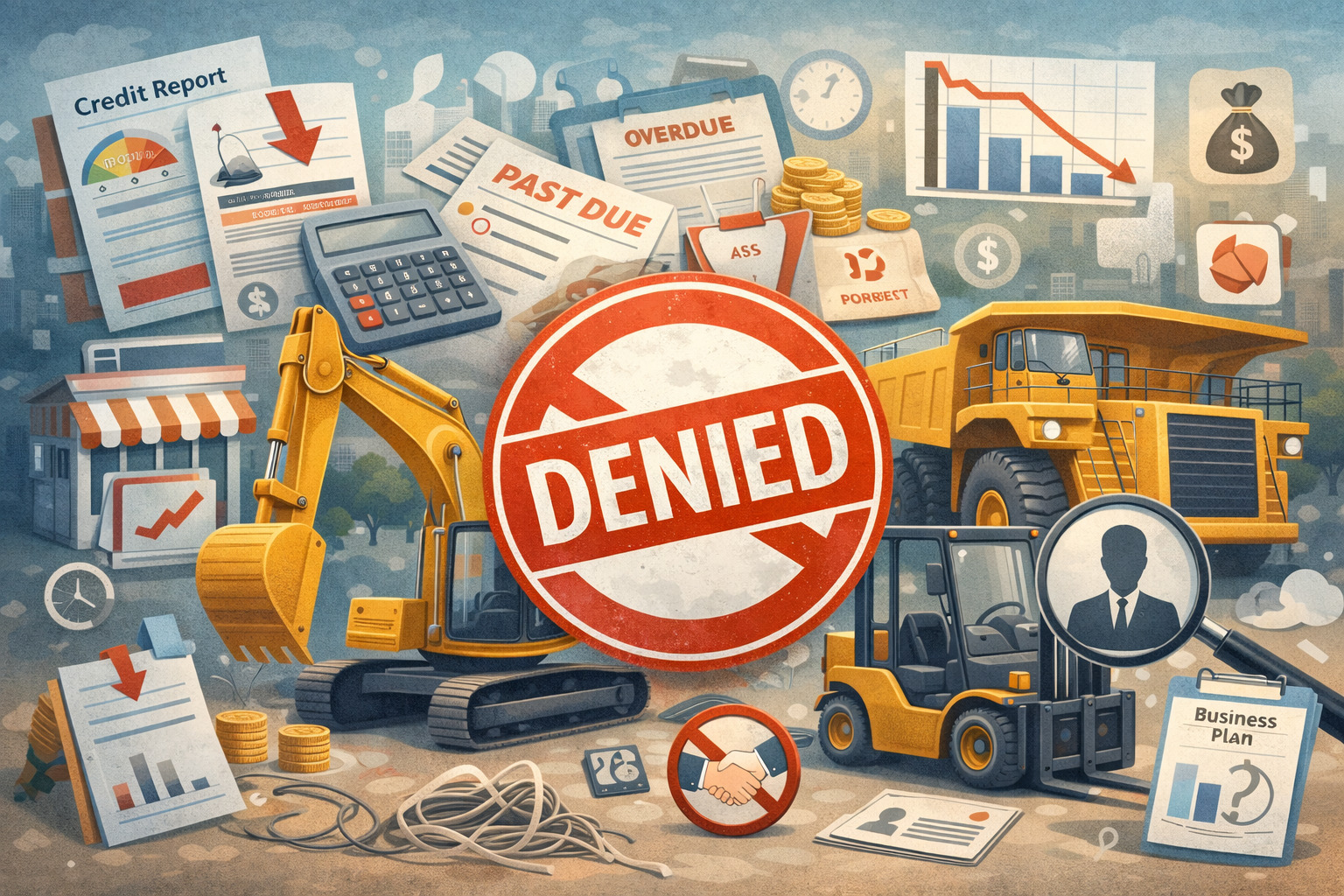
Common Reasons Equipment Financing Is Denied
Equipment financing can be one of the fastest ways to get the tools, vehicles, machinery, and technology your business needs without draining cash reserves. But it can also be frustrating when an application comes back declined.
When equipment financing is denied, it rarely happens “for no reason.” Lenders and lessors follow underwriting rules designed to predict whether the business will repay the obligation and whether the equipment can serve as reliable collateral.
This guide breaks down the most common denial triggers, explains what underwriters look for, and shows practical steps to improve approval odds.
You’ll also see realistic future trends—how automation, alternative data, and economic shifts may change why equipment financing is denied and how approvals may work going forward. Throughout the article, you’ll find relevant terms used by lenders, so you can speak the same language during the next application.
What Lenders Evaluate Before Approving Equipment Financing

When equipment financing is denied, it often traces back to how a lender scores risk across five big areas: credit, cash flow, time in business, equipment quality, and the strength of the deal structure.
Underwriting is not only about whether you want the equipment; it’s about whether the business can consistently repay and whether the asset is easy to value, insure, and resell if needed.
Most lenders start with the applicant’s credit profile—both business credit and personal credit for owners, especially for small or newer companies. Next comes cash flow.
Underwriters want to see that revenue supports existing obligations plus the new payment, with a cushion for slow seasons or unexpected expenses. This is where DSCR (Debt Service Coverage Ratio) and bank statement analysis become critical.
They also check stability signals: time in business, industry risk, customer concentration, and any recent changes in ownership or location.
Finally, the asset itself matters. Equipment that is easy to appraise, widely used, and has strong resale demand is safer collateral, while niche or custom equipment may lead to a higher decline rate.
Reason 1: Weak Personal Credit or Limited Credit Depth
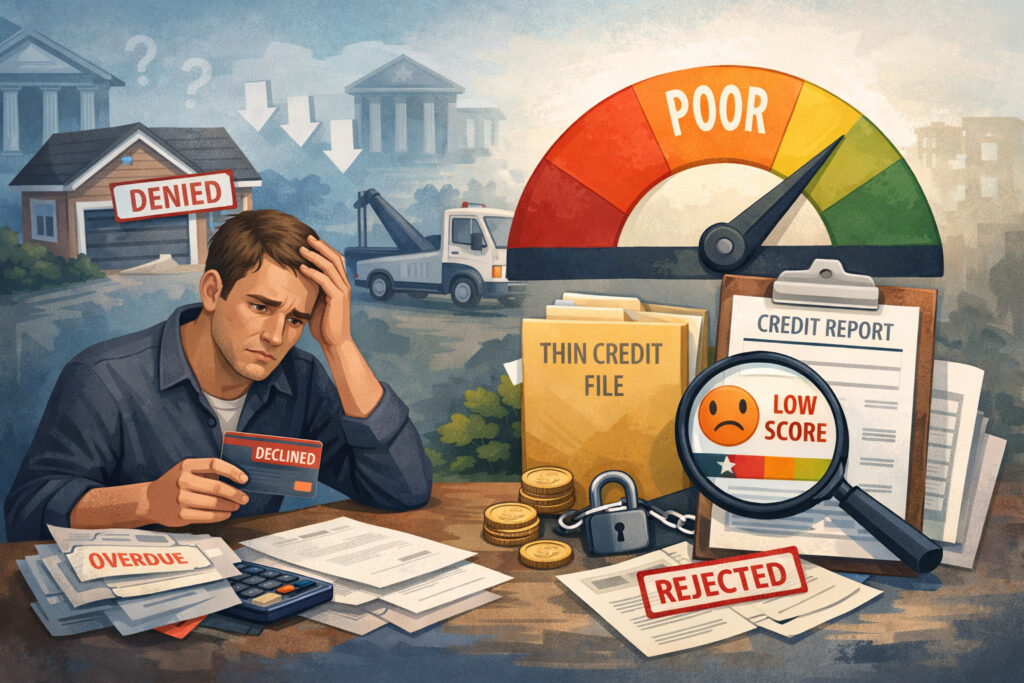
A top reason equipment financing is denied is weak personal credit, thin credit history, or recent negative activity. Many lenders use the owner’s credit as a proxy for how the business handles obligations, especially when the company is privately held or has limited business credit history.
Underwriters look beyond a single score. They review tradelines, utilization, payment history, and “freshness” of derogatory items. Late payments in the last 12–24 months can trigger declines, even if the score seems acceptable. High revolving utilization can also signal stress, because it suggests the applicant is leaning on credit to cover operating needs.
Limited credit depth can be just as harmful as poor credit. If a business owner has a short file, few accounts, or mostly small consumer tradelines, the lender may not feel confident extending a larger equipment obligation. This is common for entrepreneurs who have avoided debt for years and then apply for financing for a major purchase.
If you suspect credit is why equipment financing is denied, focus on reducing utilization, correcting errors, and building depth with a mix of accounts. Even simple changes—like paying down balances before applying—can improve approval odds quickly.
How to strengthen credit to avoid denials
A practical approach includes: bringing revolving balances down, making on-time payments for several months, avoiding new inquiries right before applying, and resolving collections or charge-offs when possible.
If there’s a past issue, a lender may still approve if you show stable cash flow and offer a larger down payment, but your application needs to be packaged well so the underwriter understands the full story.
Reason 2: Insufficient Cash Flow or Unstable Revenue
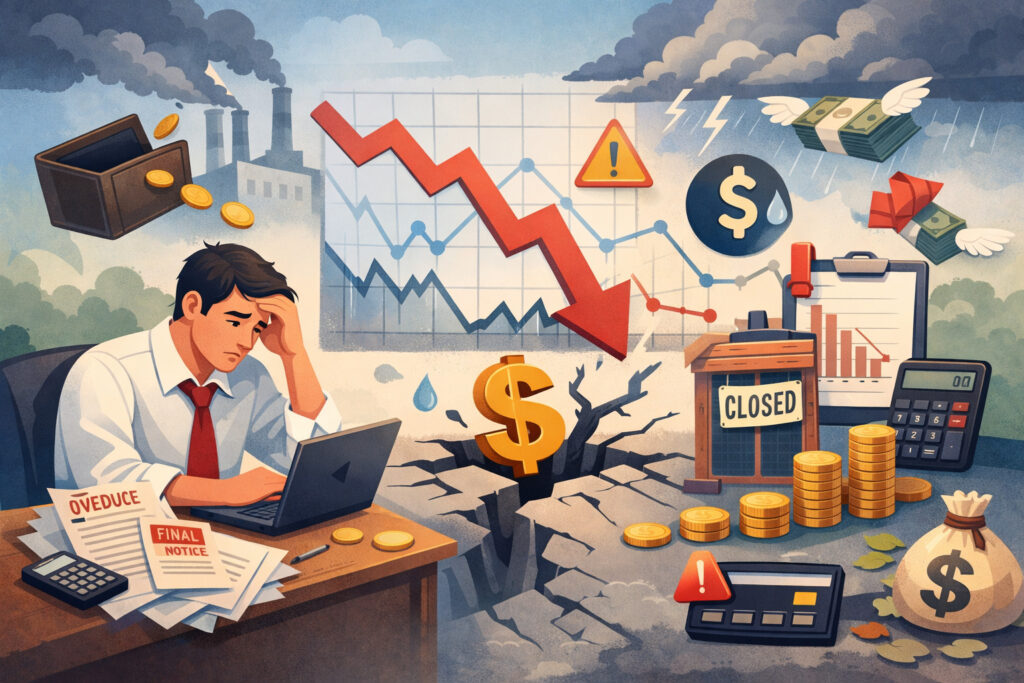
Cash flow is the heartbeat of approvals. A common reason equipment financing is denied is that bank statements and financials don’t show enough consistent income to support the new payment. Even profitable businesses can be declined if cash flow is volatile, seasonal without reserves, or “thin” after existing obligations.
Underwriters typically compare average monthly deposits to monthly expenses and debt payments. They also look for NSFs (non-sufficient funds), overdrafts, and frequent negative balances.
Those signals can indicate that the business is operating too close to the edge. If your statements show constant dips below comfortable levels, the lender may assume the new equipment payment will cause missed payments.
Another issue is revenue quality. If deposits are inconsistent—large spikes followed by quiet months—or if revenue relies on one or two customers, it creates risk. Customer concentration is a major hidden driver of why equipment financing is denied. Losing one client can collapse cash flow and quickly turn a “good” deal into a default scenario.
To reduce the chance that equipment financing is denied, prepare bank statements that reflect stability. Consider timing the application after strong months, cleaning up overdrafts, and documenting recurring contracts or purchase orders that show predictable future income.
DSCR and why it matters in equipment approvals
DSCR (Debt Service Coverage Ratio) compares net operating income to total debt payments. Many lenders want a cushion—meaning cash flow should exceed obligations by a safe margin. If your DSCR is too tight, the lender may still approve by requiring a larger down payment, shortening the term, or selecting equipment with stronger collateral value.
Reason 3: Short Time in Business or Limited Operating History

Businesses with a short operating history often face higher decline rates. If equipment financing is denied and your company is under two years old, time in business may be a key driver. Many lenders have minimum thresholds because new businesses fail at higher rates and have less predictable cash patterns.
For newer companies, lenders may rely more heavily on the owner’s credit, the owner’s industry experience, and the business’s early revenue trend.
A startup with inconsistent deposits, a new DBA, or recent entity changes may appear unstable to automated underwriting models. Even if the business is doing well, it may not have enough “track record” to satisfy standard guidelines.
That does not mean approvals are impossible. It means the deal must be structured differently. When equipment financing is denied due to limited time in business, lenders often want stronger compensating factors: a down payment, a co-signer, collateral support, or equipment that is highly liquid and easy to resell.
If you’re early-stage, your goal is to present a clear and credible story: why you need the equipment, how it will produce revenue, and how your existing cash flow supports the payment. Strong documentation can reduce the risk perception.
Alternatives for younger businesses
Newer businesses may qualify through vendor programs, secured structures, or smaller “starter” approvals that build payment history. Another common strategy is to finance essential equipment first, then refinance or expand approvals after 6–12 months of strong performance.
Reason 4: High Existing Debt or Overleveraging
Another frequent reason equipment financing is denied is that the applicant already carries too much debt relative to income. Underwriters look at total obligations—business loans, lines of credit, credit card minimums, vehicle loans, leases, and even merchant cash advances. If monthly obligations are heavy, adding another payment can feel unsafe.
Overleveraging can show up in different ways. A business might have good revenue but thin margins, making it hard to absorb additional fixed payments. Or the business may have multiple short-term products with daily or weekly withdrawals that drain cash. Those products can be especially damaging because they raise default risk, even if revenue is strong.
Lenders also consider “stacking,” meaning multiple obligations added within a short period. When several new debts appear rapidly, underwriters may assume the business is under pressure or plugging cash flow gaps with financing. That pattern increases the chance that equipment financing is denied.
A clean fix is debt consolidation or restructuring. Paying off small high-interest accounts, reducing daily-withdrawal products, or refinancing into longer terms can improve ratios. Even a simple reduction in revolving balances and unused credit lines can make your application look more stable.
Why short-term financing can trigger declines
Short-term products can create cash flow compression. Underwriters may fear that the equipment payment will compete with aggressive repayment schedules. If you can document that short-term obligations are ending soon or will be refinanced, the lender may reconsider and approve.
Reason 5: Incomplete Documentation or Application Inconsistencies
Sometimes equipment financing is denied because the file is incomplete or the application data doesn’t match supporting documents. Underwriting is detail-driven. If the application lists one revenue number but bank statements show something else, or if the business address differs across records, the lender may interpret it as risk.
Common documentation issues include missing financial statements, unclear bank statements, outdated equipment invoices, or mismatched ownership information. Even small inconsistencies—like a different spelling of the legal business name or an old DBA—can slow underwriting and trigger automated declines.
Another major problem is unverifiable information. Lenders verify business identity through public records, registrations, licenses, and sometimes online presence. If your business is hard to verify, newly registered, or lacks consistent records, approvals become harder and equipment financing is denied more often.
Fixing this is mostly operational: update registrations, keep consistent branding, and prepare a clean package. A strong submission includes a current invoice/quote, clear equipment details (make/model/serial if available), accurate ownership info, and statements that support the declared revenue.
Best practices for a “clean” equipment finance package
Aim for one version of the truth: same address, same legal name, same ownership percentage across all docs. Provide the exact equipment quote and ensure the vendor matches the application. Clear packaging reduces underwriter friction and improves approval odds.
Reason 6: The Equipment Is Hard to Value, Too Old, or Has Weak Resale Demand
Because equipment financing is asset-based, the collateral matters. A common reason equipment financing is denied is that the equipment doesn’t fit lender guidelines. This can happen when the asset is too old, has high hours, is heavily customized, or belongs to a category with weak secondary market demand.
Lenders prefer equipment with predictable valuation and strong resale. Standard commercial machinery, commonly traded vehicles, and well-known brands often qualify more easily. On the other hand, custom-built equipment can be difficult to appraise. If the lender cannot confidently estimate liquidation value, the collateral support is weaker, so the decline risk rises.
Age limits are common. Some lenders cap equipment age at a certain number of years at the end of term. If you’re trying to finance older equipment over a long term, you may see a decline because the projected value at maturity is too low.
If equipment financing is denied due to equipment type, you can often salvage the deal by choosing newer equipment, shortening the term, adding a down payment, or selecting a lender that specializes in that asset category.
Documentation that helps when equipment is “non-standard”
Provide maintenance records, serial numbers, clear photos, and third-party valuation references where possible. The goal is to reduce uncertainty and show that the asset is well-maintained and marketable.
Reason 7: Industry Risk, Restricted Categories, or Policy Limits
Certain industries are considered higher risk due to volatility, chargeback exposure, regulatory pressure, or historically higher default rates. If equipment financing is denied and your business operates in a high-risk category, that may be the hidden reason—especially with large national lenders that use strict policy filters.
Industry risk isn’t necessarily a moral judgment; it’s a portfolio management decision. Some lenders limit exposure to industries that fluctuate with commodity prices, seasonal demand, or discretionary consumer spending. Others avoid categories with complex compliance requirements or reputational risk.
Even within the same industry, subcategories can matter. For example, a repair shop might be treated differently than a brand-new dealership model. Underwriters may look for longer time in business, stronger liquidity, or larger down payments in higher-risk segments. If those compensating factors aren’t present, equipment financing is denied.
When this is the issue, the solution is often lender selection. Specialty lenders may understand the equipment and revenue model better than general banks. A properly matched lender can turn a prior denial into an approval without changing your business.
How to overcome an industry-based decline
Focus on documentation and stability: contracts, customer diversity, strong banking history, and clear equipment ROI. You may also structure the deal with more upfront equity, which reduces lender exposure and can change the underwriting outcome.
Reason 8: New Bank Account, Frequent NSF/Overdrafts, or “Messy” Banking Behavior
Bank statements are a direct window into business behavior. If statements show frequent overdrafts, repeated NSF fees, or bouncing payments, the chance that equipment financing is denied rises sharply. Even if revenue is decent, underwriters interpret these items as signs of cash management stress.
A new bank account can also be an issue. If the business recently switched banks, underwriting may not have enough history to evaluate trends. Lenders often want multiple months of statements from the same account to confirm stability. Short banking history can trigger automated declines or manual conditions.
Another red flag is heavy cash withdrawals without clear business purpose, unusual transfer patterns, or large payments to unfamiliar entities that look like other debt products. Underwriters look for predictable operating activity. When activity looks erratic, equipment financing is denied more often.
To improve, stabilize the account for a few months before applying, avoid overdrafts, and keep sufficient balances. If you’re transitioning accounts, provide statements from both banks with a clear explanation and show continuity of deposits.
Cash flow presentation matters
If your statements are “noisy,” consider providing a brief lender-facing explanation—like seasonal cycles, one-time expenses, or a recent move that caused temporary disruption. Underwriters may accept volatility if it’s documented and not ongoing.
Reason 9: Tax, Legal, or Compliance Issues (Liens, Judgments, or Unresolved Filings)
Legal and compliance issues can block approvals quickly. If equipment financing is denied unexpectedly, check for tax liens, UCC filings, judgments, or unresolved compliance gaps. Lenders search public records to see if other creditors have claims that could interfere with repayment or collateral rights.
Tax problems are particularly sensitive. Underwriters may decline if there are significant unpaid tax obligations, active liens, or repeated filing issues. The concern is priority: certain obligations can take precedence over lender claims, increasing risk.
UCC filings are not always bad—many businesses have them due to prior loans. But heavy UCC activity, especially recent filings from short-term lenders, can signal financial stress and lead to a decline. If liens and filings aren’t explained, equipment financing is denied more often.
A path forward is resolution and documentation. Payment plans, lien releases, settlement letters, and proof of compliance can help. If you can show the issue is contained and being addressed, some lenders will approve with conditions.
Why “clean title” matters for equipment collateral
Lenders want to ensure they can secure interest in the equipment. If prior creditors already have broad collateral claims, it complicates perfection and recovery. Clearing conflicts or choosing a lender comfortable with existing filings can improve outcomes.
Reason 10: Deal Structure Problems (Term, Down Payment, or Payment Too High)
Many applicants assume denial is about the business, but sometimes the structure is the real problem. Equipment financing is denied when the term is too long for the asset, the requested amount is too high, or the payment doesn’t match cash flow.
For example, financing 100% of the cost with no down payment can be tougher for newer or mid-credit applicants. Lenders like to see “skin in the game” because it lowers default probability. Similarly, requesting an unusually long term can create a mismatch between the equipment’s useful life and the loan maturity.
Another structural issue is including too many soft costs without support—such as installation, training, shipping, or extended warranties—especially when the lender’s policy is asset-only financing. If the invoice includes large non-equipment portions, underwriting may reduce the approved amount or decline.
If equipment financing is denied, rework the structure: increase down payment, shorten term, choose a slightly lower-cost model, or separate soft costs. Small changes can convert a denial into an approval.
The “right” structure is lender-specific
Some lenders prioritize low monthly payments; others prioritize collateral and down payment. Matching the structure to the lender’s appetite is often more effective than forcing one lender to fit your preferred terms.
Reason 11: Poor Business Credit Profile or No Business Credit File
Business credit can influence approvals, especially for established companies. If equipment financing is denied and your business has few tradelines, low scores, or negative payment experiences, the lender may require stronger personal credit or additional documentation.
A business credit profile usually reflects how the company pays vendors and commercial accounts. Late vendor payments, collections, or a lack of reporting accounts can weaken the file. The absence of business credit can be interpreted as uncertainty—particularly if the business is older but has little commercial credit activity.
Building business credit takes time, but the steps are straightforward: establish reporting vendor accounts, pay early, keep utilization low, and maintain accurate public records. Over time, stronger business credit can reduce reliance on personal credit and improve terms.
Because many small businesses apply before building a file, equipment financing is denied frequently due to a thin business profile. The fastest workaround is to strengthen the overall package with cash flow documentation and a sensible deal structure.
Business identity consistency supports business credit
Ensure your business name, address, EIN records, and licensing are aligned. Inconsistent data can prevent tradelines from attaching correctly and can make verification harder during underwriting.
Reason 12: Rapid Growth Without Systems (Scaling Risk)
Oddly enough, rapid growth can cause denials. If revenue has surged quickly, lenders may worry it’s unstable, unrepeatable, or dependent on temporary factors. When equipment financing is denied in a high-growth scenario, it may be because financial controls and reserves haven’t caught up.
Underwriters want to see that growth is supported by predictable demand, repeat customers, and operational capacity. If expenses are rising faster than revenue or if margins are shrinking, growth can look fragile. Lenders may also see rapid hiring, new locations, or large inventory buys as warning signs of overextension.
To counter this, show systems: contracts, backlog, purchase orders, subscription revenue, or long-term customer relationships. Document processes and demonstrate that the equipment will directly support profitable expansion rather than adding strain.
In many cases, equipment financing is denied not because growth is “bad,” but because the lender needs proof that growth is durable. Strong documentation can change the decision.
Show how the equipment produces measurable ROI
Quantify how the equipment increases output, reduces labor cost, improves turnaround time, or increases capacity. If the lender sees clear payback logic, risk perception drops.
How to Reduce Denials Before You Apply
When equipment financing is denied, it often follows avoidable mistakes: applying too early, choosing the wrong lender, or submitting an unorganized package. A proactive strategy can reduce denials and protect your credit.
Start by reviewing your bank statements like an underwriter would. Clean up overdrafts, stabilize balances, and time your application after strong months. Next, ensure your business identity is consistent across registrations, licensing, and invoices.
Then, select equipment that fits common lender guidelines—newer assets, strong brands, and clear resale markets.
Also consider deal structure. A modest down payment can dramatically improve approvals, especially if your credit or time in business is borderline. If you’ve had recent short-term financing, plan a timeline so the lender sees obligations declining instead of increasing.
Finally, treat the application like a business proposal. Provide clear equipment details, vendor information, and a concise explanation of how the equipment supports revenue. These steps reduce friction and lower the chance that equipment financing is denied.
Pre-application checklist
- Stable bank statements with minimal NSFs/overdrafts
- Accurate revenue and ownership information
- Clear equipment quote with make/model and vendor details
- Reasonable term matching asset life
- Optional down payment to strengthen approval odds
What to Do Immediately After an Equipment Financing Denial
A denial is not the end; it’s feedback. If equipment financing is denied, the most productive next step is to identify whether the issue is credit, cash flow, equipment, industry policy, or structure. Ask for the primary decline reason and whether the lender would reconsider with a different structure.
Then prioritize fixes that produce fast impact. If the issue is bank statement behavior, improve balances and reduce overdrafts for 60–90 days. If it’s credit, pay down utilization and avoid new inquiries.
If it’s equipment age or type, adjust the asset selection or shorten the term. If it’s industry policy, apply with a specialty lender rather than repeating the same profile with the same type of lender.
Also be mindful of application velocity. Multiple applications in a short window can create more inquiries and more “stacking” risk signals. A targeted approach—fix the core issue, then apply strategically—reduces repeated declines and improves your next outcome.
Most importantly, don’t guess. When equipment financing is denied, use that specific reason to build a better file and a better structure the next time.
Re-application strategy that works
Wait until you can show measurable improvement—cleaner bank statements, higher balances, lower utilization, or a better structure with a down payment. Then apply with the right lender type for your industry and asset.
Future Predictions: How Equipment Financing Approvals May Change
The reasons equipment financing is denied are likely to evolve as underwriting becomes more automated and data-rich. Expect increased use of alternative data—real-time bank analytics, payment processing trends, accounting integrations, and even shipping or invoicing signals—to evaluate cash flow and business stability.
Automation may reduce denials caused by minor documentation errors because systems can instantly verify identity and pull data from connected platforms. At the same time, automation may increase denials for applicants with inconsistent patterns because algorithms flag risk faster and with less human flexibility.
Another trend is tighter policy shifts during economic uncertainty. When rates rise or default rates increase, lenders often reduce exposure to higher-risk industries and shorter time-in-business applicants. That can make equipment financing is denied more common for startups during certain cycles, even if the equipment itself is strong.
On the positive side, more lenders are developing tiered approval paths: smaller initial approvals that expand after strong payment history. This may help newer businesses build eligibility faster without waiting years.
Overall, the future likely brings more speed, more data, and more precision—meaning the best way to avoid “equipment financing is denied” outcomes is to maintain clean financial behavior and keep documentation consistent year-round, not only when applying.
FAQs
Q.1: Why is equipment financing denied even when revenue is strong?
Answer: Revenue alone isn’t enough. When equipment financing is denied despite strong deposits, the lender may be reacting to cash flow volatility, thin margins, high existing debt, customer concentration, or repeated overdrafts. Lenders want predictable repayment capacity, not just high top-line numbers.
Q.2: Can I get approved after equipment financing is denied?
Answer: Yes. Many declines are structure-related. If equipment financing is denied, you may still qualify by adding a down payment, choosing newer equipment, shortening the term, applying with a specialized lender, or improving bank statement stability for a few months.
Q.3: Does the type of equipment affect approval chances?
Answer: Absolutely. Equipment with strong resale markets, clear valuations, and broad demand is easier to finance. If equipment financing is denied, the asset may be too old, too customized, or too hard to appraise, which reduces collateral comfort.
Q.4: How many months of bank statements do lenders usually review?
Answer: It varies, but many review several months to understand trends. If statements show frequent NSFs or unstable balances, equipment financing is denied more often. Consistency and healthy average balances matter.
Q.5: Is business credit required for equipment financing?
Answer: Not always, but it helps. If business credit is thin or negative, lenders rely more on personal credit and cash flow. When equipment financing is denied, a weak or nonexistent business credit file can be part of the reason.
Q.6: Will applying with multiple lenders increase denial risk?
Answer: It can. Multiple inquiries and rapid application activity can look like stacking or financial stress. If equipment financing is denied, it’s often better to fix the core issue and apply strategically rather than applying everywhere at once.
Conclusion
When equipment financing is denied, it usually comes down to identifiable risk signals: credit weaknesses, insufficient or unstable cash flow, short time in business, high existing debt, documentation problems, equipment that doesn’t fit guidelines, or industry policy limits.
The good news is that many denials are not permanent. They’re often “not this way, not right now,” rather than “never.”
The smartest path is to treat underwriting like a system you can prepare for. Keep bank statements clean, reduce overdrafts, maintain healthy balances, build credit depth, and choose equipment with strong resale value.
Structure your deal realistically—with a term that matches the asset and, when needed, a down payment that reduces lender risk. If the lender fit is the issue, work with providers who understand your industry and equipment category.
As underwriting evolves, data-driven decisions may make outcomes faster and more consistent. That means your everyday financial habits will matter even more.
If you take the time to address the factors that cause equipment financing to be denied, you’ll not only improve approval odds—you’ll often unlock better terms, smoother closings, and a financing strategy that supports long-term growth.