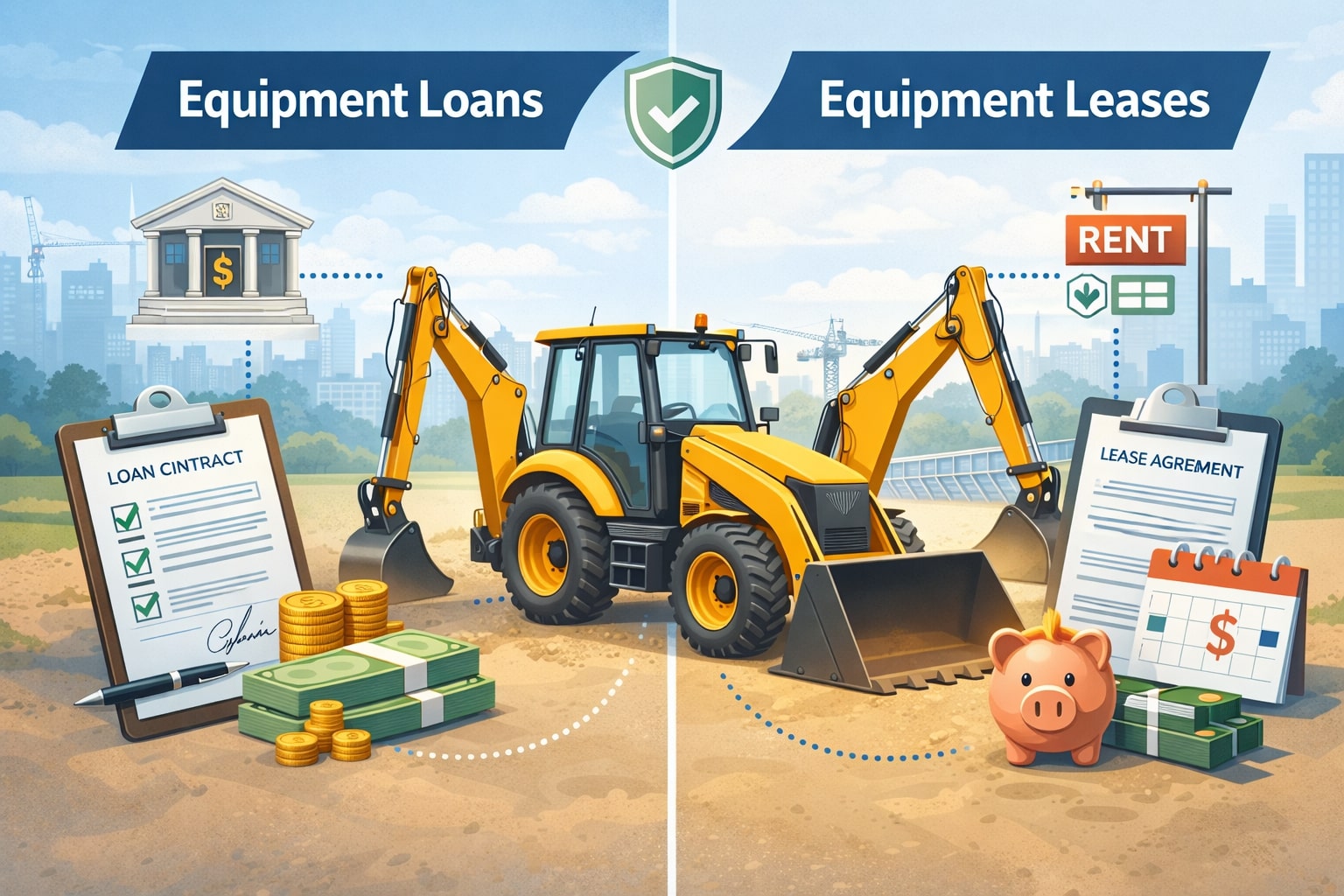
Equipment Loans vs Equipment Leases: Key Differences
Business growth often hinges on one simple question: how do you get the equipment you need without straining cash flow?
Whether you’re adding a new POS system, upgrading kitchen gear, buying medical devices, expanding a fleet, or investing in manufacturing machinery, the decision usually comes down to equipment loans vs equipment leases.
At a glance, both options solve the same problem—access to equipment—yet they do it in very different ways. In equipment loans vs equipment leases, a loan is typically about ownership (you buy the asset and pay it off over time), while a lease is usually about use (you pay for the right to use the asset for a set period).
The “right” answer depends on your industry, the equipment’s useful life, your tax strategy, your balance sheet goals, and how quickly technology changes in your space.
This guide breaks down equipment loans vs equipment leases in plain language, with practical examples, contract pitfalls to avoid, and decision frameworks you can actually use. It also includes current tax and accounting considerations and forward-looking predictions that matter when planning long-term capital purchases.
Understanding equipment loans vs equipment leases in real business terms
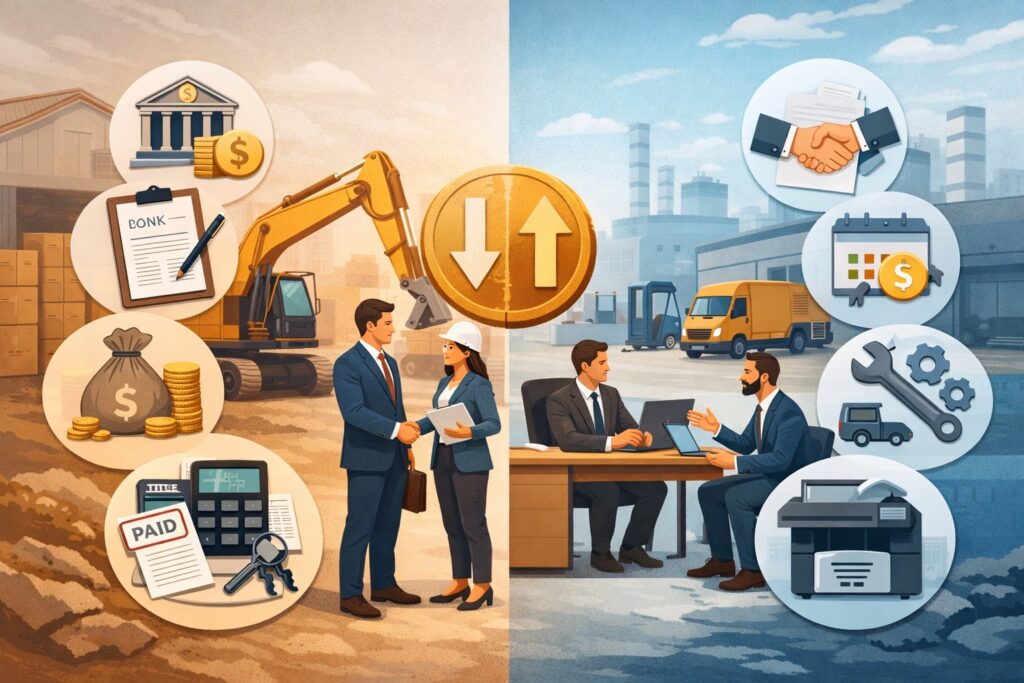
When people compare equipment loans vs equipment leases, they’re usually trying to optimize three things at once: cash flow, total cost, and flexibility. The trouble is that these goals can conflict.
A structure that looks cheaper monthly might cost more overall, and an option that looks “flexible” may include renewal clauses or buyout terms that change the real economics.
In equipment loans vs equipment leases, the most important difference is what happens at the end of the agreement. With an equipment loan, your endgame is straightforward: once you finish payments, you own the equipment free and clear (subject to any lien releases).
With an equipment lease, the endgame depends on lease type: you might return the equipment, renew the lease, or buy it for a predetermined amount.
Another major factor in equipment loans vs equipment leases is how the agreement treats risk. Ownership puts more responsibility on you—maintenance decisions, resale value, and obsolescence risk.
Leasing can reduce resale and obsolescence risk, but may come with mileage limits, usage rules, insurance requirements, and return-condition standards.
Finally, equipment loans vs equipment leases can affect how stakeholders view your business. Lenders, investors, and buyers may interpret the obligation differently, especially under modern lease accounting rules that bring many leases onto the balance sheet under ASC 842.
If you want a clean comparison, start here: equipment loans vs equipment leases is less about “which is better” and more about “which aligns with how the equipment creates value in your business.”
How equipment loans work
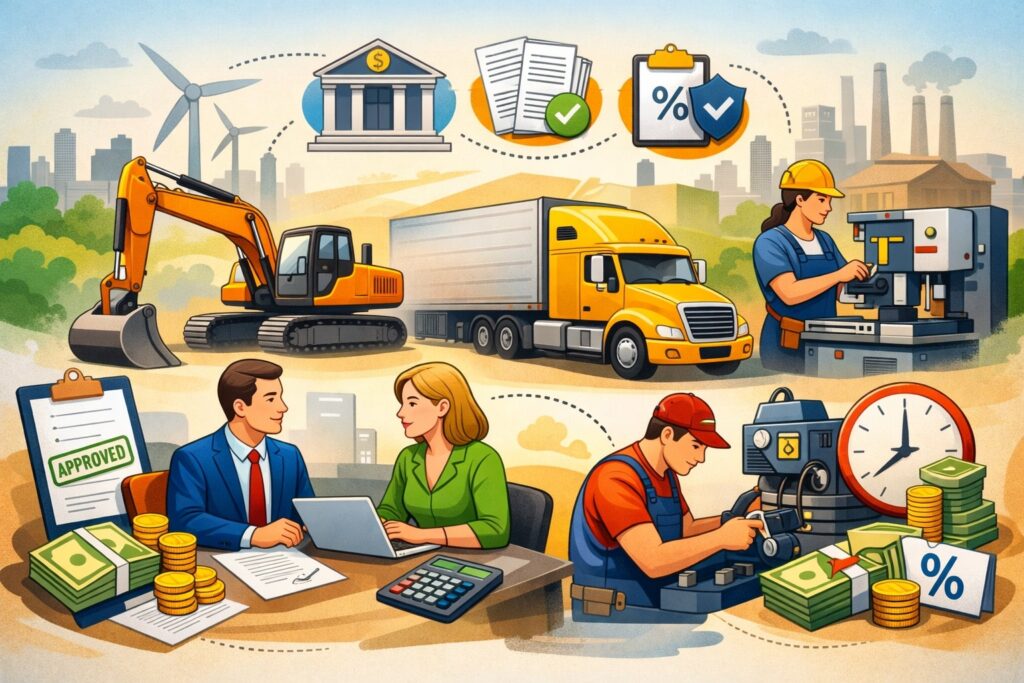
In equipment loans vs equipment leases, an equipment loan is the more familiar structure: a lender funds the purchase of a specific piece of equipment, and your business repays that amount plus interest over a fixed term.
The equipment typically serves as collateral, which can make equipment loans more accessible than unsecured financing—especially if your business has limited time in operation.
A key feature of equipment loans vs equipment leases is that equipment loans usually require a down payment in many cases, though some programs offer 100% financing depending on credit, time in business, and equipment type.
Repayment terms often align with the equipment’s expected useful life. For example, a short-lived technology asset may be financed for a shorter period than heavy machinery designed to last a decade.
In equipment loans vs equipment leases, loans also tend to be more straightforward when it comes to ownership economics. You can sell the equipment, trade it in, or keep it after the loan is paid.
That flexibility can be powerful if the asset holds value well (think durable machinery or vehicles with strong resale markets). However, you also bear the downside: if the equipment becomes obsolete or fails early, you still owe the loan unless it’s covered by warranty, insurance, or a separate protection plan.
From an operational perspective, equipment loans vs equipment leases differ in maintenance control. With a loan, you typically control maintenance schedules and vendors—useful when uptime matters and you want to standardize service across locations.
The “hidden” advantage many owners overlook in equipment loans vs equipment leases is equity. As you pay down principal, you’re building ownership in a usable asset, which can support future financing or strengthen your balance sheet position.
Equipment loan structures you’ll see most often
In equipment loans vs equipment leases, not all loans look the same. The structure you pick affects payments, approval odds, and the total cost.
- Term loans are the classic model: fixed monthly payments over a set period. These are easier to budget, and they fit businesses that want predictable expenses. In equipment loans vs equipment leases, term loans usually win on simplicity.
- Equipment financing agreements can sometimes resemble leases, but functionally they behave like loans. The lender funds the purchase, the business repays, and the business owns the asset at the end. The label matters less than the economics, so always read the ownership and buyout language carefully when evaluating equipment loans vs equipment leases.
- Soft-cost financing is another variation that can show up in equipment loans vs equipment leases. Some lenders will bundle installation, shipping, software, training, and warranties into the financed amount. This is valuable when the “real” cost of using the equipment is more than the purchase price.
- Seasonal or stepped payments can appear in equipment loans vs equipment leases when revenue is uneven. Some lenders structure higher payments during peak season and lower payments in the off-season. This can protect cash flow, but you need to model total interest and ensure the schedule is sustainable.
No matter the structure, equipment loans vs equipment leases comparisons should include: effective APR, fees, down payment, whether soft costs are included, and whether there’s a prepayment penalty.
How equipment leases work
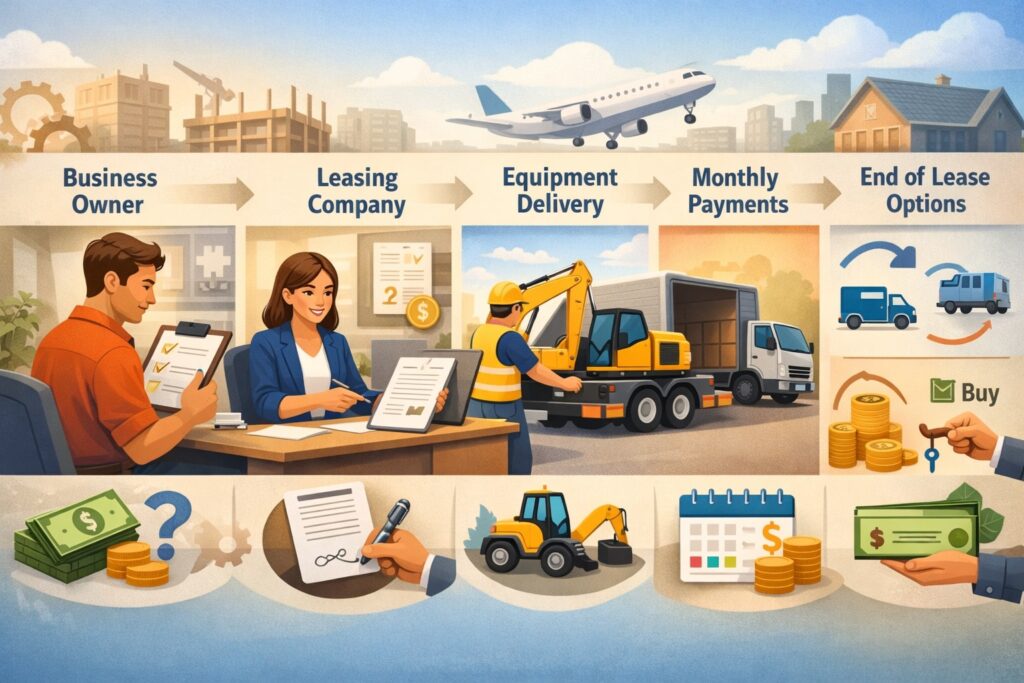
In equipment loans vs equipment leases, leasing is typically designed to give you the equipment without committing to ownership right away. Your business makes periodic payments to use the equipment for a fixed term, and the contract defines what happens when the term ends—return, renew, or buy.
Leasing can be especially attractive in equipment loans vs equipment leases when the equipment becomes outdated quickly.
Think POS hardware upgrades, specialized software-tied systems, medical diagnostic equipment, or high-performance IT hardware. If keeping current is more important than squeezing every last year out of the asset, leasing can fit.
Another important dimension in equipment loans vs equipment leases is cash flow. Leases often require less upfront cost than loans, and sometimes offer “$0 down” options (subject to credit approval). That can preserve working capital for staffing, inventory, marketing, or expansion.
But equipment loans vs equipment leases differ sharply on contract controls. Leases commonly include usage rules, insurance requirements, maintenance obligations, and return-condition clauses.
In practice, “returning” equipment can be expensive if the lease requires refurbishment, shipping, inspections, or penalties for excess wear. So leasing isn’t automatically cheaper—it’s a different risk allocation.
From an accounting standpoint, modern standards matter. Many leases are now recorded on the balance sheet as a right-of-use asset and a lease liability under ASC 842, which changes how financial statements look compared to older lease reporting habits.
In short, equipment loans vs equipment leases is often a trade: leasing can offer flexibility and lower upfront costs, but it demands sharper attention to contract details.
Common equipment lease types and what they really mean
When comparing equipment loans vs equipment leases, you’ll typically see a few lease formats. The names vary by provider, but the economics usually fall into recognizable patterns.
- Fair Market Value (FMV) leases often have lower monthly payments because they assume the equipment still has residual value at the end. In equipment loans vs equipment leases terms, you’re paying for “use,” not full ownership. At term-end, you return the equipment, renew, or buy it at then-current market value.
- $1 buyout leases (or nominal buyout leases) often behave similarly to financing. Payments are higher, but you can buy the equipment for a token amount at the end. In equipment loans vs equipment leases decisions, this can be attractive if you want near-certain ownership while still using a lease-like structure.
- Fixed buyout leases specify a defined purchase price at the end—such as 10% of original cost. In equipment loans vs equipment leases, this gives clarity for long-range planning because you can forecast the end-of-term cash need if you intend to own the equipment.
- Operating vs finance lease classification matters for reporting. Under ASC 842, both categories generally create right-of-use assets and liabilities, but expense recognition patterns and presentation can differ.
The biggest mistake businesses make in equipment loans vs equipment leases comparisons is focusing only on the monthly payment. The lease type determines residual assumptions, end-of-term obligations, and the real long-term cost.
Key differences: equipment loans vs equipment leases (ownership, flexibility, and risk)
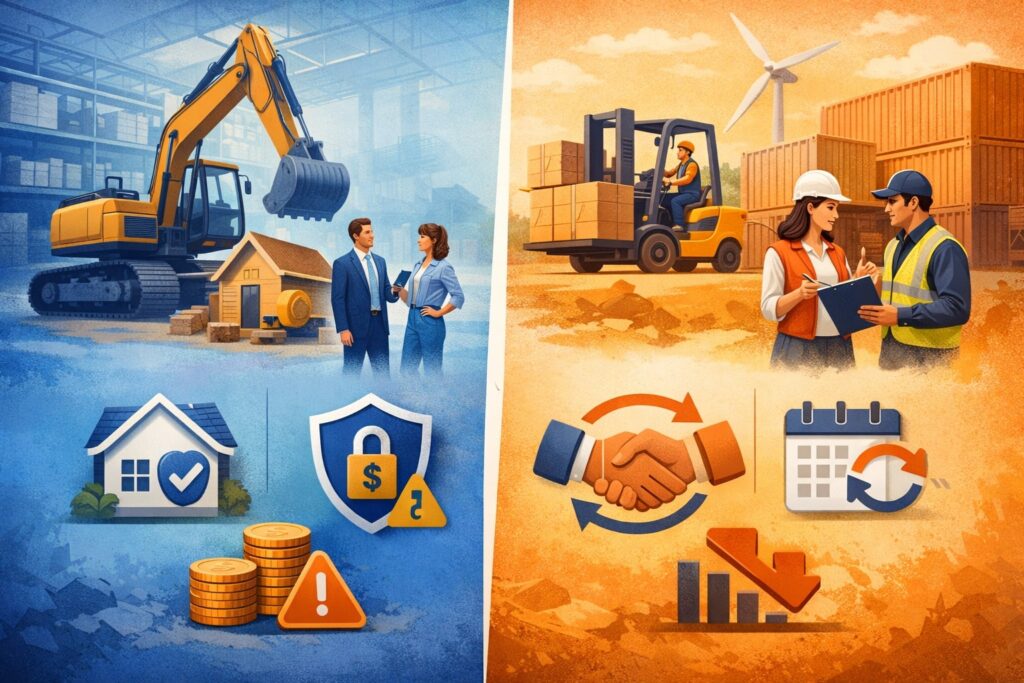
If you want a clean, decision-friendly breakdown, equipment loans vs equipment leases differ across five core dimensions: ownership, cost profile, flexibility, risk allocation, and end-of-term control.
- Ownership is the headline difference. Equipment loans are designed to transfer ownership to you. Equipment leases are designed to transfer usage rights, with optional ownership depending on buyout terms.
- Cost profile differs in how payments are calculated. In equipment loans vs equipment leases, loan payments typically reflect full asset purchase price plus interest. Lease payments may reflect only depreciation during the term plus a residual assumption, which can lower monthly cost but can also create a meaningful buyout cost later.
- Flexibility is nuanced. Leasing may be flexible if you truly plan to return or upgrade equipment regularly. But an equipment loan can be more flexible if you want to sell, trade, or refinance later. In equipment loans vs equipment leases, flexibility depends on your actual operational plan, not the marketing pitch.
- Risk allocation is central. Loans put resale and obsolescence risk on you. Leases can shift some of that risk to the lessor—especially FMV leases—though the contract may shift wear-and-tear and maintenance risk right back onto you.
- End-of-term control can be the make-or-break point in equipment loans vs equipment leases. Loans end with ownership. Leases end with a decision—and sometimes pressure tactics like auto-renewal clauses, short buyout windows, or complicated return requirements.
If you remember only one thing about equipment loans vs equipment leases, remember this: the monthly payment is not the decision—your end-of-term plan is.
The end-of-term question that decides most deals
In equipment loans vs equipment leases, you should decide what you want before you sign:
- Do you want to own the equipment for its full useful life?
- Do you want to upgrade on a predictable cycle?
- Do you want to avoid resale and disposal logistics?
- Do you want to keep cash available for growth?
If you want to own the equipment and use it long-term, equipment loans vs equipment leases often favors loans or buyout-leaning leases. If you want to upgrade frequently, equipment loans vs equipment leases often favors FMV leasing.
But be honest about your habits. Many businesses lease with the intention to return, then keep the equipment anyway—often paying more in total due to renewals and buyout terms. That’s why equipment loans vs equipment leases should be modeled with at least three scenarios: return, renew, and buy.
Also consider operational downtime. If returning equipment creates disruption—installation, reconfiguration, training—then equipment loans vs equipment leases may lean toward ownership simply to reduce transition costs.
Finally, watch for auto-renew language. In equipment loans vs equipment leases, some lease contracts renew automatically unless you provide notice in a narrow window. Missing that window can add months of unwanted payments.
Cost comparison: total cost of ownership vs total cost of use
In equipment loans vs equipment leases, cost should be analyzed as total cost, not just monthly outflow. A “cheaper” payment can produce a more expensive outcome if it hides large buyouts, fees, or penalties.
With equipment loans, the total cost is often easier to estimate: down payment + sum of payments + fees, minus any resale value when you eventually sell or trade the equipment. You can also factor in maintenance decisions and warranty coverage, which you control more directly.
With equipment leases, the total cost depends on lease type and end decision. In equipment loans vs equipment leases, an FMV lease can look extremely affordable monthly, but if you buy at the end, the combined cost (lease payments + FMV buyout) can exceed a comparable loan.
Also remember that leases may include charges that don’t show up in the headline payment quote: documentation fees, purchase-option fees, end-of-term inspection fees, shipping/return costs, refurbishing charges, and late or “evergreen” renewal fees. Those can swing equipment loans vs equipment leases outcomes dramatically.
A practical approach is to compute an “all-in effective cost” for each option under realistic assumptions. If the equipment will still be useful after the term, assign a residual value to the loan path. If you’re likely to keep the equipment under a lease, include the buyout and any extension payments. If you’re likely to return, include return logistics and downtime costs.
In equipment loans vs equipment leases, the winner is often the option that aligns with how long the equipment stays productive in your business.
Cash flow planning and working-capital protection
Cash flow is where equipment loans vs equipment leases become personal. Two businesses can choose differently for the exact same equipment because their working-capital needs differ.
Leases can protect working capital by requiring less upfront cash. That matters if your growth depends on inventory purchases, payroll, marketing, or multiple locations launching at once. In equipment loans vs equipment leases, leasing can be a strategic choice to keep cash liquid—especially for seasonal businesses.
Loans can also protect cash flow when structured well. In equipment loans vs equipment leases, longer terms can reduce monthly payments, though you should avoid stretching payments beyond the equipment’s realistic life.
If your term is longer than the equipment remains productive, you risk paying for an asset that no longer supports revenue.
Another cash flow element is revenue timing. Some equipment generates immediate return (e.g., essential production machinery), while other equipment supports long-term efficiency (e.g., back-office upgrades).
In equipment loans vs equipment leases, leasing may be preferred when ROI is uncertain or technology is evolving quickly, because it reduces long-term lock-in.
The best practice is to align payment schedules with revenue generation. If the equipment drives sales today, a loan can be justified. If the equipment may be replaced soon, a lease can avoid stranded costs.
Tax treatment and deductions for equipment loans vs equipment leases
Tax strategy can heavily influence equipment loans vs equipment leases, but it’s also an area where rules change. The key is to understand how deductions generally work, then confirm details with a qualified tax professional.
In equipment loans vs equipment leases, the basic idea is:
- If your agreement is a true lease, payments are typically treated as rent expense.
- If your agreement is effectively a purchase (including conditional sales contracts), you generally depreciate the equipment rather than deducting lease payments.
The IRS specifically notes that you must determine whether an agreement is a lease or a conditional sales contract, and that lease payments may be deductible as rent while purchases are recovered through depreciation.
For owned equipment (commonly via loans), depreciation rules can be powerful, including provisions like Section 179 and bonus depreciation. In 2025 guidance widely cited by tax resources, Section 179 limits are referenced at $2.5 million, with a phase-out threshold around $4.0 million of qualifying property placed in service.
Bonus depreciation rules have also been in flux. Some sources describe the prior phase-down schedule, while more recent tax-bill summaries report that 100% bonus depreciation was made permanent for qualified property placed in service after January 19, 2025.
Because these provisions can materially change equipment loans vs equipment leases outcomes, tax planning shouldn’t be an afterthought. Tax impact can flip the economics even when monthly payments look similar.
(Here, it becomes necessary to use the country name once: these are United States federal tax concepts administered by the IRS.)
How to think about taxes without getting lost in the weeds
The smartest way to approach taxes in equipment loans vs equipment leases is to focus on three questions:
- Do you need deductions now or later?
Some businesses value immediate deductions to offset current profits, while others may prefer smoother expense recognition over time. If you expect profits to increase, timing can matter. - What is your “placed in service” plan?
Many tax benefits depend on when the equipment is placed in service, not just purchased. If you’re buying late in the year, delivery and installation timing can affect the tax year in which deductions apply.
Recent discussions around acquisition dates and “placed in service” timing highlight how date rules can affect bonus depreciation eligibility. - Is your lease truly a lease?
In equipment loans vs equipment leases, if a “lease” is effectively a purchase (for example, with bargain buyouts or ownership-like terms), tax treatment may align more with ownership.
The IRS emphasizes evaluating the intent and facts and circumstances when determining lease versus conditional sales contract treatment.
Also remember state-level rules can differ from federal treatment, which may influence your actual savings. And if you’re comparing multiple financing offers, you should model taxes using consistent assumptions so you don’t accidentally compare apples to oranges.
Accounting impact and financial statements under ASC 842
Accounting is a major reason equipment loans vs equipment leases has changed in the last few years. Under ASC 842, many leases create a right-of-use (ROU) asset and a lease liability on the balance sheet, meaning leases can look more “debt-like” than they used to in financial reporting.
In equipment loans vs equipment leases, loans show up as debt, and the equipment appears as a fixed asset (subject to depreciation). That’s fairly intuitive. What surprises many business owners is that leases—previously seen as off-balance-sheet in some cases—can now create similar balance sheet obligations, depending on classification and terms.
This matters because financial statements influence lending decisions, investor confidence, and sometimes vendor credit. In equipment loans vs equipment leases, if you’re planning to seek additional financing soon, you should ask your accountant how each option will affect leverage ratios, covenant compliance, and EBITDA presentation.
ASC 842 also affects how you manage lease portfolios. If you have many leased assets across locations—POS hardware, vehicles, specialized machines—tracking lease terms, renewal options, and discount rates becomes more important. Some businesses adopt lease management systems simply to handle reporting and compliance efficiently.
The bottom line is that equipment loans vs equipment leases isn’t only about cash flow; it’s also about how obligations appear to outsiders reading your statements. For some businesses, that visibility is a deciding factor.
Practical reporting implications lenders and investors care about
Even when equipment loans vs equipment leases leads to similar cash payments, the reporting story can differ. Lenders and investors often look at:
- Total liabilities and leverage trends
- Debt service coverage ratios
- Operating cash flow vs financing cash flow presentation
- Asset base and depreciation schedules
- Consistency and transparency in reporting
ASC 842 commentary from accounting references highlights the broad applicability of the standard and the fact that it affects most entities with leases, including equipment leases.
In equipment loans vs equipment leases, a key practical point is documentation quality. If your business is growing and you might refinance, sell, or take on investors, having clean, well-organized financing and lease documents reduces friction during due diligence.
Also, understand that “operating lease” does not mean “invisible.” Under ASC 842, both operating and finance leases generally appear on the balance sheet, even if expense recognition differs.
If you’re deciding between equipment loans vs equipment leases and financial presentation matters, bring your accounting team into the conversation early—before you sign.
Qualification and approval: what lenders and lessors evaluate
In equipment loans vs equipment leases, approval depends on the same core idea: the funder wants confidence that you will pay, and that the equipment retains enough value to limit risk. But the weight of each factor can differ based on whether you’re borrowing or leasing.
For equipment loans, lenders commonly evaluate credit, time in business, revenue stability, bank statements, existing debt obligations, and the equipment’s resale value. Stronger borrower profiles may qualify for better rates, longer terms, and higher advance rates (sometimes financing most or all of the purchase).
For equipment leases, approval often leans more heavily on the asset itself and the lease structure. In equipment loans vs equipment leases, lessors may be comfortable offering easier upfront terms if residual value assumptions reduce their risk—especially under FMV leases.
However, don’t assume leasing is automatically easier. Certain industries, equipment categories, or startup profiles may face restrictions. Also, contracts may require additional safeguards such as personal guarantees, security deposits, or first-and-last payment structures.
In equipment loans vs equipment leases, documentation quality matters more than many owners expect. Clear invoices, vendor quotes, serial numbers, installation plans, and insurance coverage can speed up approval. If time-to-fund is critical, being organized can save days.
Finally, consider how fast you need the equipment. Some providers specialize in quick approvals for smaller tickets, while others focus on larger, more complex equipment packages.
Credit score is not the whole story
A common misconception in equipment loans vs equipment leases is that a single credit score determines everything. In reality, funders underwrite the full picture.
They care about ability to pay (cash flow and consistency), willingness to pay (credit history), and collateral support (equipment value). In equipment loans vs equipment leases, collateral can reduce perceived risk, but it doesn’t erase it—especially if the equipment is niche and has a limited secondary market.
If your business is newer, you can still improve approval odds in equipment loans vs equipment leases by presenting clean financials, stable processing statements (for revenue visibility), realistic projections, and strong vendor documentation. You can also consider shorter terms, larger down payments, or selecting equipment with stronger resale value.
For established businesses, underwriting can still be sensitive to volatility. Seasonal swings, recent debt increases, or margin pressure can change approval terms. That’s why equipment loans vs equipment leases should be paired with a cash-flow forecast, so you don’t accept a payment schedule that becomes a strain during slow months.
Contract terms and pitfalls that can change the deal
In equipment loans vs equipment leases, the contract you sign determines the deal you actually get. Many businesses focus on rate and payment, then discover terms that change the real cost.
With loans, watch for: origination fees, documentation fees, UCC filing, required insurance, late fees, default interest, and prepayment penalties. Prepayment penalties are especially important if you expect to refinance or sell the equipment.
With leases, watch for: automatic renewals, narrow notice windows, end-of-term fees, return-condition standards, shipping obligations, inspection charges, and buyout mechanics. In equipment loans vs equipment leases, these lease-specific terms can add thousands of dollars unexpectedly.
Also pay attention to “hell or high water” clauses, which are common in equipment finance. These clauses generally mean you must continue paying even if the equipment is damaged or fails, and your remedy is usually through insurance or the vendor—not by stopping payments.
For both loans and leases, ensure you understand: who owns the equipment during the term, who holds the title, who is responsible for taxes and insurance, and what happens if you relocate, sell the business, or want to upgrade early.
In equipment loans vs equipment leases, the best protection is to request a plain-language summary of end-of-term options and all fees in writing.
End-of-lease “evergreen” renewals and how to avoid them
One of the most costly traps in equipment loans vs equipment leases is the evergreen renewal. This is when a lease automatically renews for additional months (or even a year) unless you provide written notice within a specific window—sometimes 30 to 120 days before the end date.
If you miss that window, you might be locked into extra payments you didn’t plan for. In equipment loans vs equipment leases, this can turn a “short-term lease” into a longer obligation, changing the total cost and the upgrade timeline.
To protect yourself:
- Put notice deadlines on your calendar the day you sign.
- Ask for a contract section that states notice requirements plainly.
- Request a written confirmation of your end-of-term selection.
- If you plan to buy, ask when buyout pricing becomes available and whether there are purchase-option fees.
Also, clarify return logistics. In equipment loans vs equipment leases, the cost of returning equipment (shipping, packaging, insurance, condition repairs) can surprise owners who assumed “return” was simple.
Evergreen renewals aren’t always malicious—sometimes they’re administrative—but they are absolutely a factor that can decide equipment loans vs equipment leases outcomes.
Use cases by industry: when each option tends to fit
In equipment loans vs equipment leases, industry realities often predict the best choice.
Technology-forward retail and hospitality often lean toward leasing for POS hardware, kiosks, and systems that refresh every few years. If your competitive edge comes from newer tech, leasing can match your upgrade rhythm.
Manufacturing and construction often lean toward loans for heavy equipment with long useful lives and strong resale markets. Ownership can reduce long-term cost when the equipment remains productive for many years.
Healthcare and specialized services may choose leasing for high-cost diagnostic equipment that evolves rapidly, especially when vendor support and upgrade paths are bundled.
Delivery, logistics, and field services sometimes use a mix: loans for vehicles if they keep fleets long-term, leases for specialized add-ons that change with service requirements.
In equipment loans vs equipment leases, the general rule is: the faster equipment becomes obsolete, the more leasing makes sense. The longer it stays productive, the more ownership (loans) makes sense.
But there’s always nuance. Some businesses even lease long-life equipment to preserve cash for growth. Others loan-finance short-life tech because they want full control and don’t mind faster replacement cycles.
The best equipment loans vs equipment leases decision is the one that aligns with your operational reality—how you use equipment, how quickly you replace it, and how it impacts revenue.
A practical decision framework you can apply in 15 minutes
When you need a quick answer, run this checklist for equipment loans vs equipment leases:
- Useful life test: Will the equipment still be productive after the term?
If yes, equipment loans vs equipment leases often favors ownership. - Obsolescence test: Is replacement likely within 2–4 years?
If yes, equipment loans vs equipment leases often favors leasing. - Cash flow test: Is cash more valuable than total cost right now?
If yes, leasing may win if it preserves working capital. - Control test: Do you need full control over modifications, maintenance, or resale?
If yes, loans often win. - Exit test: Might you sell the business soon?
Ownership can simplify transfers, but lease assignment rules vary—so check contract terms. - Tax strategy test: Do accelerated deductions materially change your economics?
Because tax provisions like Section 179 and bonus depreciation can shift quickly, confirm current rules and model both paths.
This approach keeps equipment loans vs equipment leases grounded in business reality, not marketing.
Future predictions: where equipment financing is heading
Equipment loans vs equipment leases are evolving quickly due to technology, underwriting automation, and shifting tax policy. Several trends are likely to shape the next few years.
Embedded financing at checkout is growing. More vendors now offer integrated financing options directly in the purchase flow, making equipment loans vs equipment leases decisions happen faster—sometimes too fast. The upside is convenience. The downside is that businesses may accept terms without comparing alternatives.
AI-driven underwriting will likely accelerate approvals and personalize pricing. That can benefit businesses with strong real-time revenue signals, but it also means lenders may reprice risk faster during economic volatility.
Usage-based and subscription-like equipment models are expanding. Instead of traditional equipment loans vs equipment leases, some providers price equipment based on utilization (hours, throughput, transactions). This can align cost to revenue, which is appealing for scaling businesses—but contracts can be complex.
More emphasis on lifecycle management is coming. Businesses increasingly want bundled service, replacement cycles, and warranty coverage. Leasing fits naturally here, but loan providers may compete by bundling maintenance and protection plans.
Tax policy volatility remains a factor. Recent reporting around changes to bonus depreciation rules after January 19, 2025 shows how quickly incentives can shift, and those shifts can influence whether equipment loans vs equipment leases delivers better after-tax outcomes.
The practical takeaway is that equipment loans vs equipment leases decisions will become more dynamic. Businesses that review financing strategy annually—not only when buying—will have an advantage.
FAQs
Q1) Which is cheaper overall: equipment loans vs equipment leases?
Answer: In equipment loans vs equipment leases, the cheaper option depends on how long you keep the equipment and what you do at the end of the term. Loans often have a clearer path to lower total cost when you keep equipment for its full useful life, because once the loan is paid, you still have usable equipment (and potentially resale value).
Leases can be cheaper monthly, especially FMV leases, because payments may cover only part of the asset’s value during the term. But if you end up buying the equipment, the buyout plus lease payments can exceed what a loan would have cost.
To decide, build a simple model with three lease scenarios: return, renew, and buy. Many businesses plan to return but end up buying or renewing due to operational convenience, which changes the economics.
Also include fees—documentation charges, end-of-term fees, shipping, inspection, and refurbishment obligations—because those can materially change totals.
Finally, factor taxes carefully. Depending on current federal rules and your situation, depreciation deductions (ownership path) or rent deductions (lease path) may shift after-tax cost.
The IRS makes clear that agreements must be evaluated to determine whether they are true leases or conditional sales contracts, and the deduction approach differs accordingly. In short: equipment loans vs equipment leases is “cheapest” only after you match the structure to your real end-of-term behavior.
Q2) Can I deduct lease payments, and how does that compare to depreciation?
Answer: In equipment loans vs equipment leases, many businesses like leases because payments can often be treated as rent expense—simple and predictable—if the agreement is a true lease.
The IRS notes that if the agreement is a lease, payments may be deductible as rent; if it’s a conditional sales contract (effectively a purchase), the cost is generally recovered through depreciation.
If you finance equipment with a loan, you typically deduct depreciation (and may deduct interest expense as applicable). Depreciation strategies can be powerful, especially with provisions like Section 179 and bonus depreciation.
For 2025, multiple tax references describe Section 179 limits at $2.5 million with a phase-out threshold near $4.0 million, which can substantially increase first-year deductions when you place qualifying equipment in service.
Bonus depreciation rules have recently been discussed in connection with post–January 19, 2025 changes reported in tax-bill summaries that describe permanent 100% bonus depreciation for qualifying property placed in service after that date.
Because outcomes vary widely by business type, profitability, and timing, the best practice is to compare equipment loans vs equipment leases using after-tax cash flow, not just pre-tax payment amounts.
Q3) Do equipment leases still stay off the balance sheet?
Answer: For many businesses, equipment loans vs equipment leases used to include a common belief: “leasing keeps liabilities off the balance sheet.” Under modern rules, that belief is often outdated.
ASC 842 generally requires lessees to recognize a right-of-use asset and a lease liability for many leases, including equipment leases, bringing lease obligations onto the balance sheet in many cases.
While expense recognition and presentation can differ between operating and finance leases, the broad impact is that leases may look more like financing obligations than they did historically.
This matters in equipment loans vs equipment leases when you care about leverage ratios, financing covenants, or how your business appears to lenders and potential investors. If you’re planning a refinance, a line-of-credit expansion, or a sale process, the balance sheet presentation may influence how stakeholders perceive risk—even if cash payments are similar.
That doesn’t mean leasing is bad. It just means equipment loans vs equipment leases should include an accounting conversation early. Your accountant can help you anticipate how each option impacts your statements and whether a lease portfolio needs better tracking systems for compliance and reporting.
Q4) What happens if the equipment breaks—am I stuck paying?
Answer: In equipment loans vs equipment leases, many agreements are structured so that payment obligations continue even if the equipment breaks. This is why warranty coverage, service plans, and insurance requirements matter so much.
With equipment loans, you own the equipment, so repairs are typically your responsibility (unless covered by warranty). You generally still owe the loan payments, because the loan is separate from the equipment’s performance.
If the equipment is essential to revenue, downtime can be more damaging than the repair cost—so service responsiveness matters as much as financing terms.
With equipment leases, contracts often include strong payment protections for the lessor. Many equipment finance agreements include “pay regardless” obligations, meaning you must continue payments and pursue remedies through the vendor, manufacturer warranty, or insurance. That can feel harsh, but it’s common.
So how do you protect yourself in equipment loans vs equipment leases? First, confirm warranty length, service response times, and whether the vendor provides loaner units or rapid replacement.
Second, check insurance requirements and confirm coverage for theft, damage, and business interruption if relevant. Third, for mission-critical equipment, consider bundling maintenance into the agreement or using vendors with strong service networks—even if the monthly number is slightly higher.
In equipment loans vs equipment leases, reliability planning is part of financing strategy, not a separate issue.
Q5) Is it easier to get approved for leasing than for a loan?
Answer: Sometimes, but not always. In equipment loans vs equipment leases, approval is based on credit strength, business health, and equipment value.
Leasing can appear easier because some lessors rely heavily on the equipment’s residual value—especially for FMV structures. But leases can also come with stricter controls, like deposits, guarantees, or usage limits, which can offset that “ease.”
Loans may require stronger financials because the lender is funding full purchase price and expecting repayment regardless of residual assumptions. Yet equipment collateral can make loans accessible for many businesses that wouldn’t qualify for unsecured borrowing.
If you’re borderline, there are ways to improve approval odds in equipment loans vs equipment leases: choose equipment with stronger resale value, increase down payment, shorten term, provide cleaner documentation (quotes, invoices, serial numbers), and demonstrate stable revenue through statements.
Also, be cautious about judging approval speed as approval ease. Some providers specialize in fast decisions for smaller ticket sizes, while larger or specialized equipment may require deeper review regardless of whether it’s a loan or lease.
In the end, equipment loans vs equipment leases approvals are about risk clarity. The more clearly you can show ability to pay and equipment value, the more options you’ll have.
Q6) How do I decide quickly if I should lease or buy?
Answer: If you need a fast decision on equipment loans vs equipment leases, answer these five questions honestly:
- How long will I realistically keep this equipment?
If you’ll use it beyond the term and it won’t be obsolete, ownership often wins. - How quickly does this equipment become outdated in my industry?
If upgrades are frequent, leasing often matches the reality of replacement cycles. - Is preserving cash more important than minimizing total cost?
Leasing can preserve working capital. Loans can still be cash-friendly with the right structure. - Do I care about resale value and control?
If you want to modify, resell, or trade-in freely, ownership can be simpler. - Does tax timing change the math?
Tax rules can shift the economics. The IRS distinguishes lease payments as rent vs depreciation for purchases depending on the nature of the agreement. And current 2025 tax references highlight Section 179 limits and recent reporting on bonus depreciation changes that can materially affect after-tax costs.
If you’re still uncertain, assume your likely behavior at term end. In equipment loans vs equipment leases, many “lease-to-return” plans become “lease-to-keep” decisions. Model that scenario first—because it’s often the most realistic.
Conclusion
Choosing between equipment loans vs equipment leases is not about picking a popular option—it’s about matching financing to how your business actually uses equipment.
Loans generally align with long-term ownership, stable operations, and assets that remain productive well beyond the payment term. Leases often align with rapid upgrade cycles, working-capital preservation, and situations where you want clearer short-term commitments.
To make the right decision, treat equipment loans vs equipment leases as a full-lifecycle analysis. Start with your end-of-term plan, then compare total cost under realistic scenarios.
Don’t let the monthly payment be the only deciding factor. Contract terms—especially renewals, buyouts, and return obligations—can change the deal more than the rate does.
Also, include tax and accounting realities in the conversation early. The IRS distinguishes lease vs purchase treatment based on the facts of the agreement, which affects deductions. And modern lease accounting under ASC 842 means leases can affect balance sheet presentation more than many business owners expect.
Finally, current tax discussions around Section 179 and bonus depreciation rule changes show why “updated” planning matters—rules can shift, and those shifts can move the equipment loans vs equipment leases break-even point significantly.