Financing Used Equipment: What to Know Before You Borrow
Buying equipment can shape how a business grows, serves customers, and manages cash flow. For many owners, managers, and operators, the decision is not simply whether to buy equipment, but whether to buy new or used.
When budgets are tight, expansion needs are urgent, or a great deal becomes available, financing used equipment can offer a practical path forward.
Used equipment often makes sense because it can lower the upfront investment needed to get the tools, machinery, vehicles, or systems a business depends on.
It may also help a company move faster. Instead of waiting until enough cash is available for a full purchase, a borrower may be able to spread costs over time and keep working capital available for payroll, inventory, marketing, repairs, or other operating needs.
This article explains what financing used equipment means, why businesses often choose it, which funding structures are commonly available, and how lenders review both the borrower and the asset.
It also covers lender concerns, required documents, approval tips, major risks to watch for, and how to compare offers with more confidence.
Whether you are a startup buying your first piece of machinery, a growing company adding capacity, or an established business replacing older assets, understanding used equipment financing can help you make a smarter decision.
What Financing Used Equipment Means
Financing used equipment means borrowing money or using a structured payment arrangement to acquire pre-owned business assets instead of paying the full purchase price upfront.
Those assets can include heavy machinery, work vehicles, restaurant appliances, manufacturing tools, medical systems, agricultural equipment, office technology, point-of-sale systems, or specialized commercial equipment. The goal is simple: get the equipment the business needs now while paying over time.
In many cases, the equipment itself plays a central role in the financing. With an equipment loan, the asset often serves as collateral.
That means the lender considers not only the business’s credit profile and financial health, but also the value, condition, age, and useful life of the equipment being financed. This is one of the biggest differences between business equipment financing and other types of working capital.
Used equipment financing is not limited to one structure. It can include traditional equipment loans, used equipment lease options, term loans, business lines of credit, and financing arranged through a dealer or seller.
The right option depends on the equipment type, the business’s financial condition, and how long the asset is expected to remain productive.
For many businesses, used equipment financing is really about timing and capital efficiency. A company may need a delivery van before a busy season starts, a replacement excavator before a project begins, or a second oven before demand outpaces kitchen capacity. Waiting to save the full amount could delay revenue opportunities. Financing helps bridge that gap.
How used equipment financing works in practice
The process usually starts when a business identifies the asset it wants to buy. The lender then reviews the purchase details and evaluates the borrower and the equipment together.
This dual review is especially important in used equipment financing because the lender wants to know not only whether the borrower can repay, but also whether the equipment has enough remaining value and working life to support the deal.
In many transactions, the lender will ask for an equipment invoice or quote, details about the seller, and information about the make, model, year, serial number, and condition of the asset.
Depending on the deal size and equipment category, the lender may also ask for maintenance records, photos, or inspection reports. The borrower may need to provide bank statements, ownership identification, business formation documents, and financial records as well.
Once approved, the lender may pay the seller directly, and the borrower begins making scheduled payments. Those payments may be monthly, though some structures vary based on the nature of the business.
In some cases, the agreement includes a down payment. In others, the borrower finances a large portion of the purchase price, depending on the lender’s policies and the asset profile.
Why the asset matters so much in used equipment loans for businesses
When a lender finances a brand-new asset, there is usually less uncertainty around condition, service history, and remaining life. With pre-owned equipment loans, there are more questions.
Has the asset been maintained properly? Is it likely to need major repairs soon? Does it still have a strong resale market? Are replacement parts easy to find? Those details can affect approval, rate, term length, and required down payment.
That is why financing secondhand equipment is often more nuanced than financing new equipment. A lender may be comfortable financing a well-known brand with broad resale demand, but more cautious with a niche asset that is difficult to value.
They may also prefer equipment purchased from an established dealer rather than an unknown private seller, especially if documentation is limited.
Borrowers sometimes assume financing is based mostly on credit score. Credit matters, but with business equipment financing for used assets, the lender is also judging whether the equipment makes sense as collateral.
This is especially true in industries where values can shift quickly or where the useful life of the asset can vary widely based on how it has been used.
Why Businesses Choose Used Equipment Financing

Businesses choose used equipment financing for many reasons, but the most common one is cost. Pre-owned equipment is often less expensive than new equipment, which can reduce the total amount financed and make monthly payments easier to manage.
That lower entry cost may allow a business to upgrade sooner, buy more than one asset, or preserve cash for other priorities.
Another major reason is speed. In some industries, waiting for a factory order or a custom build is not practical. A used asset that is available now may solve an immediate operational problem.
If a landscaping company needs another skid steer, a manufacturer needs a replacement press, or a restaurant needs a working freezer before the weekend rush, buying used can be the fastest way to keep business moving.
Used equipment financing also supports flexibility. Some businesses do not need the latest version of a machine. They need reliable performance, manageable costs, and a financing structure that fits their cash flow.
Buying used can help them match equipment investment to real operational needs rather than overcommitting to features or technology they may never use.
Lower upfront costs can protect working capital
Cash flow is one of the most important realities in any business. Even profitable companies can run into pressure when too much cash gets tied up in fixed assets. Used equipment financing helps reduce the amount of cash required at purchase, which can leave room for inventory, hiring, repairs, insurance, software, and seasonal expenses.
This is especially important for small business used equipment financing. A smaller company often cannot afford to make a large purchase without affecting day-to-day operations.
Financing lets the business spread the cost over time while using the equipment to generate revenue. In the best cases, the asset begins supporting the payment through increased output, better service capacity, or lower downtime.
Buying used can also stretch a budget further. Instead of choosing a lower-grade new asset, a business may be able to buy a higher-quality used model from a trusted brand. That can mean better durability, stronger resale value, and better support over the life of the equipment.
Faster access to revenue-producing equipment
Time matters. Businesses often seek used machinery financing because the equipment is available immediately, not months from now.
Faster access can be critical when demand rises, a contract begins, or an existing machine fails unexpectedly. In these situations, a delay may cost more than the difference between buying new and buying used.
For example, a contractor may need a second piece of earthmoving equipment to take on a larger project. A warehouse may need another forklift to improve throughput. A bakery may need a larger mixer to handle rising order volume.
When the right used asset is already on the market, financing it can help the business move quickly and avoid missed opportunities.
Used assets can also help businesses test expansion more carefully. Instead of taking on the cost of a new machine for a new service line, a company may finance used commercial equipment to gauge demand first. That can reduce risk while still allowing the business to grow.
Budget flexibility for startups, growing firms, and established operators
Used equipment financing options appeal to businesses at different stages for different reasons. Startups may use them to get essential tools without draining early-stage capital.
Growing businesses may use them to add capacity while preserving funds for staffing and sales. Established companies may use them to replace aging assets or expand into new service areas without making oversized capital commitments.
This flexibility is one reason used equipment loans for businesses remain popular across many industries. They can support practical growth without forcing owners into all-or-nothing decisions. In many cases, financing pre-owned business equipment allows a company to build operational strength in steps.
There is also a strategic advantage. A company that avoids overspending on equipment may be better positioned to adapt later. Markets shift, customer needs change, and equipment needs evolve. Choosing used assets can create room to adjust instead of locking too much capital into one purchase.
Common Used Equipment Financing Options
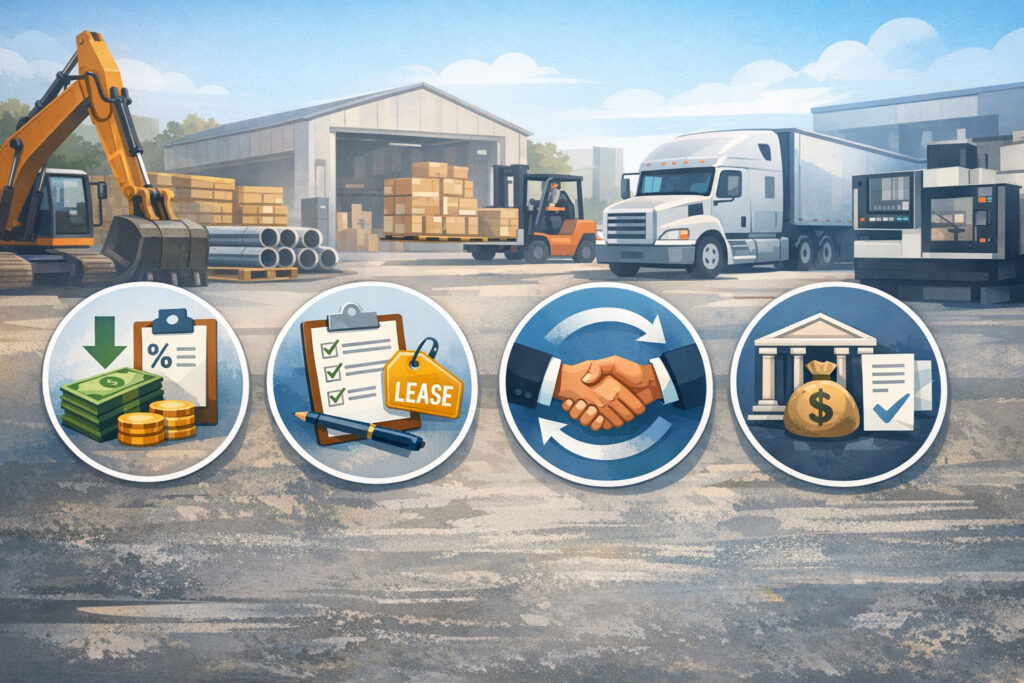
There is no single best way to finance used equipment. The right structure depends on the borrower’s credit profile, the type and age of the asset, the size of the transaction, and how the equipment will be used.
Understanding the main used equipment financing options can help borrowers narrow their choices and ask better questions before signing anything.
Some lenders specialize in equipment-based structures, while others use broader business lending products. In one case, a loan may be built around the resale value and expected life of a specific machine.
In another, the borrower may use general business financing to make the purchase. Each approach comes with tradeoffs involving approval standards, collateral, term length, payment structure, and total cost.
The best starting point is often to define the role of the equipment. Is it core to operations? Does it produce revenue directly? Will it still be useful in three to seven years? Does it hold value well? The answers can guide which financing route makes the most sense.
Equipment loans and pre-owned equipment loans
Equipment loans are among the most common forms of used equipment financing. In this structure, the lender finances a portion of the purchase, and the equipment often serves as collateral for used equipment loans.
Because the asset helps secure the transaction, these loans can be well suited to machinery, vehicles, and other hard assets with measurable value.
The loan term usually reflects the lender’s view of the asset’s remaining useful life. A newer used machine in strong condition may qualify for longer repayment terms than an older asset nearing the end of its service life. The better the equipment’s resale value, condition, and documentation, the more flexible the lender may be.
This route works best when the business wants ownership from the beginning. As payments are made, the borrower builds equity in the asset. Once the loan is paid off, the business owns the equipment outright, subject to the lender releasing any lien.
For many companies, that ownership matters because the equipment may remain productive long after financing ends.
Used equipment lease options and lease-to-own structures
Leasing can also be a practical path, especially when flexibility matters. Used equipment lease options may appeal to businesses that want lower initial costs, different end-of-term choices, or a structure that aligns with anticipated upgrades.
Some lease arrangements allow the business to return the equipment, renew the lease, or purchase the asset at the end.
For used assets, lease availability can vary more than it does with new equipment. Not every lessor is comfortable with older or highly specialized assets. When lease approvals are available, the terms may reflect the asset’s age, expected depreciation, and projected residual value at the end of the lease.
Lease-to-own structures can bridge the gap between renting and buying. They may allow a business to start with manageable payments while preserving the option to take ownership later. This can be useful when a company wants to test an asset in operations before committing to full ownership, though the total cost still needs careful review.
Term loans, business lines of credit, and vendor financing
Not every equipment purchase is financed through a dedicated equipment lender. Some businesses use term loans or lines of credit instead. A term loan may provide a lump sum that the borrower uses to buy the equipment, while a line of credit can help cover part or all of the purchase if the business already has approved access to funds.
These broader products may be helpful when the equipment is part of a larger capital need, such as opening a second location or expanding production.
However, because they are not always structured around the equipment itself, they can carry different collateral requirements or pricing models. Businesses should weigh whether the convenience is worth the cost.
Vendor financing is another option, especially when buying from a dealer. Some sellers work with financing partners or offer in-house arrangements. This can simplify the purchase process, but it should still be compared against outside offers. Convenience is valuable, but not if it hides higher fees, shorter terms, or restrictive conditions.
Alternative funding routes may also appear in the market, including merchant-style products or short-term financing. These can move quickly, but they are not always the best fit for equipment with a longer useful life. Matching a long-lived asset to a short-term, high-cost product can put pressure on cash flow.
How Lenders Evaluate Used Equipment and Borrowers

When reviewing used equipment financing, lenders usually evaluate two things at once: the borrower and the equipment. This dual underwriting process is one of the defining features of financing pre-owned business equipment.
A strong borrower helps the lender feel confident about repayment, while a strong asset helps support the transaction if problems arise later.
Borrower review typically includes time in business, revenue trends, bank activity, credit profile, existing debt, and overall repayment capacity.
Equipment review focuses on the make, model, age, condition, resale value, useful life, market demand, and available records. If either side of the file looks weak, the lender may reduce the approval amount, shorten the term, request a down payment, or decline the application.
Understanding this process helps businesses prepare better. It also explains why one lender may approve a deal that another lender rejects. Some are more comfortable with certain industries, asset classes, or equipment ages. Others have stricter policies around private-party sales, startups, or specialized machinery.
Lender concerns about age, condition, value, and remaining life
Lender requirements for used equipment financing often center on risk tied to the asset. Older equipment can still qualify, but the lender will usually want confidence that it can continue operating long enough to justify financing. If a machine is too old, too worn, or too difficult to value, approval can become more difficult.
Condition matters because it directly affects the likelihood of repairs, downtime, and value loss. A machine with consistent maintenance records, recent servicing, and signs of responsible ownership will often be easier to finance than a similar model with unclear history. The lender may also assess whether parts and service support are still available.
Resale value matters because it affects collateral strength. Equipment that holds value well, has strong market demand, and comes from a respected manufacturer is usually easier to finance than obscure or highly customized assets. The lender wants to know whether the asset could be recovered and sold if necessary.
How lenders assess the borrower alongside the asset
Even the best equipment does not eliminate the need for borrower review. Lenders still want evidence that the business can make payments consistently. They may review bank statements for cash flow patterns, look at revenue stability, and check whether the business has managed debt responsibly in the past.
Startups may face more scrutiny because they have limited operating history. That does not mean financing is impossible, but approvals may depend more heavily on owner credit, down payment, industry experience, or the strength of the equipment itself.
Established businesses may benefit from stronger financial records, but lenders will still watch leverage and liquidity.
Some lenders also evaluate whether the equipment purchase makes operational sense. If a small company with modest revenue wants to finance an expensive, highly specialized machine, the lender may question whether the asset fits the business’s scale.
On the other hand, a clear story about how the equipment supports growth, efficiency, or replacement needs can strengthen the application.
Documents and Requirements for Financing Pre-Owned Equipment
A well-prepared application can make a meaningful difference in used equipment financing. When documents are complete and organized, lenders can review the opportunity faster and with more confidence.
Missing or inconsistent records, on the other hand, often slow down approvals and can raise questions that might have been avoided.
The exact paperwork varies by lender, deal size, and equipment category, but most transactions require a mix of business documents and equipment-specific documents. This is because the lender is underwriting both the borrower and the asset.
Strong documentation helps them verify the purchase, assess the equipment’s value, and confirm that the business is in a position to repay.
Borrowers sometimes focus only on their financial paperwork and overlook the importance of the seller’s information or the equipment history. That can be a mistake. A lender may be ready to move forward on the borrower but still pause the file if the equipment details are incomplete or difficult to verify.
Common borrower documents lenders may request
For the borrower side of the file, lenders often request standard business and identity documents. These help confirm legal ownership, business operations, and financial stability. The required list can vary, but many businesses should be ready to provide several core items early in the process.
Common borrower documents may include:
- A completed financing application
- Business formation documents
- Ownership identification
- Recent business bank statements
- Business tax returns, when required
- Profit and loss statements or other financial statements
- Information about existing debt or obligations
- A voided business check or bank verification in some cases
For small business equipment loans for used machinery, lenders may streamline the process on lower-dollar deals, especially when the borrower has strong credit and healthy bank activity. Larger or more complex requests usually require more depth. Startups may need to provide more owner-level information if business history is limited.
It helps to prepare clean, recent, and readable records. If your statements show large unusual deposits, frequent overdrafts, or irregular transfers, be ready to explain them. Lenders care about patterns, not just snapshots.
Equipment-specific paperwork and seller information
On the equipment side, lenders want enough information to verify what is being purchased and whether it is financeable. This usually starts with a quote, invoice, or purchase agreement showing the equipment description, price, and seller details. The more complete the description, the easier it is for the lender to review.
They may also ask for the make, model, year, serial number, hours or mileage if applicable, and current condition. Maintenance records, repair logs, photos, inspection reports, and ownership history can be valuable, especially for used machinery financing and financed used commercial equipment where condition drives value. If the equipment is coming from a private seller, the lender may require additional verification steps.
Seller information matters too. A reputable dealer with clear documentation can reduce friction. A private seller with limited records may create more questions. In some cases, lenders are cautious with private-party transactions because title, condition, or pricing can be harder to verify.
Pros and Cons of Financing Used Equipment
Like any financing decision, financing used equipment comes with both advantages and tradeoffs. For many businesses, the benefits are significant.
Lower acquisition costs, faster access, and improved cash preservation can make used equipment financing a smart operational move. But those strengths do not erase the need for caution. A poor equipment choice or a weak financing structure can create problems that are expensive to fix.
The best way to think about it is this: financing can make a used asset more accessible, but it does not automatically make it a good buy. The value of the decision depends on the quality of the equipment, the terms of the financing, and how well the purchase aligns with the business’s real needs.
Businesses that approach the process carefully can often capture the upside while limiting downside risk. That means understanding not only the monthly payment, but also the maintenance reality, useful life, seller credibility, and long-term role of the asset in the company.
The biggest benefits of used equipment financing
One of the clearest benefits is lower capital strain. Used equipment typically costs less than new, and financing spreads that lower amount over time. This can make it easier to acquire essential tools without draining liquidity. For businesses that need growth equipment quickly, that can be a major advantage.
Another benefit is practical access to better-grade equipment. Instead of settling for entry-level new equipment, a business may be able to finance a well-built used machine from a respected brand. That can improve durability, performance, and support value over time. In some industries, that matters more than owning the newest version.
Used equipment financing also supports growth without waiting. Buying used equipment for business growth can help companies add capacity, replace breakdown-prone assets, or serve new customers sooner. If the equipment produces revenue or reduces downtime, the financing may support itself through improved operations.
The main drawbacks and risks to consider
The main concern is uncertainty. Used assets can come with wear, hidden issues, incomplete records, or shorter remaining life. Even when financing terms look attractive, the wrong equipment can lead to repairs, lost productivity, and disappointing resale value. That is why inspection and documentation matter so much.
Another challenge is that not all used equipment financing options are equally flexible. Some lenders impose stricter age limits, shorter terms, or larger down payments for older assets. That can affect affordability. In some cases, financing pre-owned business equipment may cost more overall than expected if the borrower focuses only on the monthly payment.
There is also the risk of mismatch. A business may finance an asset that seems affordable now but becomes expensive when maintenance, insurance, installation, and downtime are considered. Lease terms can add another layer of complexity if return conditions, purchase options, or end-of-term fees are not fully understood.
Tips to Improve Approval Odds and Avoid Costly Mistakes
A successful used equipment financing request often comes down to preparation and judgment. Lenders respond better when the application is organized, the equipment choice makes sense, and the borrower shows a clear understanding of the purchase.
Businesses improve their chances when they present a complete picture rather than treating financing as a last-minute step.
This is also the stage where common mistakes can be avoided. Many problems happen before the loan closes, not after. Overpaying for an aging machine, skipping an inspection, underestimating maintenance costs, or accepting unclear terms can turn a workable deal into a costly one. A few practical steps can prevent many of these issues.
Whether you are financing secondhand equipment for the first time or adding another asset to an established fleet, it helps to approach the deal with discipline. Think beyond approval and focus on whether the asset and financing truly fit the business.
Ways to strengthen your used equipment financing application
Lenders want confidence. You can build that confidence by reducing uncertainty wherever possible. Start with the equipment. Choose assets from known brands, with reasonable age, strong market demand, and available service support. Then gather documentation early rather than waiting to be asked.
To improve approval chances:
- Provide complete seller and equipment details upfront
- Include maintenance records or inspection reports when available
- Show stable business bank activity and healthy cash flow patterns
- Be ready to explain how the equipment supports revenue or operations
- Consider a down payment if it meaningfully improves terms
- Avoid applying for equipment that clearly exceeds business scale or needs
For startups, experience matters. If the business is new but the owners have strong industry experience, say so. Lenders often look at the whole story, not only time in business. For established borrowers, consistency helps. Clean records and a clear purpose make underwriting easier.
Mistakes that can cost more than expected
One of the biggest mistakes is overpaying. A used asset is only a good value if the price reflects its actual condition, age, market demand, and remaining life. Some buyers get attached to availability and move too quickly.
Others assume financing approval means the equipment is worth the price. That is not always true. Lenders assess financeability, not necessarily whether you negotiated well.
Another mistake is skipping inspection or due diligence. Even if the equipment appears functional, hidden mechanical issues can erase any savings. This is especially risky with used machinery financing, construction assets, and specialized commercial equipment where repair costs can be substantial.
Borrowers also get into trouble when they focus only on the payment amount and ignore the full financing cost. Fees, total repayment, down payment, maintenance, shipping, installation, taxes, and insurance all affect the real cost of the deal. Lease agreements can create confusion too if the purchase option or return obligations are not reviewed closely.
How to Compare Financing Offers for Used Equipment
Once offers start coming in, the comparison process becomes just as important as the approval process. A financing offer can look attractive on the surface because the monthly payment seems manageable, but that does not mean it is the best choice. The smartest comparison looks at structure, total cost, flexibility, and fit with the equipment’s expected life.
Different lenders may present pricing in different ways. One may emphasize speed. Another may highlight low monthly payments. Another may ask for a down payment but offer a more practical term. The challenge is to compare them on equal footing and understand what the business is actually committing to.
The same goes for sellers. The quality of the equipment source can be just as important as the financing offer. A strong lender cannot fix a bad asset, and a good asset can still become a poor deal if the financing is misaligned. Evaluating both sides together leads to better decisions.
What to look for when comparing lenders and financing structures
Start with the basics: amount financed, required down payment, repayment term, payment frequency, and total repayment. Then go deeper. Ask whether there are origination fees, documentation fees, prepayment penalties, late charges, insurance requirements, or restrictions tied to the collateral. These details shape the real cost.
Also compare how well the term matches the asset. Financing used commercial equipment over too short a period can strain cash flow. Stretching payments too long on an older asset can leave the business paying for equipment that is no longer productive. The right balance depends on the remaining useful life and the role the equipment plays in operations.
If you are reviewing used equipment lease options, pay close attention to end-of-term provisions. Can you buy the equipment, and at what price? Are there return conditions? What happens if the equipment has more wear than expected? These questions matter as much as the payment itself.
How to compare equipment sellers more effectively
Seller quality can affect both financing and long-term outcomes. An established dealer may provide clearer documentation, more accurate condition details, and better support during the transaction. A private seller may offer a lower price, but the deal can involve more uncertainty and more lender scrutiny.
Compare sellers based on transparency. Do they provide service history, inspection reports, photos, usage data, and serial number details without hesitation? Are they knowledgeable about the equipment? Are they responsive when questions come up? These are practical signs of a more reliable transaction.
Also consider whether the seller’s asking price matches the market. If the price seems high for the age and condition, get comparable listings or independent feedback. Financing an overpriced machine does not make the asset a better buy. It only spreads the overpayment over time.
For businesses looking at small business used equipment financing, choosing a transparent seller can make the entire process smoother. Better records usually mean better lender confidence, faster closing, and fewer surprises after delivery.
Frequently Asked Questions
Q.1: Can you finance used equipment for a new business?
Answer: Yes, in many cases a new business can qualify for used equipment financing, but the review may be more detailed. Because the company has limited operating history, lenders often place more weight on owner credit, industry experience, down payment, and the quality of the equipment itself.
A startup buying a practical, revenue-supporting asset with clear documentation may have a better chance than one trying to finance a highly specialized or aging machine.
The stronger the application story, the better. Show how the equipment fits the business model, how it will be used, and why the purchase amount is reasonable. Complete documentation can make a meaningful difference.
Q.2: Is used equipment financing harder to get than new equipment financing?
Answer: It can be. Financing used equipment often involves more asset-related questions because lenders want to understand condition, age, resale value, maintenance history, and remaining useful life. New equipment usually comes with fewer unknowns, so underwriting may be more straightforward.
That said, used equipment loans for businesses are common, and many lenders actively work in this space. Approval often depends on the specific equipment, the borrower profile, and how complete the documentation is.
Q.3: What types of equipment are commonly financed as used assets?
Answer: Many categories can qualify, including construction equipment, manufacturing machinery, work vehicles, agricultural tools, restaurant equipment, retail systems, medical devices, warehouse equipment, and specialized commercial assets.
Approval depends on how well the lender understands the category and whether the equipment has enough useful life and collateral value.
Some assets are easier to finance because they have strong resale demand and established valuation data. Highly customized or niche equipment may require more review.
Q.4: Do lenders require a down payment on used equipment financing?
Answer: Sometimes. A down payment may be required based on the borrower’s credit profile, time in business, the age of the equipment, the deal size, or the lender’s collateral comfort. Newer used assets with stronger value may qualify with less money down than older or harder-to-value equipment.
Even when a down payment is not required, offering one may improve the overall structure. It can reduce the amount financed, strengthen the collateral position, and sometimes help produce better terms.
Q.5: What documents are usually needed for financing pre-owned business equipment?
Answer: Borrowers are often asked for an equipment quote or invoice, seller information, equipment details, recent business bank statements, ownership identification, and business formation documents.
Depending on the lender and deal size, tax returns, financial statements, maintenance records, inspection reports, and photos may also be requested.
The exact list varies, but the general rule is simple: the lender wants to understand both the borrower and the asset. The more complete your file, the smoother the process tends to be.
Q.6: Is a lease better than a loan for used equipment?
Answer: It depends on the business goal. A loan may be the better fit when ownership matters and the equipment is expected to remain useful well beyond the financing term. A lease may appeal to businesses that want flexibility, lower initial costs, or an option to upgrade later.
The most important step is comparing total cost and terms. Used equipment lease options can be helpful, but they should be reviewed carefully for purchase options, return conditions, and end-of-term responsibilities.
Q.7: How can a business avoid overpaying for used equipment?
Answer: Start with research. Compare similar assets based on age, brand, condition, hours, mileage, and service history. Ask for maintenance records, inspection details, and current photos. If the equipment is expensive or highly specialized, consider an independent inspection or valuation review before moving forward.
A financing approval does not guarantee that the purchase price is fair. Buyers still need to assess whether the asset is priced appropriately for its condition and remaining life.
Conclusion
Financing used equipment can be a smart, practical move for businesses that want to preserve cash, expand capacity, replace aging assets, or respond quickly to operational needs. It gives companies a way to access essential tools, vehicles, machinery, and systems without paying the full cost upfront.
When the equipment is chosen carefully and the financing is structured well, the decision can support growth without putting unnecessary strain on working capital.
The key is to treat the process as more than a search for approval. A good outcome depends on the quality of the equipment, the strength of the documentation, the credibility of the seller, and the fit between the financing term and the asset’s remaining useful life. Lenders will evaluate both the borrower and the equipment, so the most successful applicants prepare both sides of the file with care.
Before moving forward, take time to compare used equipment financing options, review total cost instead of only monthly payment, and verify that the asset will continue delivering value throughout the financing term.
Businesses that do their homework are better positioned to avoid common mistakes, improve approval chances, and choose a financing path that supports operations with confidence.