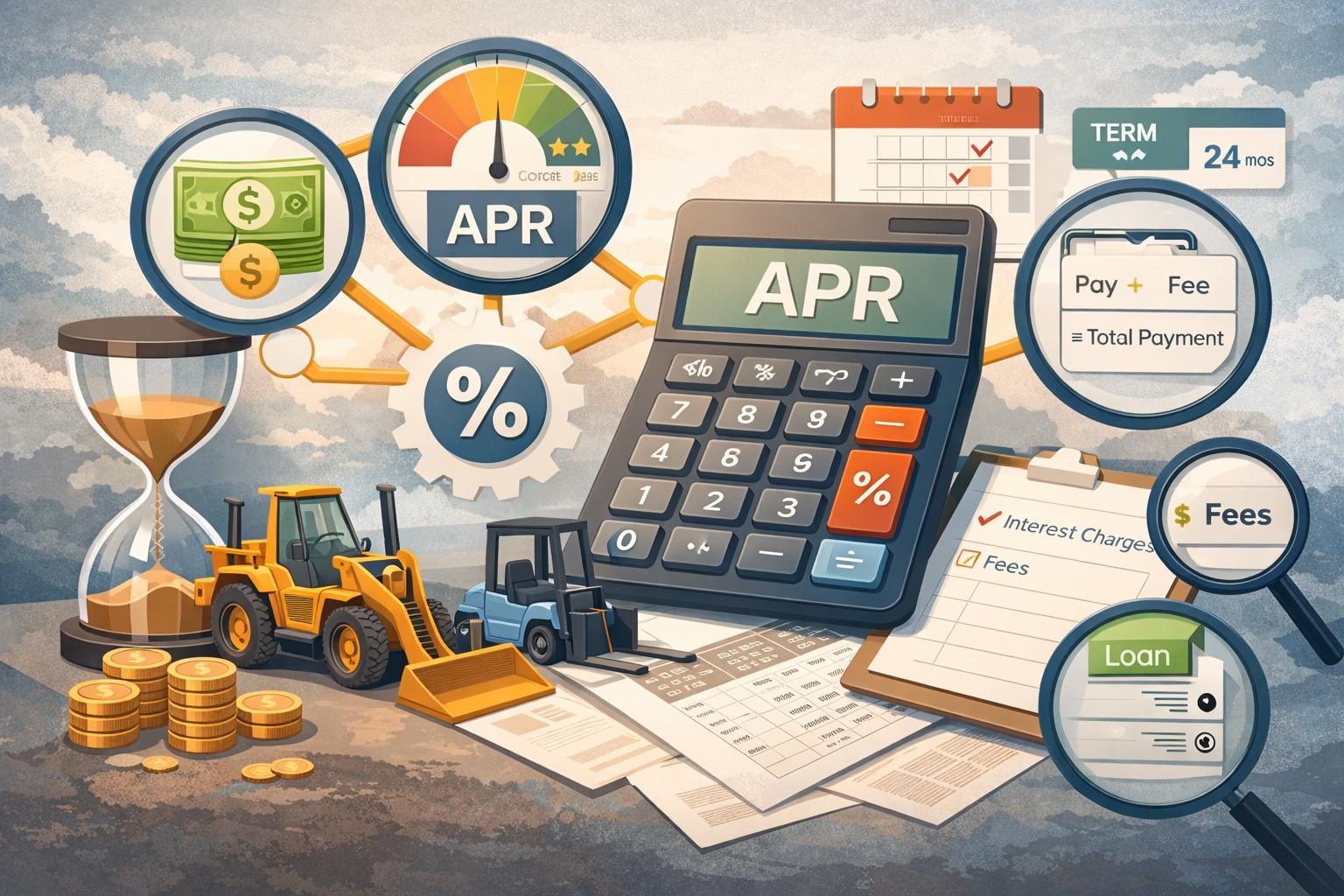
How APR Is Calculated for Equipment Loans
APR for equipment loans is the most useful “apples-to-apples” number you can use to compare offers, because it reflects not only the stated interest rate, but also many of the lender-required costs that come with borrowing.
When you finance a truck, restaurant oven, CNC machine, medical imaging device, or construction equipment, the monthly payment you see is shaped by several moving parts: the principal amount financed, the interest rate, the term, the payment timing, and the fees that are charged upfront or rolled into the balance. APR for equipment loans turns those moving parts into a standardized annualized cost.
It’s easy to assume APR is just the interest rate with a little extra. In reality, APR for equipment loans is usually calculated as an annualized rate that makes the present value of your payments equal to the amount you actually receive (or the amount that is truly “financed” after certain prepaid charges).
That’s why two loans with the same interest rate can produce different APRs if one has a higher origination fee or requires specific add-on charges. It’s also why short-term equipment financing can show a larger gap between interest rate and APR for equipment loans than long-term financing, since fees are spread over fewer months.
This guide explains how APR for equipment loans is calculated, what gets included (and what usually doesn’t), and how to estimate APR using real-world steps so you can compare offers with confidence and avoid surprises.
APR for Equipment Loans vs. Interest Rate: What You’re Actually Measuring

APR for equipment loans is often confused with the nominal interest rate (sometimes called the “note rate”). The interest rate is the percentage charged on the outstanding principal balance, and it primarily determines the interest portion of each payment.
APR for equipment loans, on the other hand, is designed to represent the total borrowing cost expressed as a yearly rate, including certain lender-required finance charges.
Here’s the key idea: the interest rate describes the price of money over time, while APR for equipment loans describes the price of money plus many of the costs required to access that money.
If you borrow $100,000 at 10% for five years with no fees, the APR for equipment loans will be close to the rate. If you borrow the same $100,000 at 10% but pay a 3% origination fee upfront, your APR for equipment loans rises because you’re effectively receiving less net proceeds while still making payments based on the financed amount.
APR for equipment loans is also sensitive to timing. Paying fees at closing increases APR more than rolling fees into the loan, because the “amount financed” is reduced at the start. Likewise, weekly or daily payments can change the effective annual cost compared with monthly payments, even when a lender advertises a similar nominal rate.
That’s why APR for equipment loans is a better comparison metric than “payment only,” especially when one lender quotes monthly payments and another quotes weekly auto-debits.
If you want to compare multiple equipment financing options—bank term loan, SBA-style structure, captive financing, or online lender—APR for equipment loans gives you a standardized lens that captures fees and timing, not just the headline rate.
The Building Blocks Used to Calculate APR for Equipment Loans
To understand APR for equipment loans, you need to understand what goes into the calculation. APR is not a single input; it’s the output of a model that uses your cash flows. Put simply, APR for equipment loans is derived from: (1) how much money you get at the start, (2) how much you pay back, and (3) when you pay it.
Most APR for equipment loans calculations rely on these components:
- Amount financed (net proceeds): The effective loan amount after certain prepaid finance charges are deducted. If you sign for $100,000 but pay a $3,000 origination fee at closing, the amount financed may be closer to $97,000, depending on how fees are treated.
- Finance charges included in APR: Many lender fees that are required as a condition of getting the loan can be included as finance charges. This is where APR for equipment loans differs from interest rate.
- Payment schedule: Monthly, weekly, or daily payments change the math. Earlier and more frequent payments usually raise the effective cost, which can raise APR for equipment loans.
- Term length: Fees matter more in short terms because they are spread over fewer payments. A 2% fee on a 12-month equipment loan can increase APR for equipment loans meaningfully compared to the same fee on a 72-month term.
- Amortization method: Fully amortizing, balloon payments, seasonal structures, or step-up payments all affect APR for equipment loans because they change the time-weighted cost.
In practice, APR for equipment loans is the single annual rate that makes the present value of the payment stream match the amount financed. That’s why two “10% loans” can have very different APRs when fee structures and timing differ.
Which Fees Commonly Affect APR for Equipment Loans (and Which Usually Don’t)
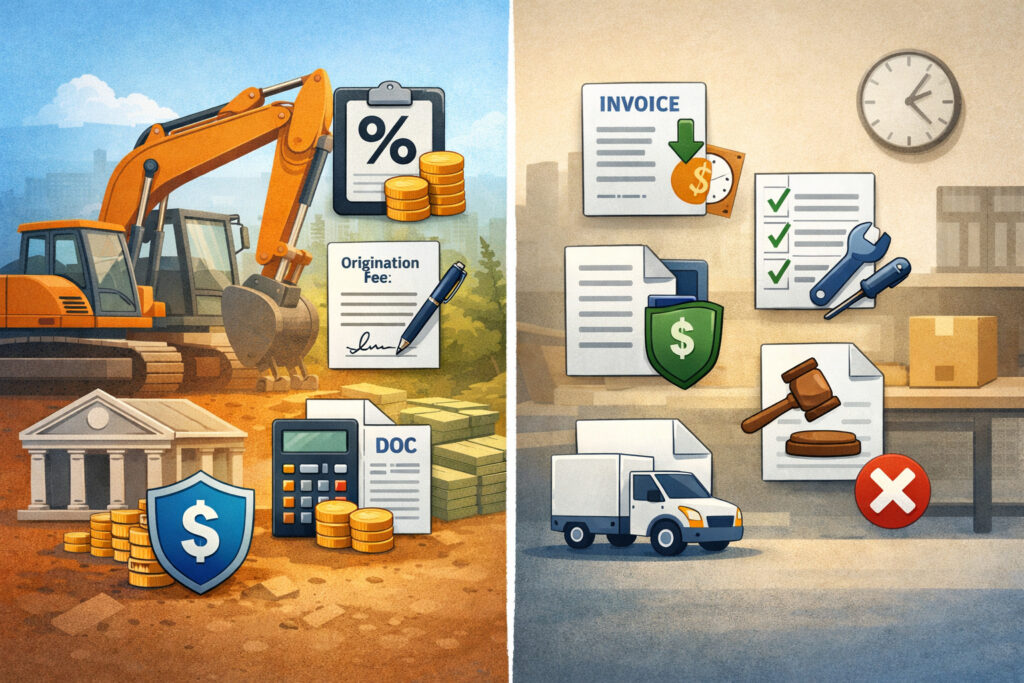
A major reason APR for equipment loans varies across lenders is how fees are charged and whether they are lender-required finance charges. While exact disclosure rules can vary by product type and borrower profile, the core concept remains: APR for equipment loans generally includes costs that are required to obtain financing and are paid to the lender or arranged through the lender as part of the credit.
Fees and charges that often influence APR for equipment loans include:
- Origination or underwriting fees: Often a percentage of the loan amount. Paid upfront, they raise APR for equipment loans because you receive less net funding.
- Documentation or admin fees: Fixed dollar fees may look small, but on smaller equipment loans they can meaningfully increase APR.
- Lender-arranged closing fees: If the lender requires and arranges certain services and the cost is tied to making the loan, it can affect APR for equipment loans.
- Prepaid interest: If interest is collected at closing, it changes the net amount financed and increases APR for equipment loans.
- Certain broker fees: If a broker fee is required as part of obtaining the credit and is financed or paid from proceeds, it can raise APR for equipment loans.
Items that often do not count toward APR for equipment loans (or are not always included) include:
- Late fees and default charges: These are contingent, not guaranteed, so they typically aren’t part of APR for equipment loans.
- Optional add-ons: If truly optional (like voluntary warranties or optional maintenance plans not required for approval), they usually should not be part of APR.
- Third-party costs not required by the lender: For example, a service you choose independently.
- Insurance you can shop for: If insurance is required but you can choose the provider and the lender doesn’t retain the cost, the treatment can vary by structure.
The practical takeaway: when comparing offers, ask for a breakdown of what is deducted from proceeds, what is financed, and what is required. APR for equipment loans rises most when required fees are taken out upfront.
The Core Math: How APR for Equipment Loans Is Derived From Cash Flows
APR for equipment loans is typically derived by solving for the annual rate that equates the present value of your payments to the amount financed. This is closely related to an “internal rate of return” concept.
You don’t usually calculate APR by hand with a simple one-line formula, because payment schedules and fee timing complicate the math. Instead, APR for equipment loans is the rate that satisfies this relationship:
- You receive a lump sum at the start (net of prepaid finance charges).
- You repay a stream of payments over time (monthly, weekly, etc.).
- The APR is the annualized discount rate that makes those two sides equal.
Present Value Intuition (Why Timing Changes APR for Equipment Loans)
Timing is everything. If you pay the same total dollars but pay sooner, the effective cost rises. That’s why weekly payments can produce higher APR for equipment loans than monthly payments with the same nominal rate.
You are returning principal faster, so the lender has less money “out” for a shorter time, yet still collects similar finance charges. Also, fees charged at closing raise APR for equipment loans because they reduce the net amount you receive on day one.
For example, if a lender advertises “10% interest,” but takes 3% upfront, you are effectively paying interest on money you didn’t get. APR for equipment loans captures that effect by treating the upfront fee as part of the finance charge and reducing the amount financed.
If you’ve ever wondered why two lenders can show the same payment but different APR for equipment loans, it’s usually because of this cash-flow math. APR is not “what you pay” alone; it is “what you pay, relative to what you received, adjusted for time.”
Step-by-Step: A Practical Way to Estimate APR for Equipment Loans
You can estimate APR for equipment loans without advanced math by organizing the deal into cash flows and using a spreadsheet-style approach. Even if you don’t solve the exact APR yourself, doing these steps will help you compare lenders and catch hidden cost drivers.
Step 1: Identify the net amount you receive
Start with the approved loan amount. Subtract any fees taken from proceeds (origination, doc fee, prepaid interest). Add any fees that are financed into the balance instead of paid upfront. The result is the amount that truly reaches your business or the equipment vendor.
Step 2: List every required payment and its date
Write down the payment amount, frequency, and number of payments. Monthly payments for 60 months is straightforward; weekly payments for 156 weeks is different. Payment timing affects APR for equipment loans.
Step 3: Confirm whether there is a balloon or residual
Some equipment loans have balloon payments. That large final payment can materially shift APR for equipment loans because it changes how much principal is outstanding across the term.
Step 4: Compare the “total of payments” to the net amount financed
This won’t give you APR directly, but it reveals whether fees are the big driver. If total payments are only slightly above principal, APR for equipment loans is likely close to the note rate. If total payments are much higher, something (rate, term structure, or fees) is driving the cost.
Step 5: Use an APR/IRR function (or ask the lender for a standardized APR disclosure)
APR for equipment loans is typically computed with a standardized method. If you use a spreadsheet, the goal is to find the annual rate that makes the present value of all payments equal to the net amount financed.
Even if you don’t compute the exact APR, this process forces clarity: “How much money did I actually get?” and “When did I pay it back?” Those two questions are the heart of APR for equipment loans.
Example Scenario: Why Fees Can Raise APR for Equipment Loans More Than You Expect
A clear example helps show how APR for equipment loans behaves. Suppose two lenders offer the same equipment loan size and same nominal interest rate, but different fee structures.
- Equipment loan amount: $80,000
- Term: 60 months
- Nominal interest rate: 10%
- Lender A: 0% origination fee
- Lender B: 3% origination fee deducted from proceeds ($2,400)
With Lender A, you receive close to the full $80,000 (ignoring minor third-party items). Payments are based on $80,000 at 10% over 60 months. APR for equipment loans should be close to 10%, because there’s little difference between what you receive and what you repay.
With Lender B, you sign for $80,000 but only receive about $77,600 after the $2,400 fee is deducted. Yet your monthly payment is still calculated using the $80,000 principal. That gap increases APR for equipment loans because the same payment stream is now “more expensive” relative to the net proceeds.
This is why smaller equipment loans are especially sensitive to fixed fees. A $500 documentation fee on a $15,000 equipment loan can move APR for equipment loans noticeably. It’s not that the fee is huge in dollars; it’s huge compared with the amount financed.
When you compare offers, don’t just compare monthly payments. Compare APR for equipment loans and net proceeds. If two offers have similar APR for equipment loans but one gives you more net funding, that can be the better value.
Payment Frequency and APR for Equipment Loans: Monthly vs. Weekly vs. Daily
Many equipment lenders now offer weekly or even daily repayment via ACH auto-debit. This can be convenient and may align with cash flow for high-velocity businesses. But it also changes how APR for equipment loans behaves.
With more frequent payments, principal is returned faster. If the lender’s pricing model results in similar total finance charges, the effective annualized cost rises, which can increase APR for equipment loans.
This is especially noticeable when the lender quotes a “simple interest” or “flat rate” and collects payments frequently. Even if the nominal rate seems competitive, the time-weighted cost can be higher.
Monthly amortization is the most common baseline for comparison because it’s how many traditional term loans are structured. Weekly payments can still be fair, but you should insist on seeing APR for equipment loans using the actual payment schedule.
A “10% rate” quoted with weekly payments can yield a different APR than the same “10% rate” quoted with monthly payments, depending on how interest is calculated and how fees are applied.
If you’re choosing between monthly and weekly, focus on these questions:
- Is the APR for equipment loans calculated using the exact payment frequency?
- Are fees deducted upfront or financed?
- Is interest calculated on a declining balance or on the original principal (“flat”)?
- Is there a prepayment penalty that limits your ability to reduce interest cost?
APR for equipment loans is sensitive to payment timing. That’s not a trick—it’s math. Understanding it helps you choose a repayment structure that fits both your budget and your real cost of capital.
Amortization, Simple Interest, and “Flat Rate” Pricing in Equipment Financing
APR for equipment loans depends on how interest is computed. Many traditional equipment loans use simple interest on a declining balance with amortized payments. In that structure, each payment includes interest on the current outstanding principal plus principal reduction. Over time, interest decreases and principal increases.
However, some financing offers use “flat rate” language or present pricing as a factor or a total payback amount. In a flat-rate style, interest can be calculated on the original principal for the entire term, regardless of how quickly the principal is repaid. That can cause APR for equipment loans to be significantly higher than what the headline “rate” suggests.
Here’s why: if you pay principal down each month but interest is still charged as if the full principal is outstanding, the time-weighted cost is higher. APR for equipment loans is designed to reveal that difference by annualizing the effective cost based on actual cash flows.
Amortization also matters when there is a balloon payment. A balloon keeps principal outstanding longer, which can shift the distribution of interest and affect APR for equipment loans. In some cases a balloon can lower the monthly payment but raise overall borrowing cost if it changes the fee or pricing structure.
If an offer doesn’t clearly state whether interest accrues on a declining balance, request a repayment schedule. Then compare the disclosed APR for equipment loans, not just the nominal rate or total payback. Transparent amortization is one of the easiest ways to ensure you’re evaluating equipment financing fairly.
Prepayment and APR for Equipment Loans: When Paying Early Helps (and When It Doesn’t)
Many business owners assume paying off early automatically lowers borrowing cost. That’s often true with simple-interest, declining-balance equipment loans—because you reduce the time principal is outstanding. But it is not always true, and the difference matters when you evaluate APR for equipment loans.
If the loan uses a true amortization model with no prepayment penalty, paying early typically reduces total interest paid. Your realized cost may end up lower than the original APR for equipment loans, because APR assumes you follow the scheduled payments.
But there are common situations where paying early does not reduce cost much:
- Precomputed or flat pricing: If the finance charge is effectively fixed, paying early may not save interest proportional to time.
- Minimum interest clauses: Some contracts require a minimum amount of interest, especially early in the term.
- Prepayment penalties: A penalty can offset interest savings.
- “Rule of 78s” or similar allocation methods: These front-load finance charges, reducing savings from early payoff.
This is why APR for equipment loans is a starting point, not the whole story. APR helps compare offers under the assumption that you follow the schedule.
If your plan is to refinance, sell the equipment, or pay off early once cash flow improves, then you should evaluate the early payoff terms and estimate your “effective APR for equipment loans” under your expected payoff timeline.
Always ask for: (1) payoff quote methodology, (2) any prepayment penalty, and (3) whether interest is calculated daily on a declining balance. Those answers determine whether early payoff reduces your real cost.
Equipment Loans vs. Equipment Leases: How “APR for Equipment Loans” Translates
Many businesses shop equipment loans and equipment leases side by side. A lease can look cheaper on a payment basis, while a loan can build ownership faster. The challenge is that “APR for equipment loans” is a standardized concept, but leases often quote money factors, implicit rates, or total rent charges instead of APR.
Still, you can translate many lease structures into an APR-like measure by treating the lease payments as cash flows and solving for an implied rate. This is particularly useful for:
- Capital leases (finance leases) where ownership or a bargain purchase option is likely.
- $1 buyout leases that behave very similarly to a loan.
- TRAC leases for vehicles, which include residual value assumptions.
APR for equipment loans is most straightforward when you have a principal amount and interest rate. With leases, the “amount financed” can be less explicit because the lessor retains ownership and may be using residual value to price the deal.
But the economics still reflect a time value of money: you get use of the equipment now and make payments over time.
When comparing a lease and a loan, don’t rely solely on the monthly payment. Compare: total payments, end-of-term ownership cost, residual/buyout terms, and an implied APR for equipment loans calculation based on cash flows. That approach prevents you from choosing a low payment option that ends up being a higher effective cost.
Credit Profile, Collateral, and Market Conditions: What Drives APR for Equipment Loans
APR for equipment loans is not just math—it’s pricing. Lenders set interest rates and fees based on risk and operating costs. Then APR aggregates those into a comparable number. Understanding pricing drivers can help you negotiate.
Key factors that influence APR for equipment loans include:
- Time in business and cash flow consistency: Stronger, predictable cash flow often earns lower APR for equipment loans.
- Credit history: Both business and owner credit can impact pricing, depending on the lender and the deal size.
- Loan-to-value (LTV): Financing 100% of equipment cost (including installation, shipping, and tax) can increase APR for equipment loans compared to a lower LTV request.
- Equipment type and resale value: Assets with strong secondary markets (like certain vehicles or standardized machinery) can reduce risk and improve APR for equipment loans.
- Term length: Longer terms can reduce monthly payments but may increase total interest paid. APR can go up or down depending on how the lender structures fees.
- Industry volatility: Some industries face higher risk policies, which can affect approvals, fees, and APR for equipment loans.
- Rate environment: When benchmark rates rise, lenders’ cost of funds rises, and APR for equipment loans can trend upward.
Fees are also influenced by the lender process. A lender with high-touch underwriting may charge higher origination or documentation fees. A lender with automated underwriting may reduce some fees but adjust pricing through rate.
APR for equipment loans captures both approaches, which is why it’s the best single number to compare offers—provided it’s calculated on the exact same assumptions and payment schedule.
Common APR Traps in Equipment Financing (and How to Avoid Them)
Because APR for equipment loans is meant to standardize costs, it’s tempting to assume every offer is presented consistently. In reality, the biggest “APR traps” happen when offers are not apples-to-apples.
One trap is comparing interest rate on one offer to APR for equipment loans on another. Always compare APR to APR, not rate to APR. Another trap is ignoring fee timing.
A fee deducted from proceeds increases APR for equipment loans more than the same fee that is financed into the balance. Also watch for offers that quote “as low as” APR without stating the credit tier assumptions.
Payment frequency is another common pitfall. Weekly payments can look smaller per payment but may raise APR for equipment loans if pricing doesn’t adjust fairly. Similarly, some offers quote a flat “factor rate” or total payback that isn’t directly comparable to APR.
If you can’t get a clear APR for equipment loans disclosure, you should request a full schedule of payments and a breakdown of fees so you can compute an implied APR.
Finally, prepayment terms matter. A deal might show a competitive APR for equipment loans under full-term repayment, but if there’s a minimum interest clause or prepayment penalty, your effective cost for an early payoff strategy can be much higher.
To avoid these traps, insist on: net proceeds, itemized fees, payment schedule, payoff policy, and the disclosed APR for equipment loans based on actual payment timing.
Future Outlook: How APR for Equipment Loans May Evolve in the Next Few Years
APR for equipment loans is likely to become more transparent and more “real time” as underwriting and payments become increasingly automated. More lenders are embedding financing at the point of sale through equipment dealers and software platforms, which can reduce friction but can also introduce complexity in how fees are bundled.
As this continues, borrowers will benefit from clearer, standardized APR for equipment loans disclosures that reflect the true net proceeds and exact repayment schedule.
Another trend is risk-based pricing that updates faster. As lenders use more data—bank transaction data, invoicing signals, equipment utilization, and cash flow forecasting—APR for equipment loans may vary more precisely by business performance rather than relying heavily on broad score tiers.
That can be good for strong operators who previously fell into generic pricing buckets. It can also mean APR changes more quickly when revenue trends shift.
Payment rails may also influence APR for equipment loans. As instant payment systems and improved ACH tooling reduce servicing costs and payment failures, some lenders may reduce certain fees. At the same time, faster repayment options (weekly/daily) will continue to require careful APR comparisons because timing will always affect annualized cost.
Finally, competitive pressure is likely to push toward more borrower-friendly comparison tools: clearer APR for equipment loans explanations, standardized worksheets, and offer summaries that separate true finance charges from optional services.
The borrowers who win will be the ones who consistently compare APR for equipment loans alongside net proceeds and payoff flexibility—not just the monthly payment.
FAQs
Q.1: What is the simplest explanation of APR for equipment loans?
Answer: APR for equipment loans is the annualized cost of borrowing that includes the interest rate plus many lender-required fees, expressed as a single percentage. Think of it as the “true yearly price” of the loan when you account for what you actually receive upfront and how you repay over time.
If you sign for a certain amount but fees are deducted from the proceeds, APR for equipment loans rises because you’re repaying the loan as if you received more than you actually did. APR also reflects payment timing, so weekly payments can produce a different APR than monthly payments even with similar advertised rates.
The reason borrowers rely on APR for equipment loans is comparability: it helps you evaluate two offers that use different fee structures, payment schedules, or rate presentations.
For the cleanest comparison, make sure the APR for equipment loans you’re comparing is calculated on the exact same assumptions: same term, same payment frequency, same financed amount, and the same treatment of upfront charges.
Q.2: Why can APR for equipment loans be higher than the interest rate?
Answer: APR for equipment loans can be higher than the interest rate because APR includes certain finance charges beyond interest. The most common reason is fees.
If you pay an origination fee, documentation fee, or underwriting fee, and especially if that fee is deducted from your proceeds at closing, you receive less cash than the loan amount but still repay based on the larger balance.
That difference increases APR for equipment loans. Another reason is payment frequency. Weekly payments change the time value of money by returning principal faster, which can shift the effective annualized cost.
In addition, some pricing methods—like flat-rate structures—can create a bigger gap between interest rate and APR for equipment loans because the stated rate doesn’t reflect how interest is actually applied over time.
If you want to reduce APR, negotiate fees, choose fair amortization, and confirm that interest accrues on a declining balance with no hidden minimum interest or payoff penalties.
Q.3: Do all equipment lenders calculate APR for equipment loans the same way?
Answer: Not always. Many lenders follow standardized disclosure methods for APR for equipment loans, but differences still appear based on product type, borrower type, and what the lender treats as a finance charge.
Some offers—especially those that look more like merchant-style financing or use factor-rate language—may not present APR clearly or may present an estimated APR that assumes certain payment timing.
Even when APR is disclosed, the exact inclusions can vary if fees are optional versus required, or if third-party charges are independent versus lender-arranged. That’s why it’s smart to request an itemized breakdown: net proceeds, all fees (and whether they’re required), payment schedule, and payoff terms.
If you can’t get a clear APR for equipment loans disclosure, you can still compare offers by translating cash flows into an implied APR using the net funding amount and the exact payment stream. Consistency is the goal: compare APR for equipment loans only when the underlying assumptions match.
Q.4: Does a longer term always reduce APR for equipment loans?
Answer: A longer term often reduces the payment, but it does not always reduce APR for equipment loans. APR is influenced by both interest rate and fee structure.
If fees are fixed, spreading them across a longer term can reduce their impact on APR for equipment loans because the upfront cost becomes smaller relative to the time horizon. However, longer terms can also increase total interest, and some lenders price longer terms at higher rates to compensate for risk.
In those cases, APR for equipment loans may stay the same or even rise. Also, balloon structures can distort the picture: a balloon can lower the monthly payment but not necessarily lower APR if pricing or fees change.
The best approach is to compare multiple term options side by side: look at APR for equipment loans, total of payments, and your expected usage life of the equipment. A term that matches the equipment’s productive life can be financially safer even if APR is slightly higher.
Q.5: How do down payments and trade-ins affect APR for equipment loans?
Answer: A down payment often reduces APR for equipment loans because it lowers the amount you need to finance, which can reduce lender risk and improve pricing. With a lower financed balance, you may qualify for a better rate or lower fees, and the finance charges represent a smaller portion of the deal.
Trade-ins can have a similar effect by reducing the net purchase price. However, the impact on APR for equipment loans depends on how the transaction is structured. If the lender charges the same fixed fees regardless of loan size, a smaller loan can sometimes show a slightly higher APR because fees represent a larger percentage of the amount financed.
That’s why it’s important to review net proceeds and itemized charges. In general, though, strong equity—through down payment or trade-in—improves approval odds and can lead to better terms, including a more favorable APR for equipment loans, especially for higher-ticket equipment where lenders have room to negotiate.
Q.6: Can I rely only on APR for equipment loans to choose the best offer?
Answer: APR for equipment loans is the best single comparison metric, but it shouldn’t be the only one. APR assumes you follow the scheduled repayment timeline, so if you plan to pay off early, refinance, or sell the equipment, your realized cost can be different—sometimes much different—depending on prepayment penalties, minimum interest clauses, or flat pricing.
You also need to consider operational factors: speed of funding, documentation requirements, whether the lender pays the vendor directly, and whether the loan requires liens beyond the equipment. Two offers could have similar APR for equipment loans, but one could have more flexible payoff terms, better customer support, or fewer restrictive covenants.
A smart selection process uses APR for equipment loans as the foundation, then checks net proceeds, total payment amount, payoff policy, and any required add-ons. When APR is paired with these practical checks, you can choose the offer that is both affordable and operationally workable.
Conclusion
APR for equipment loans exists to simplify a complicated reality: equipment financing can include interest, upfront fees, different payment schedules, and different amortization methods.
APR pulls those parts into a single annualized cost number so you can compare offers fairly. But APR only helps when you understand what it reflects—net proceeds, lender-required finance charges, and the timing of payments.
To evaluate an offer, focus on three things: the net amount you actually receive, the full payment schedule (including frequency and any balloon), and the payoff terms if you might exit early. Then use APR for equipment loans as your main comparison metric across lenders.
If one offer has a slightly lower APR but much stricter payoff rules, the “cheaper” loan can become expensive in real life. If another offer has a higher APR but gives you more flexibility and stronger cash flow alignment, it may be the better business decision.