
Long-Term Financial Planning for Equipment Upgrades
Long-term financial planning for equipment upgrades is one of the most practical ways to protect cash flow, avoid surprise breakdown costs, and keep operations competitive without overextending your balance sheet. Equipment doesn’t just “wear out.”
It becomes less efficient, harder to service, less secure, and sometimes incompatible with new software, compliance rules, or customer expectations. When businesses treat upgrades as emergency purchases, they usually pay more—higher financing costs, rush shipping, overtime labor, and missed revenue during downtime.
The goal of long-term financial planning for equipment upgrades is to move from reactive spending to intentional investing. That means building a multi-year roadmap, estimating total cost of ownership, comparing financing choices, and aligning tax timing with operational priorities.
It also means planning for uncertainty—interest-rate swings, supply chain disruptions, inflation, and new technology cycles—so upgrades happen on your schedule, not when a critical asset fails.
This guide walks you through long-term financial planning for equipment upgrades with a practical, step-by-step approach. You’ll learn how to create an upgrade calendar, calculate ROI and payback, choose funding strategies, manage accounting impacts, and build a future-ready plan that supports growth.
Why long-term financial planning for equipment upgrades is a competitive advantage
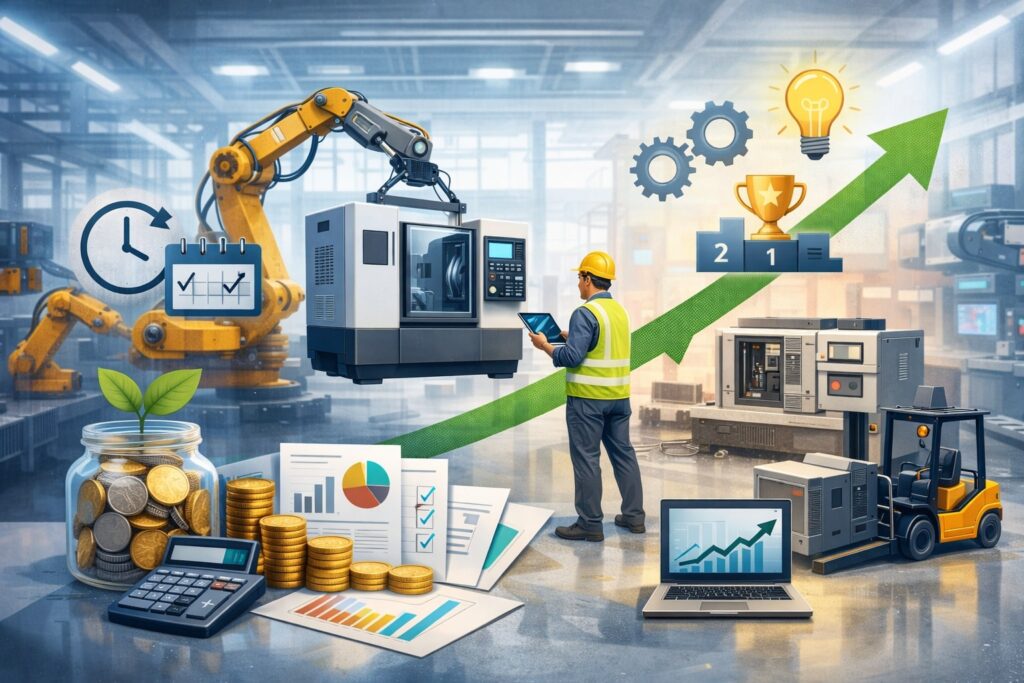
Long-term financial planning for equipment upgrades is not just “budgeting.” It’s a strategic system that connects operations, finance, and growth. When you plan upgrades across a 3–10 year horizon, you can reduce downtime, improve productivity, and negotiate better pricing because you’re not buying under pressure.
This planning approach also gives leadership clearer visibility into capital needs, which improves lender confidence and helps you maintain healthy working capital.
A major advantage is cost control. Planned upgrades reduce the “hidden costs” that don’t show up on the invoice—production delays, quality issues, excess energy consumption, maintenance spikes, or customer churn caused by slow service.
If your equipment touches customer experience (POS systems, printers, packaging, manufacturing lines, delivery tools), long-term financial planning for equipment upgrades becomes directly tied to retention and brand reputation.
Another advantage is financing flexibility. With lead time, you can compare multiple financing structures (term loans, leases, vendor programs) and optimize total cost. You can also time purchases to align with expected rate trends.
Recent reporting on equipment financing activity and rate expectations highlights how interest-rate environments can shape equipment demand and financing conditions.
Finally, long-term financial planning for equipment upgrades supports resilience. You build reserves, diversify vendors, and create a replacement strategy that prevents one failure from becoming a business interruption event. Over time, this turns equipment from a constant stressor into a controlled, predictable investment cycle.
Build an equipment inventory and lifecycle roadmap that your budget can trust
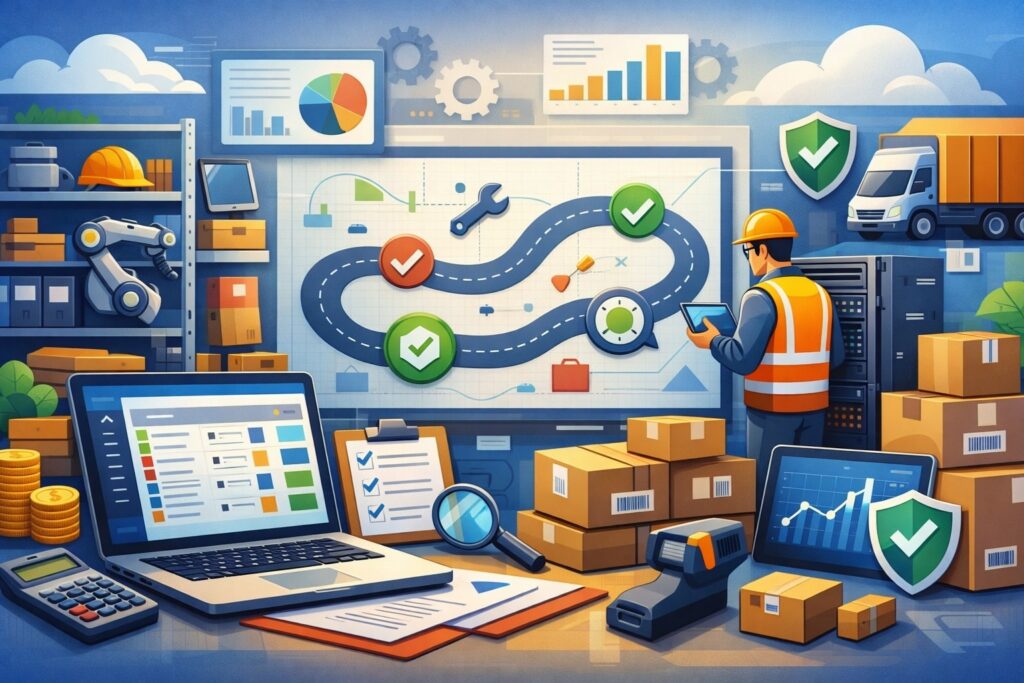
A strong long-term financial planning for equipment upgrades process starts with an equipment inventory that is more detailed than an asset list for taxes.
You want a “decision-grade” inventory: what you own, what it does, what condition it’s in, what it costs to operate, and what happens if it fails. Without this foundation, upgrade planning becomes guesswork.
Start by listing every mission-critical asset and grouping by function—production, fulfillment, IT, customer-facing tools, vehicles, and safety systems.
For each item, capture: purchase date, original cost, current utilization, maintenance history, downtime incidents, warranty status, and replacement lead time. Add a simple risk score based on failure impact. A POS terminal failure might slow checkout; a packaging line failure might stop shipments entirely.
Next, assign a lifecycle category:
- Keep (optimize): reliable, efficient, supported by vendors.
- Repair (short-term): acceptable now, but trending upward in maintenance cost.
- Replace (planned): near end-of-life, obsolete, or insecure.
- Retire (immediate): high risk, unsupported, or too costly to maintain.
Then build a replacement roadmap across multiple years. Long-term financial planning for equipment upgrades works best when you stagger upgrades instead of clustering them in one expensive year. A staggered plan also reduces training burden, implementation disruption, and the chance you’ll over-finance at the wrong time.
Finally, validate your roadmap with operations leaders. Finance can estimate numbers, but only operators can tell you what “can’t go down.” This alignment is what makes long-term financial planning for equipment upgrades actionable instead of theoretical.
Calculate total cost of ownership and ROI the right way
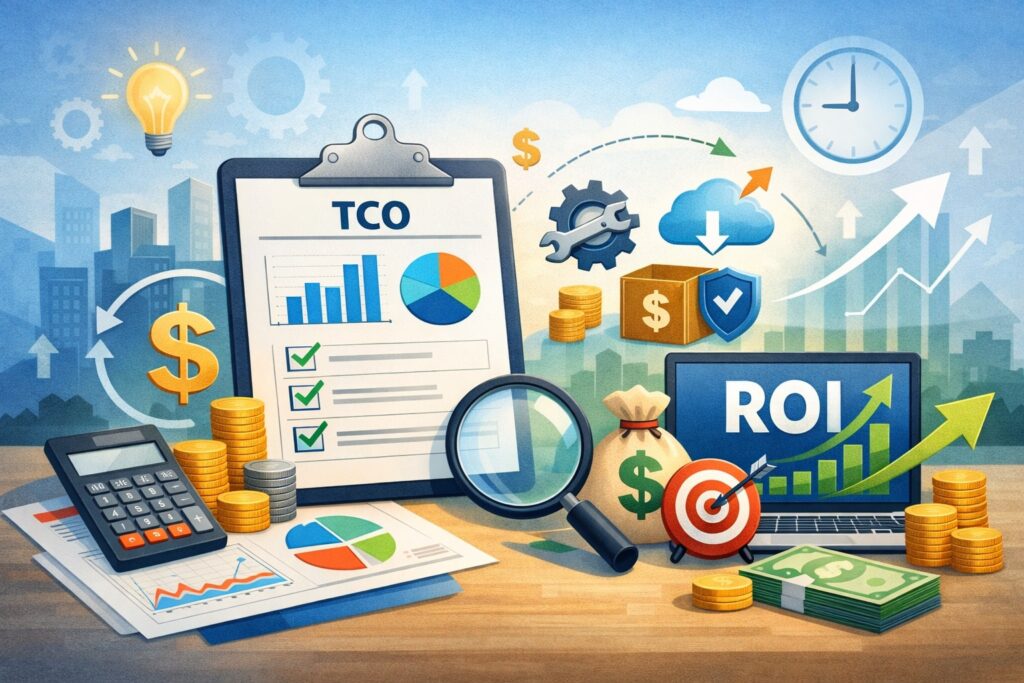
Long-term financial planning for equipment upgrades requires a total cost of ownership (TCO) view, not just a purchase price comparison.
Two machines with the same sticker price can have radically different lifetime costs due to energy usage, maintenance, consumables, staffing requirements, and downtime. When you build TCO into your plan, your upgrade decisions get easier, and your budget becomes more predictable.
TCO typically includes:
- Acquisition costs (purchase, shipping, installation, training)
- Financing costs (interest, fees, documentation)
- Operating costs (energy, fuel, software subscriptions, licenses)
- Maintenance and repairs (parts, labor, service contracts)
- Downtime costs (lost revenue, SLA penalties, overtime recovery)
- End-of-life costs (disposal, data wiping, trade-in value)
Then, calculate ROI using scenarios rather than a single forecast. For example, build a “base case” using expected savings, a “downside case” assuming delays or slower adoption, and an “upside case” assuming productivity gains arrive sooner.
Long-term financial planning for equipment upgrades becomes far stronger when decision-makers can see the range of outcomes.
Payback period is helpful, but don’t stop there. Also model:
- Net present value (NPV) to reflect the time value of money
- Internal rate of return (IRR) for comparing projects
- Cash conversion impact if upgrades change inventory turns or fulfillment speed
Be careful with “soft savings.” If a new system saves 10 hours per week but you don’t reduce payroll or redeploy labor to revenue-generating work, the savings may not fully materialize. The best long-term financial planning for equipment upgrades treats soft savings as partially realizable unless you have a clear operational plan.
Create a multi-year capital budget and upgrade reserve strategy
A multi-year capital budget is the bridge between operational needs and financial reality. Long-term financial planning for equipment upgrades works when you treat upgrades as a recurring program, not occasional big purchases. That means creating a rolling plan—often 3, 5, or 10 years—updated at least quarterly.
A practical structure is:
- Baseline replacements (non-negotiable): end-of-life assets, safety-related equipment, unsupported systems.
- Growth upgrades (capacity): new lines, expansion, additional vehicles, new locations.
- Optimization upgrades (efficiency): automation, energy reduction, faster throughput.
- Innovation bets (strategic): pilots for new tech with measured risk.
Then build an upgrade reserve, similar to how property owners reserve for roof and HVAC replacement. The reserve can be a dedicated savings account or internal earmark. A common method is to allocate a fixed percentage of revenue or gross profit monthly. The exact number varies by industry, but the key is consistency.
Long-term financial planning for equipment upgrades becomes more stable when you separate cash planning from tax planning. Even if tax incentives encourage a purchase in a certain year, your reserve strategy ensures you don’t drain working capital.
This is especially important during uncertain rate cycles, where borrowing costs and lender appetites can shift. Recent finance reporting shows ongoing sensitivity to rate expectations and equipment borrowing trends.
To keep the budget realistic, include implementation costs: IT configuration, cybersecurity hardening, staff training, and process redesign. Many upgrades fail to deliver ROI because those costs weren’t planned.
Choose the right funding mix: cash, loans, leases, and vendor programs
Long-term financial planning for equipment upgrades is also about choosing how to pay, not just what to buy. The right funding strategy protects cash flow while matching the asset’s useful life. A simple rule: don’t finance a short-lived asset with long-term debt, and don’t drain cash for an asset that won’t generate returns soon enough.
Cash purchase can be best when:
- You have strong reserves and predictable cash flow.
- The asset has a clear, fast payback.
- The cost is small relative to operations.
But cash purchases can create opportunity cost. If using cash prevents marketing investment, hiring, or inventory replenishment, it may be too expensive in a different way.
Term loans are useful when:
- The asset has a long useful life.
- You want ownership and depreciation benefits.
- The business qualifies for favorable terms.
Leases can be ideal when:
- You want lower upfront cost and easier upgrades.
- The technology becomes obsolete quickly (IT, POS, specialized tools).
- You want to bundle service, maintenance, or replacements into one payment.
Leasing is particularly relevant in long-term financial planning for equipment upgrades because it can convert big spikes in spending into smoother monthly payments. Industry trend discussions from commercial finance sources often emphasize rate dynamics and planning for elevated-but-stabilizing borrowing costs.
Vendor financing is another option, especially for specialized equipment. Vendors may offer promotional terms, deferred payments, or service bundles. Always compare total cost, not monthly payment, and confirm what happens at end-of-term.
A smart plan often uses a mix: cash for small, high-ROI tools; term loans for durable equipment; leases for fast-obsolescence tech; and vendor programs where they truly reduce total cost.
Tax-smart timing for upgrades without letting taxes drive the whole decision
Long-term financial planning for equipment upgrades should consider tax strategy, but not be controlled by it. Tax incentives can improve after-tax cost and cash flow, but buying the wrong equipment—or buying too early—just to capture a deduction usually backfires operationally.
Two major concepts shape equipment expensing decisions:
- Section 179 expensing (up to a limit, with phase-outs at higher purchase levels)
- Bonus depreciation (often broader eligibility, with changing percentage rules over time)
For 2025, many guides and practitioner summaries describe Section 179 limits around $2.5 million with a phase-out threshold around $4 million, with inflation adjustments and additional details depending on asset type and business use rules.
Bonus depreciation has also been a moving target. Some explain the scheduled phase-down approach (reducing by increments each year), while others discuss legislative changes that may alter the schedule.
Because of this, long-term financial planning for equipment upgrades should include a “tax rules sensitivity” section: your plan should still work even if expensive rules change again.
Practical best practices:
- Model after-tax cost with your advisor using conservative assumptions.
- Separate “place in service” timing from purchase timing in your calendar.
- Avoid stacking too many upgrades into a single tax year if it threatens cash flow.
- Document business use, depreciation schedules, and supporting records cleanly.
This is one of the few places where it’s necessary to reference the U.S. specifically: these rules are tied to IRS treatment and federal tax policy, and they can change based on legislation and IRS guidance.
Understand accounting impacts, covenants, and lease treatment before you sign
Long-term financial planning for equipment upgrades must account for how purchases and leases appear in financial statements—because lenders and investors often evaluate you through those statements. Even if the equipment improves operations, the way it’s financed can affect debt ratios, covenant compliance, and borrowing capacity.
With newer lease accounting rules (ASC 842), many leases create right-of-use assets and lease liabilities on the balance sheet, changing how leverage and liquidity ratios look. This doesn’t mean leasing is “bad.” It means you should plan for the reporting impact and explain it clearly to stakeholders.
Key steps:
- Review how a lease will be classified (operating vs finance) and what hits the balance sheet.
- Forecast covenant ratios before committing to an upgrade schedule.
- Coordinate upgrades with refinancing windows if your covenants are tight.
- Ensure your depreciation and amortization forecasts align with budget projections.
Also consider the operational accounting side: implementation costs, training expenses, and software subscriptions can land in different categories. Long-term financial planning for equipment upgrades is cleaner when you separate capex (capitalized) from opex (expensed) so leaders don’t confuse “monthly subscription growth” with “upgrade cost creep.”
Finally, if you’re using vendor programs, read the fine print on end-of-term options, buyout costs, and early termination clauses. A plan that looks affordable monthly can become expensive if you need to exit early.
Reduce risk: inflation, supply chain delays, maintenance spikes, and cybersecurity
Long-term financial planning for equipment upgrades is fundamentally risk management. The biggest threats are rarely the purchase itself—they’re the surprises surrounding timing, availability, and operational disruption.
Inflation and cost volatility can change equipment prices, service costs, and wages. Your plan should include escalation assumptions and a buffer for high-volatility categories (electronics, specialized parts, fuel-intensive equipment). Build contracts where possible that lock pricing or service rates, but don’t overcommit if technology is shifting fast.
Supply chain and lead times matter more than many budgets assume. If your replacement window is too tight and the asset arrives late, you may be forced to repair at premium cost or rent short-term equipment. Good long-term financial planning for equipment upgrades includes a lead-time calendar, alternate suppliers, and a plan for temporary capacity.
Maintenance risk is a major budget killer. Track maintenance cost as a percentage of replacement value. When it rises above a threshold (commonly 8–10% annually for many asset types), planned replacement often wins. Pair this with predictive maintenance tools where possible.
Cybersecurity risk is now an equipment-planning issue, not just an IT issue. POS devices, scanners, printers, cameras, and industrial systems can become attack surfaces when they stop receiving updates. A future-ready plan includes scheduled replacement for unsupported devices and a security baseline for new purchases.
This section is where long-term financial planning for equipment upgrades becomes a resilience program. It’s not pessimism—it’s cost control through preparation.
Technology trends and future predictions that should shape your upgrade roadmap
Long-term financial planning for equipment upgrades should include “technology horizon scanning.” You don’t need to chase every trend, but you do need to know which shifts will affect costs, capabilities, and competitive expectations.
AI and predictive analytics will increasingly influence maintenance, inventory handling, fraud detection, and throughput optimization. Over the next few years, more equipment will ship with built-in sensors and analytics subscriptions. That means future upgrades may include recurring software costs that don’t exist in older assets.
Connected equipment (IoT) will keep expanding. This improves visibility, but it also raises security and network reliability requirements. Your roadmap should budget for network upgrades, segmentation, monitoring, and staff training to avoid “smart equipment” becoming “fragile equipment.”
Automation and labor substitution will remain a major driver of upgrades. Even small businesses will adopt semi-automation—labeling, packaging, scheduling, inventory scanning—because it improves consistency and reduces reliance on scarce labor.
Energy efficiency and electrification will matter more, especially as utility costs fluctuate and customers increasingly expect sustainable practices. When you compare equipment options, include energy usage and expected price scenarios. Efficiency upgrades often deliver quiet, consistent ROI.
The financing and rate environment will continue to shape the upgrade strategy. Reporting in late 2025 highlighted shifting borrowing trends and expectations tied to rate moves. That suggests businesses that prepare multiple funding paths—rather than relying on one lender or one product—will have an advantage in 2026 and beyond.
The practical takeaway: long-term financial planning for equipment upgrades should assume more hybrid costs (hardware + software + service), faster obsolescence in connected devices, and a higher premium on security and uptime.
Step-by-step implementation: turn long-term planning into predictable execution
Long-term financial planning for equipment upgrades only works when execution is built into the process. A good plan should answer: who decides, how purchases are approved, how results are measured, and how the plan updates when reality changes.
A proven implementation system looks like this:
- Create an upgrade committee: Include operations, finance, IT/security (if relevant), and a senior decision-maker. Keep it small and consistent.
- Set upgrade triggers: Examples: downtime exceeds X hours/month, maintenance exceeds X% of value, vendor support ends within Y months, throughput falls below target, or security patches end.
- Standardize ROI templates: Use the same TCO/ROI model across all proposals. This helps leaders compare projects objectively and improves decision speed.
- Use a rolling forecast: Update your long-term financial planning for equipment upgrades quarterly. Add new needs, move timing based on performance, and remove projects that no longer make sense.
- Measure outcomes: Track uptime, throughput, defect rates, customer wait time, energy use, and maintenance costs after upgrades. If the upgrade didn’t deliver, document why and update your assumptions.
- Build vendor and financing readiness: Maintain a shortlist of vendors, lenders, and leasing options. Gather required documents ahead of time so you can act fast without panic.
When long-term financial planning for equipment upgrades becomes a rhythm—inventory, forecast, fund, execute, measure—you stop fearing upgrades and start using them to drive growth.
FAQs
Q.1: How far ahead should long-term financial planning for equipment upgrades go?
Answer: A practical window for long-term financial planning for equipment upgrades is 3 to 5 years for most small and mid-sized businesses, with a 10-year view for industries with heavy, long-life assets (manufacturing, logistics, construction).
The right horizon depends on how quickly your equipment becomes obsolete and how large your capital purchases are relative to cash flow.
A 3-year plan is often detailed: specific equipment, timing, budget ranges, and funding method. Years 4–5 may be more directional: “replace fleet,” “upgrade packaging line,” “refresh POS and network.” The longer window helps you avoid stacking multiple big replacements in the same year and gives you time to build reserves.
Your horizon should also match financing realities. If you typically finance equipment over 3–7 years, your plan should at least cover the repayment period so you understand future debt capacity.
It’s also wise to include a “rate sensitivity” assumption because interest-rate environments can change equipment affordability and lender appetite.
Recent reporting and trend commentary around equipment borrowing and rate expectations show how macro shifts can influence capex decisions. The key is not picking the “perfect” horizon—it’s updating the plan regularly so it stays real.
Q.2: Should I lease or buy when building long-term financial planning for equipment upgrades?
Answer: Leasing vs buying is not a one-time philosophical choice; it’s a tool you apply based on asset type, cash flow, and obsolescence risk. Long-term financial planning for equipment upgrades improves when you create rules for when leasing makes sense and when ownership is better.
Buying often wins when the equipment has a long useful life, stable technology, and strong resale value. Ownership can also support certain depreciation strategies depending on your tax situation.
Leasing often wins when the equipment becomes outdated quickly, when uptime is mission-critical, or when you want to bundle service and replacement into predictable payments.
Many businesses use a hybrid approach: buy durable assets and lease fast-changing technology. What matters most is total cost and flexibility. A lease with lower monthly payments might still be more expensive if the buyout is high or the contract is hard to exit.
Accounting and reporting also matter. Under modern lease accounting guidance (ASC 842), leases can create balance-sheet impacts that may affect ratios and covenants, so it’s smart to model those impacts before committing.
Long-term financial planning for equipment upgrades works best when your lease/buy choice matches the asset’s lifecycle and your business’s risk tolerance.
Q.3: What is the biggest mistake businesses make with long-term financial planning for equipment upgrades?
Answer: The most common mistake is planning only for the purchase price and ignoring the real operating costs and implementation effort. Long-term financial planning for equipment upgrades fails when leaders assume new equipment automatically produces ROI without process changes, training, and measurement.
A new machine may require workflow redesign. A new POS system may require staff retraining, security configuration, and integration with accounting and inventory. If those steps aren’t planned, the upgrade can disrupt operations and delay benefits.
Another big mistake is “year-end panic buying” purely for tax reasons. Tax incentives can be valuable, but buying too early—or buying the wrong asset—can lock you into equipment that doesn’t fit your future needs.
Tax rules and incentives can shift, and bonus depreciation schedules have been widely discussed as changing over time based on policy and legislation.
Finally, many businesses don’t stagger upgrades. They delay replacements for years, then get hit with multiple failures at once. Long-term financial planning for equipment upgrades is supposed to prevent exactly that by creating a replacement rhythm and reserve strategy.
Q.4: How do I budget for upgrades if cash flow is seasonal or unpredictable?
Answer: Seasonal or uneven cash flow makes long-term financial planning for equipment upgrades more important, not less. The strategy is to separate planning from timing and build flexibility into funding.
First, build a rolling 12–18 month cash forecast and identify your strongest cash months. Use those months to fund your upgrade reserve consistently. Even small monthly contributions create a buffer that prevents emergency borrowing.
Next, stagger upgrades so large purchases align with your best cash periods or with predictable financing approval windows.
If cash flow is volatile, consider funding approaches that reduce upfront burden: staged implementation, vendor programs, or leasing with lower initial payments. The goal is to match payment schedules to revenue reality. But always compare total cost and avoid contracts that punish early exit.
Also, create “upgrade tiers.” Tier 1 projects are critical replacements. Tier 2 projects improve efficiency. Tier 3 projects are innovation bets. In a tight year, Tier 3 pauses first. In a strong year, you accelerate Tier 2.
Long-term financial planning for equipment upgrades gives you a decision framework so you don’t freeze when cash flow tightens. You already know what to do because priorities were set ahead of time.
Q.5: How can I use tax incentives responsibly within long-term financial planning for equipment upgrades?
Answer: Use tax incentives as a secondary benefit, not the primary reason to buy. Responsible long-term financial planning for equipment upgrades starts with operational need and ROI. Then you optimize timing and structure to improve after-tax cost.
For many businesses, Section 179 expensing is a major planning tool, and multiple 2025 summaries describe limits around $2.5 million with phase-out thresholds around $4 million (with additional details and adjustments).
Bonus depreciation guidance has also been widely discussed as evolving over time, so conservative modeling is smart.
Practical guardrails:
- Only include tax savings you’re reasonably sure you can use (based on taxable income).
- Avoid compressing too many upgrades into one period if it creates cash strain.
- Track “placed in service” timing carefully because it can determine eligibility.
- Keep excellent documentation: invoices, delivery, installation, business-use evidence.
If you treat taxes as a lever—rather than the steering wheel—long-term financial planning for equipment upgrades stays healthy and ROI-driven.
Q.6: What metrics should I track to prove long-term financial planning for equipment upgrades is working?
Answer: You prove long-term financial planning for equipment upgrades is working by tracking operational outcomes and financial outcomes. Both matter.
Operational metrics typically include:
- Uptime and downtime hours
- Throughput (units/hour, orders/day)
- Error/defect rates and returns
- Customer wait time or service time
- Maintenance cost and frequency
- Energy usage where relevant
- Security incidents or patch compliance for connected equipment
Financial metrics include:
- Total cost of ownership vs forecast
- Payback period vs plan
- Cash flow impact (monthly and seasonal)
- Debt service coverage and covenant headroom
- Working capital changes (inventory, receivables)
- Actual vs planned financing cost
The most useful metric is often downtime cost avoided—but you must estimate it consistently. Define how you value an hour of downtime (lost gross margin, overtime, SLA penalties) and apply it the same way over time.
Also track “planning health” metrics: how many upgrades happened as scheduled, how much of the upgrade reserve was funded, and how often you had emergency purchases. When emergency buying drops, long-term financial planning for equipment upgrades is delivering value even before you measure productivity gains.
Conclusion
Long-term financial planning for equipment upgrades is how you turn equipment spending into a controlled program instead of a recurring crisis. When you build a lifecycle inventory, forecast total cost of ownership, and create a multi-year roadmap, upgrades become predictable.
When you fund an upgrade reserve and choose the right mix of cash, loans, and leases, upgrades become affordable. When you include risk planning and technology horizon scanning, upgrades become future-ready.
The most successful businesses don’t wait for equipment to fail. They decide in advance what “end-of-life” looks like, what metrics trigger replacement, and how funding will work. They also understand that technology is moving toward connected systems, software subscriptions, and stronger security requirements—so they plan for more than just hardware.