
Preparing Financial Statements for Equipment Loans: How to Build a Stronger, More Credible Application
Buying equipment can move a business forward fast. It can improve production, shorten turnaround times, expand services, reduce labor strain, or help you take on larger contracts.
But before a lender agrees to finance that purchase, they usually want a clear picture of your business finances. That is where preparing financial statements for equipment loans becomes one of the most important parts of the application process.
Strong financial statements do more than check a box. They help lenders understand whether your business can support the new debt, make timely payments, and use the equipment in a way that strengthens operations.
If your records are accurate, current, and easy to follow, you make the lender’s job easier and improve confidence in your application. If your statements are incomplete, inconsistent, or outdated, even a good business may look riskier than it really is.
This article explains how to approach financial preparation for equipment loans in a practical way. You will learn which statements lenders review, what they look for during underwriting, how to prepare your numbers before applying, and how to avoid the common mistakes that slow down approvals.
Whether you are buying your first major machine, replacing vehicles, upgrading technology, or financing specialized commercial equipment, the goal is the same: present clear, reliable financial information that supports your request.
Why Financial Statements Matter for Equipment Loans
When lenders review an equipment financing request, they are not only looking at the equipment itself. They are also evaluating the business behind the request.
Even if the equipment has resale value and serves as collateral, the lender still wants to know whether the company can make payments consistently and manage the new obligation responsibly. That is why financial statements for equipment loan approval are such a central part of the process.
Your financial statements tell the story of how the business performs, how it uses cash, what it owns, what it owes, and whether its results are stable enough to support financing.
A lender may look at revenue trends, margins, debt levels, available working capital, and monthly cash flow. They may also review whether the business has been growing, staying flat, or showing signs of stress. If those answers are easy to find in your statements, the review process is smoother.
For many business owners, this part of the application feels intimidating because it seems highly technical. In reality, lenders are often looking for clarity and consistency as much as they are looking for size or scale.
A business does not need to be perfect. It needs to show that its records are organized, that the numbers make sense, and that management understands the financial side of the company.
Financial records for equipment purchase loans also help lenders match the financing structure to the situation. A shorter-term loan for fast-depreciating equipment may be evaluated differently than a longer-term request for durable equipment with a longer useful life.
If your financials show dependable cash flow, the lender may be more comfortable with a larger request or a more flexible structure.
Financial Statements Help Lenders Measure Repayment Ability
The most basic question in any financing request is whether the borrower can repay the loan. Equipment may secure the financing, but repayment usually comes from business cash flow. That makes your financial statements one of the main tools lenders use to assess risk.
A profit and loss statement shows whether the business generates revenue and whether that revenue turns into operating profit. A balance sheet shows the strength of the business position at a given point in time.
A cash flow statement helps explain how money moves through the business, which matters because profitable companies can still face cash shortages. Together, these statements help lenders see whether you are likely to handle the monthly payment without creating strain elsewhere.
This is especially important when the equipment purchase is large relative to the size of the business. If a small company wants to finance a major asset, lenders will want to understand how that payment fits into the broader financial picture.
They may compare the proposed debt payment to current cash flow, existing obligations, and seasonal swings in revenue. If your financial statements show stable operations and realistic capacity, the request looks more credible.
In many cases, preparing financial statements for equipment loans is also about reducing uncertainty. When your numbers are organized and supported by the rest of your file, the lender has fewer reasons to delay, question, or decline the application. That can make a meaningful difference in both approval speed and terms.
Good Financial Preparation Can Improve More Than Approval Odds
A strong package may do more than help you get approved. It can also influence pricing, down payment expectations, requested documentation, and the level of scrutiny involved in underwriting.
Financial documents for equipment financing serve as evidence of how well the business is managed, and lenders often respond positively when the file is easy to review.
Businesses that submit complete, current, and internally consistent financials tend to project readiness. That matters because lenders are not only financing equipment.
They are deciding whether to trust the borrower’s reporting, decision-making, and ability to manage obligations over time. Clean records suggest discipline. Messy records create doubt.
Good preparation can also help you negotiate from a stronger position. When you know your revenue trends, debt load, working capital, and payment capacity, you are better able to request a loan amount and structure that fits your business.
That can prevent overborrowing, reduce future strain, and help you choose equipment financing that supports growth instead of creating it.
The Key Financial Statements Lenders Review
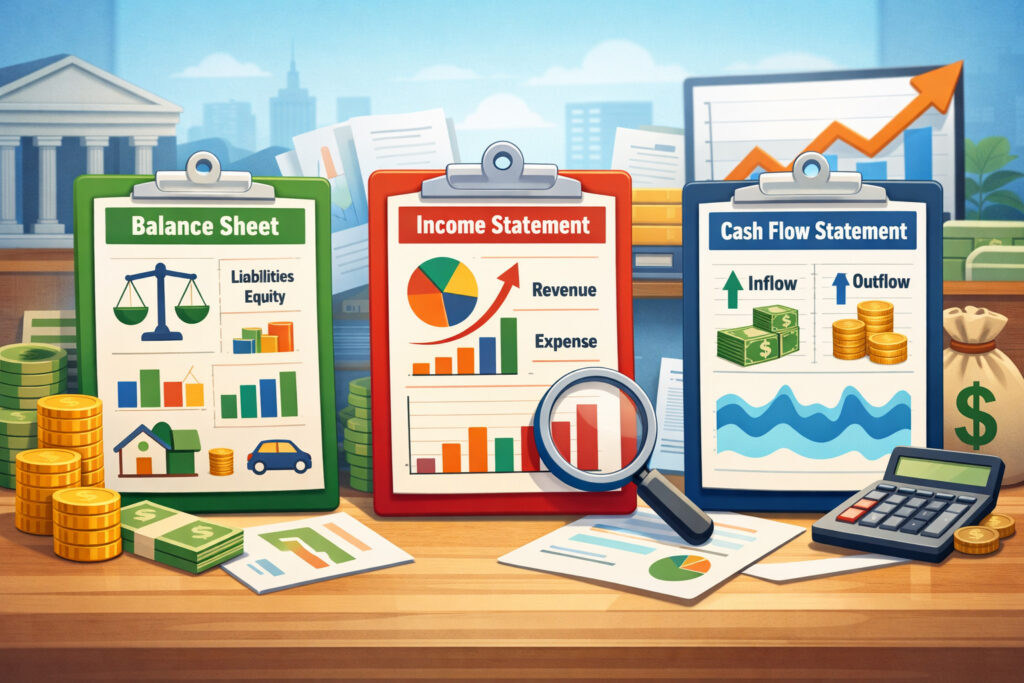
Most equipment financing applications involve more than one document. Lenders typically review a group of business financial statements for equipment loans so they can evaluate the company from several angles. Each statement answers a different question, and together they form the core of the underwriting file.
At the center of the review are the profit and loss statement, balance sheet, and cash flow statement. Many lenders also ask for business bank statements, tax returns, debt schedules, and supporting details tied to receivables, payables, or ownership structure.
The larger the request, the more likely it is that the lender will want a fuller financial package rather than just high-level numbers.
The exact documentation can vary based on credit profile, loan size, time in business, and equipment type. Some lower-documentation requests may rely heavily on bank statements and application data.
Larger or more complex requests usually involve more formal financial statements for equipment financing, often including year-end and interim reports. If the business is newer or has uneven results, the lender may also request projections or explanatory notes.
The important point is not to assume that one statement will do all the work. Lenders look at the full picture. A strong profit and loss statement helps, but it does not replace the need for a solid balance sheet.
Healthy bank activity is useful, but it may not answer questions about liabilities or owner equity. Preparing a complete package helps prevent gaps that trigger additional questions.
Profit and Loss Statement: Showing Revenue, Expenses, and Profitability
A profit and loss statement for equipment financing, sometimes called an income statement, shows how the business performed over a period of time.
It tracks revenue, cost of goods sold when applicable, operating expenses, and net income. Lenders use it to assess whether the business is generating enough profit to support a new loan payment.
This statement helps underwriters spot trends. They may compare year-over-year revenue, gross margin, operating expenses, and net income to see whether the business is stable, improving, or under pressure.
A growing business with improving profitability often inspires more confidence than one with declining revenue or shrinking margins. That does not mean a business must be flawless, but the pattern should make sense.
Interim statements also matter. If your last full-year statement is several months old, the lender may ask for year-to-date results to understand current performance.
A strong year-end statement can lose value if the current period tells a different story. That is why financial preparation for equipment loans should include updated reporting, not just last year’s numbers.
It also helps to be ready to explain unusual items. A one-time expense, a seasonal dip, or a temporary loss does not always hurt the application if it is well documented and understandable. What hurts more is leaving the lender to guess.
Balance Sheet: Showing What the Business Owns and Owes
The balance sheet for equipment loan application review gives lenders a snapshot of the business at a specific point in time. It shows assets, liabilities, and equity. While the profit and loss statement explains performance over time, the balance sheet shows financial position.
Lenders review this statement to understand liquidity, leverage, and overall financial stability. They may look at current assets such as cash, receivables, and inventory, then compare them to short-term liabilities.
They also review long-term debt, existing equipment loans, credit lines, and owner equity. This helps them assess whether the business already carries too much debt or has enough financial cushion to absorb another payment.
For equipment loan financial requirements, the balance sheet is often critical because it reveals how the company manages obligations beyond day-to-day operating results.
A business might show profit on its income statement but still have limited liquidity or excessive liabilities. On the other hand, a company with moderate profit but solid equity and manageable debt may still appear financially sound.
Accuracy matters here more than many business owners realize. Old fixed asset values, missing liabilities, overstated receivables, or unclear shareholder loans can weaken the lender’s confidence. Make sure the balance sheet is current and reflects real conditions, not estimates that were never cleaned up after month-end or year-end closing.
Cash Flow Statement, Bank Statements, and Supporting Schedules
A cash flow statement for equipment loans helps lenders understand how cash actually moves through the business. This matters because accounting profit does not always equal available cash.
A company can show positive net income while still struggling to cover payments if receivables are slow, inventory is heavy, or debt service is already consuming cash.
Lenders may use a formal cash flow statement if one is available, but they also often review business bank statements to see real account activity. Bank statements help confirm deposits, average balances, and spending patterns.
They can also reveal whether cash flow is steady or erratic. For smaller businesses, bank statements sometimes play an especially important role in the lender financial review for equipment financing.
Supporting schedules add more detail where needed. A debt schedule shows existing loans, monthly payments, balances, and maturities. Accounts receivable aging reports help lenders see whether customers pay on time.
Accounts payable aging reports show whether the business is staying current with vendors. In some situations, lenders may also request fixed asset schedules, lease obligations, or large contract summaries.
These extra documents are part of the broader equipment financing underwriting documents package. They help lenders test whether the core statements are supported by operational reality.
If your profit and loss statement looks strong but receivables are aging badly or payables are severely past due, that inconsistency may raise concern. That is why organizing supporting schedules can be just as important as polishing the main statements.
What Lenders Look for in Equipment Loan Financial Documents

When reviewing financial statements for equipment loan approval, lenders are trying to answer a set of practical questions.
Is the business stable enough to take on new debt? Is cash flow sufficient? Are the numbers reliable? Does the equipment purchase fit the company’s size, needs, and operating pattern? The answers come from both the statements themselves and the way those statements fit together.
Lenders usually do not expect every business to have perfect results. Many strong companies go through seasonal slow periods, margin pressure, expansion costs, or uneven year-to-year growth.
What matters more is whether the business can explain its financial position and show a pattern of reasonable control. Clear records, consistent reporting, and a believable explanation of business performance often go a long way.
Another important factor is proportionality. A modest request for essential equipment may be easier to approve with limited documentation if the business has stable deposits and a clean credit profile.
A larger request, specialized equipment, or a company with uneven history will usually trigger a deeper financial review. That is why business loan financial requirements tend to expand as the deal becomes more complex.
Understanding what lenders want to see helps you prepare more strategically. Instead of sending a pile of documents and hoping for the best, you can shape a package that answers likely questions before they are asked.
Revenue Stability, Profitability Trends, and Debt Capacity
One of the first things lenders review is revenue. They want to know whether the business has enough sales volume and operating consistency to support equipment financing. Revenue does not need to be perfectly smooth, but sudden drops, unexplained swings, or short operating history can lead to more questions.
Profitability matters too. Lenders often review gross profit, operating income, and net income over multiple periods. A temporary decline may not be a deal breaker if the broader trend is positive or the cause is clear.
What underwriters want to avoid is funding a company that appears unable to convert sales into enough operating strength to carry debt responsibly.
Debt capacity is another major issue. Even a profitable business may be stretched if it already has heavy monthly obligations.
Lenders review existing term loans, credit lines, leases, merchant cash flow obligations, and other recurring debt. They want to see whether there is room for the proposed payment without creating pressure on cash reserves or working capital.
For equipment loan financial requirements, the question is usually not only whether you have profit, but whether you have enough free cash flow after other commitments.
Businesses that understand this tend to prepare stronger applications because they address payment capacity directly rather than assuming revenue alone will tell the story.
Liquidity, Working Capital, and Consistency in Reporting
Liquidity refers to the business’s ability to meet short-term obligations. Lenders look at available cash, cash equivalents, receivables, and other current assets to understand whether the company can operate comfortably while taking on a new equipment payment.
A business may qualify even with modest liquidity, but low cash combined with unstable earnings or heavy payables can make the file riskier.
Working capital is closely related. It measures whether the business has enough short-term resources to manage operations. When lenders review business financial statements for equipment loans, they want to know that financing the new asset will not leave the company too tight to function well.
Equipment may help generate future value, but the business still needs enough flexibility to handle payroll, inventory, vendor bills, and normal operating costs in the meantime.
Consistency in reporting is just as important as the numbers themselves. Lenders notice when profit and loss statements do not align with tax returns, when balance sheet entries change suddenly without explanation, or when bank deposits do not seem to support reported revenue. Inconsistent reporting can create more concern than weak numbers that are honestly presented.
Business Stage, Equipment Type, and Overall Risk Profile
Financial statements do not exist in a vacuum. Lenders also interpret them in context. A long-established company buying replacement equipment will usually be judged differently than a newer business financing its first major asset.
The same is true for equipment type. Essential, revenue-producing equipment may receive a more favorable view than equipment that is highly specialized, hard to resell, or less central to operations.
If the business is mature, lenders often expect more complete and better-organized records. They may want full financial statements, tax returns, debt schedules, and interim updates.
If the business is newer, they may accept a different mix of financial documents for equipment financing, such as bank statements, contracts, projections, and owner support. What changes is not the need for credibility, but the way credibility is demonstrated.
Overall risk profile also includes management experience, credit history, industry conditions, and how clearly the equipment purchase fits a business purpose.
Financial statements remain central, but they are interpreted alongside the rest of the file. That is why financial preparation for equipment loans should be matched to the real situation rather than copied from a generic checklist.
How to Prepare Financial Statements Before Applying

Preparing financial statements for equipment loans is not something to leave until the day you submit an application. The best approach is to review, update, and organize your records in advance so the lender sees a clear and complete package.
This does not require complicated financial engineering. It requires accuracy, consistency, and thoughtful presentation.
Start by gathering your most recent year-end financial statements and current interim reports. Then compare them to tax returns, bank statements, debt records, and bookkeeping reports. Look for gaps, errors, and items that may prompt questions. The goal is to submit statements that are current, reconciled, and easy to interpret.
Business owners often focus heavily on the equipment quote and less on the financial package. But the financial side can determine whether the deal moves quickly or gets delayed.
A clean file also helps you answer lender requests faster because you have already reviewed the business from an underwriting perspective.
It is useful to think of this process as a lender-readiness review. You are not just assembling documents. You are showing that the business understands its own financial position and is prepared to borrow responsibly.
Update Bookkeeping and Reconcile Key Accounts
Before sending financial statements to a lender, make sure your books are up to date. That means entering recent transactions, closing the latest month, and reconciling bank accounts, credit cards, loans, and major balance sheet items. Outdated books are one of the fastest ways to create inconsistencies in a loan file.
Reconciliation matters because small errors can create big credibility problems. If bank balances do not match, if old liabilities were never cleared, or if receivables include amounts that are no longer collectible, your statements may look stronger or weaker than reality. Underwriters often catch these issues when they compare statements to supporting records.
It is also worth reviewing expense classification. Owners sometimes code major purchases, owner draws, loan payments, or one-time expenses incorrectly, which can distort profitability. A lender looking at those statements may reach the wrong conclusion unless the records are cleaned up first. Accurate categorization improves both clarity and confidence.
If your bookkeeping has fallen behind, address that before applying. Even a short delay to catch up your records may be better than submitting financials that immediately trigger questions. This step is one of the foundations of small business financial preparation for loans.
Prepare Current Interim Financials and Supporting Notes
Many lenders want recent interim financials in addition to year-end statements. These reports help them understand how the business is performing now, not just how it performed at the last fiscal year-end. If you are several months into the current year, submitting only old year-end reports may leave too much uncertainty.
Interim statements should include a current profit and loss statement and balance sheet, and in some cases a cash flow statement or bank statement package.
It helps to include a year-to-date view plus a comparison to the same period in the prior year if available. This gives the lender better context on trends, seasonality, and current conditions.
Supporting notes can also help. If your revenue is up because of a major contract, say so. If profit dipped because of a temporary repair issue, inventory build, or planned staffing increase, document it. Underwriters do not always need a long memo, but they do appreciate concise explanations for significant changes.
Match the Financial Package to the Request
Not every equipment financing request needs the same level of documentation. A smaller request for standard equipment may require a lighter package than a larger request for specialized machinery or multiple assets. Part of effective financial preparation for equipment loans is matching your package to the size and complexity of the deal.
If the request is relatively small and your business has strong bank activity and stable operations, the lender may focus more on recent statements and cash flow support. For larger deals, expect more scrutiny.
You may need full year-end financials, current interim reports, business tax returns, debt schedules, aging reports, and owner information. The more complex the request, the more important it is to present a complete set of equipment financing underwriting documents.
The business stage matters too. A well-established company with several years of operating history should usually provide a fuller package than a new business with limited history. Newer businesses may rely more on owner support, projections, contracts, or a strong explanation of how the equipment will generate revenue.
A tailored package signals that you understand the financing request and have taken the process seriously. That can build lender confidence before underwriting even begins.
Financial Statement Challenges for Startups and Small Businesses
Not every company applying for equipment financing has years of polished financial records. Many smaller businesses are still building systems, and newer companies may not yet have long operating history, strong retained earnings, or formal monthly reporting.
That does not mean financing is out of reach. It does mean the business should prepare differently and present its financial information with extra care.
Lenders know that startups and young businesses often have different profiles. Revenue may still be ramping up. Profit may be limited because the business is investing in growth. The balance sheet may be lean.
In those cases, the lender is often looking for signs of control, discipline, and realistic planning rather than long-term financial depth.
This is where financial documents for equipment financing become more than a standard statement package. Supporting evidence matters.
Bank statements, signed contracts, receivables, owner liquidity, industry experience, and business plans can help explain the application when traditional historical financials are limited. The goal is to reduce uncertainty with whatever reliable information is available.
Small businesses also face a practical challenge: they may not have a full accounting team. The owner may be handling sales, operations, payroll, and bookkeeping at the same time. That can lead to delayed reconciliations and less polished financial reporting. Lenders understand this to a point, but they still need usable information.
How Newer Businesses Can Show Financial Strength
If your business does not have years of financial history, focus on producing the clearest available picture of current performance and near-term capacity.
That may include current bank statements, year-to-date profit and loss reports, customer contracts, open invoices, and evidence of incoming work. These items help lenders see that the business is active and generating real commercial activity.
Owner support may matter more in these cases as well. Some lenders may request owner financials, especially if the business is young, closely held, or not yet strongly capitalized.
A personal financial statement, proof of liquidity, or tax returns may help supplement the business file. This is especially relevant when the equipment is critical to launching or scaling operations.
It also helps to explain why the equipment purchase makes sense now. If the equipment will increase production, reduce outsourcing costs, or allow the business to fulfill confirmed demand, say so clearly. Lenders are more likely to support a request that is tied to a visible operating purpose than one that feels speculative or loosely defined.
A startup does not need to pretend to be mature. It needs to show that management understands the risks, has a credible plan, and can support the financing responsibly.
Limited History Does Not Mean Limited Preparation
One mistake newer businesses make is assuming that limited history excuses weak presentation. In reality, when there is less financial history, each document matters even more.
Your current records, deposit patterns, receivables, and explanations may carry more weight because there is less long-term data to offset uncertainty.
That is why small business financial preparation for loans should focus on quality and clarity. Make sure the statements you do provide are current and accurate. If you use accounting software, clean up the chart of accounts and produce readable reports. If you are using spreadsheets, keep them organized, dated, and tied back to source documents.
Lenders may also look closely at cash reserves and payment behavior in newer businesses. Strong deposit flow, stable account balances, and timely payment of vendors can support the idea that the company is managing its obligations carefully.
In contrast, disorganized banking activity or unclear transfers between personal and business accounts can hurt the file.
Common Mistakes to Avoid When Preparing Loan Financials
A business can have decent fundamentals and still weaken its application through poor preparation. Many equipment loan files stall not because the business lacks potential, but because the financial package raises avoidable questions.
When lenders see incomplete records, unexplained inconsistencies, or outdated statements, they often slow the process to verify what should have been clear from the start.
The most common mistakes tend to fall into a few categories: missing information, inaccurate reporting, poor organization, and lack of explanation. None of these issues is unusual, especially in fast-moving small businesses. But each one can reduce lender confidence and make the request feel riskier than it should.
Preparing financial statements for equipment loans means doing more than printing reports from software and attaching them to an application. It means reviewing them for completeness, making sure the numbers align with the rest of the file, and presenting them in a way that makes sense to an outside reviewer.
The stronger your preparation, the fewer assumptions a lender has to make. That matters because underwriters tend to favor files that are easier to understand and defend internally.
Incomplete, Outdated, or Inconsistent Financial Records
One major problem is sending financial statements that are missing key periods or do not reflect current conditions. If your last balance sheet is several months old, your bank statements are more recent, and your application references current sales levels that are not shown anywhere else, the lender may question what changed and why.
Inconsistency is another common issue. Revenue on the profit and loss statement should generally make sense relative to bank deposits, tax returns, and receivables.
Debt balances on the balance sheet should align with payment obligations disclosed elsewhere. If those items do not line up, the lender may worry that the business does not have reliable controls.
Old records can also make the business look weaker than it is. A company that improved recently may miss the chance to tell that story if it only submits older year-end statements.
On the other hand, a company that has weakened since year-end may look misleading if current interim reports are not included. Updated, accurate records are essential for a fair lender review for equipment financing.
Poor Bookkeeping, Unexplained Losses, and Weak Presentation
Poor bookkeeping can create a chain reaction of problems. Misclassified expenses can distort profit. Unreconciled bank accounts can throw off cash balances. Old receivables can overstate assets.
Unrecorded liabilities can make leverage appear lower than it is. These issues do not just affect one line item. They can undermine the credibility of the entire financial package.
Unexplained losses are another issue. A lender does not automatically reject a business because of a loss, but the cause matters. If losses came from a one-time expansion cost, supply disruption, or nonrecurring event, a short explanation may be enough.
If the file contains losses with no context, the underwriter may assume ongoing weakness or poor planning.
Presentation matters more than many owners expect. Sending scattered PDFs with inconsistent dates, unlabeled files, and no supporting detail can make the lender work harder than necessary.
That slows underwriting and increases the chance of confusion. Even good financial records lose value when they are presented poorly.
Tips to Improve Lender Confidence and Strengthen Your Application
A lender’s confidence is built through evidence, clarity, and consistency. While no presentation can erase a weak financial profile, strong preparation can make a real difference when the business is fundamentally financeable.
The goal is to help the lender see that the company understands its numbers, has thought through the equipment purchase, and can manage the obligation responsibly.
One of the best ways to do that is to connect the financial statements to the purpose of the loan. Do not treat the financial package and the equipment request as separate things.
The lender wants to know why this equipment matters, how it fits into operations, and how the business will support the payments. When the equipment purpose and the financial story align, the application becomes more persuasive.
This is also where trustworthiness comes into play. If there are weaknesses, address them honestly. A temporary dip in margin, a seasonal revenue pattern, or a recent debt increase can often be explained. Trying to hide weaknesses usually causes more damage than the weakness itself.
Businesses that strengthen applications well tend to think ahead. They identify likely lender questions, prepare supporting details, and present a package that feels coherent from the beginning.
Show the Business Case Behind the Equipment Purchase
Financial statements for equipment financing become more powerful when they are paired with a clear business reason for the purchase. Explain what the equipment will do, why now is the right time, and how it will affect operations.
Will it expand capacity, improve efficiency, replace unreliable machinery, reduce subcontracting, or help fulfill existing demand?
This matters because lenders are more comfortable financing assets that have an obvious role in revenue generation or cost control. If the equipment is essential to delivering services or completing jobs, that supports the logic of the request. If the purchase seems optional or poorly timed relative to business performance, the lender may hesitate.
You do not need an elaborate report. A concise explanation tied to actual operations is often enough. If there are signed contracts, backlog, service demand, or replacement needs driving the purchase, mention that. When the business case is clear, the financial statements are easier to interpret in context.
Be Transparent About Weaknesses and Ready With Support
No business financial package is perfect. A thoughtful lender knows that. What often separates stronger applications from weaker ones is how the business handles imperfect areas. If there was a loss, explain it.
If receivables stretched because of one large customer, provide context. If debt increased recently because of expansion, show how the business is managing it.
Transparency builds credibility. It tells the lender that management understands the business and is not trying to hide the hard parts. That matters because equipment financing is a relationship decision as much as a numbers decision. The lender is deciding whether to trust the borrower over time.
It also helps to support your explanations with documents. If revenue is seasonal, comparative monthly reports may help. If margins dipped because of a temporary issue, show the current trend.
If liquidity is tight but expected to improve because of incoming receivables, provide an aging report. Supporting documentation turns explanations into evidence.
How to Organize Supporting Financial Documents for Equipment Financing
Strong statements are important, but most equipment loan applications also rely on supporting records. These documents give lenders more context, help validate the main statements, and answer follow-up questions before they slow the process.
Organizing them well can make the difference between a smooth review and a frustrating series of document requests.
Start by thinking in categories. There are core financial statements, tax and compliance records, cash flow support documents, debt and obligation records, and ownership-related documents.
Within each category, keep files current, clearly labeled, and arranged in a logical order. This makes it easier for the lender to review the package and easier for you to respond if more detail is requested.
Documents needed for equipment loan approval often include at least some of the following:
- Year-end profit and loss statements
- Year-end balance sheets
- Current interim financial statements
- Business bank statements
- Business tax returns
- Debt schedules
- Accounts receivable aging reports
- Accounts payable aging reports
- Equipment quotes or invoices
- Ownership information
- Owner financials when relevant
The exact list varies, but the principle is the same: show the lender a complete, current, and organized file. Businesses that prepare these materials in advance are usually better positioned to move quickly once the application starts.
Tax Returns, Aging Reports, and Debt Schedules
Business tax returns are often requested because they provide an externally filed version of the business’s financial history. Lenders may compare them to internally prepared statements to confirm that the business is reporting consistently. Large differences are not always a problem, but they usually require explanation.
Accounts receivable aging reports help lenders understand how quickly customers pay. A business with strong sales but slow collections may face cash pressure that does not show clearly on the income statement alone.
Likewise, accounts payable aging reports show how the business manages vendor obligations. If payables are badly past due, the lender may see signs of strain even if current revenue looks healthy.
Debt schedules are also important. A good debt schedule lists existing loans, original amounts, current balances, monthly payments, and maturity dates. This helps the lender evaluate whether the business has room for another obligation.
It also helps verify that liabilities reported on the balance sheet reflect real commitments. For many equipment loan financial requirements, the debt schedule is one of the most practical documents in the file because it translates balance sheet debt into real monthly obligations.
Owner Financials and When They Matter
Owner financials are not always required, but they can become relevant in several situations. If the business is new, closely held, thinly capitalized, or seeking a larger request relative to current operations, the lender may want to understand the owner’s personal financial strength and support capacity. This can include a personal financial statement, personal tax returns, or proof of liquidity.
This request is not necessarily a negative sign. For smaller and newer businesses, the owner is often closely tied to the company’s financial profile. Lenders may simply want to confirm that there is enough outside support if operations fluctuate or ramp-up takes longer than expected.
If owner financials are requested, present them cleanly and honestly. Do not overstate asset values or leave debts off the statement. As with business records, credibility matters. The purpose is to give the lender confidence that the broader financial picture supports the request.
Frequently Asked Questions
Q.1: What financial statements do lenders usually require for equipment loans?
Answer: Most lenders review a profit and loss statement, balance sheet, and recent business bank statements. Depending on the size of the request and the credit profile, they may also ask for a cash flow statement, tax returns, debt schedules, accounts receivable aging, accounts payable aging, and other supporting records.
The larger or more complex the request, the more likely it is that full financial documents for equipment financing will be required.
Q.2: How current should financial statements be when applying?
Answer: Financial statements should be as current as reasonably possible. Year-end reports are often needed, but many lenders also want interim financials that show current performance.
If your last full-year statement is several months old, include year-to-date results and recent bank statements. Outdated statements can lead to more questions and may not reflect the business’s current condition.
Q.3: Can a business qualify if its financial statements show a recent loss?
Answer: Yes, a recent loss does not automatically prevent approval. What matters is the reason for the loss, whether it was temporary or ongoing, and how the rest of the financial picture looks.
If there was a one-time event, startup investment, seasonal issue, or unusual expense, explain it clearly. Lenders often respond better to a documented explanation than to numbers that are left unexplained.
Q.4: Do startups need the same financial documents as established businesses?
Answer: Not always. Startups and newer businesses may not have the same operating history, so lenders may rely more heavily on bank statements, contracts, projections, owner financials, or evidence of industry experience.
Even so, the business should still provide organized and accurate records. Limited history does not eliminate the need for strong financial preparation for equipment loans.
Q.5: Why do lenders ask for bank statements if they already have financial statements?
Answer: Bank statements help validate the financial statements and show actual cash activity. They can confirm deposit patterns, average balances, and account behavior.
For some smaller businesses, bank statements are especially important because they offer a real-time view of operations. Lenders may compare bank activity to the profit and loss statement to make sure the reported numbers are credible.
Q.6: Should I use an accountant or bookkeeper before applying?
Answer: In many cases, yes. A qualified bookkeeper can help keep records current and accurate, while an accountant can review statements, correct classification issues, and help explain unusual items.
You may not need a full accounting department, but professional support can improve the quality of your equipment financing underwriting documents and reduce preventable problems during review.
Q.7: What is one of the most common mistakes in equipment loan applications?
Answer: One of the most common mistakes is submitting incomplete or inconsistent financial information. This includes outdated statements, unreconciled balances, tax returns that do not align with internal reports, or missing debt details. These issues can weaken lender confidence even when the business itself is otherwise financeable.
Conclusion
Preparing financial statements for equipment loans is about more than assembling paperwork. It is about showing lenders that your business is financially aware, operationally organized, and ready to take on equipment financing with confidence.
When your statements are current, accurate, and supported by clear documentation, you make it easier for a lender to understand your business and approve the request on solid ground.
The most effective financial preparation combines clean bookkeeping, current reporting, thoughtful explanation, and good organization. Profit and loss statements, balance sheets, cash flow support, bank statements, tax returns, aging reports, and debt schedules all play a role in helping lenders evaluate the application.
Together, they show not only where the business stands today, but also whether the proposed equipment loan fits the company’s real capacity.
If your business is established, strong preparation helps you present stability and repayment strength. If your business is newer, it helps you replace limited history with clarity, support, and credibility. In both cases, the goal is the same: reduce uncertainty and increase lender confidence.