
Managing Debt Responsibly With Equipment Loans
Equipment can determine how efficiently a business serves customers, completes projects, produces goods, manages inventory, or expands into new markets.
A contractor may need an excavator, a restaurant may need refrigeration equipment, a medical practice may require diagnostic devices, and a transportation company may depend on commercial vehicles.
Paying the entire purchase price upfront is not always practical. An equipment loan allows a business to acquire an important asset while spreading its cost over a defined repayment schedule. This structure can preserve cash for payroll, inventory, rent, insurance, marketing, and other operating expenses.
However, financing does not make equipment inexpensive. It converts the purchase price into a debt obligation that may include principal, interest, origination fees, insurance requirements, maintenance expenses, and collateral risk. The monthly payment continues even if revenue slows, the equipment needs repairs, or the asset does not produce the expected return.
Managing debt responsibly with equipment loans means evaluating the business need before borrowing, calculating the full cost, selecting suitable equipment loan terms, protecting working capital, and monitoring both the debt and the asset after purchase. It also means borrowing based on realistic revenue projections rather than optimistic assumptions.
Responsible equipment financing is not simply about receiving equipment loan approval. Approval only indicates that a lender is willing to provide financing under specific conditions. The business must still determine whether those conditions are affordable, practical, and aligned with its long-term financial position.
This article provides general educational guidance. Financing structures, accounting treatment, tax rules, and contract obligations can vary. Business owners should seek qualified financial, accounting, tax, or legal review when making decisions involving substantial debt or complex agreements.
What Does Managing Debt Responsibly With Equipment Loans Mean?
Managing debt responsibly with equipment loans means using borrowed funds in a way that supports business operations without creating repayment obligations the business cannot comfortably handle. The financed asset should solve a real operational problem, improve productivity, reduce costs, or create a reasonable opportunity to generate revenue.
Responsible borrowing begins before an application is submitted. The business should identify the exact equipment needed, obtain accurate pricing, estimate installation and operating costs, and determine how the monthly payment will fit into existing cash flow.
It also requires selecting a loan term that reflects the equipment’s useful life. A business should generally avoid making payments for years after an asset becomes obsolete, unreliable, or too expensive to maintain. Financing a short-life technology system over an unusually long period, for example, could leave the business paying for equipment it no longer uses.
Equipment loan debt management continues after funding. Payments should be incorporated into the monthly budget, due dates should be monitored, reserves should be maintained, and the equipment’s financial contribution should be reviewed regularly.
The objective is not necessarily to avoid debt. Debt can be useful when it allows a business to acquire productive assets while retaining enough cash to operate. The objective is to ensure that the amount, cost, structure, and purpose of the debt remain reasonable.
Equipment Loans as Business Debt
An equipment loan is still a liability even though it is connected to a physical asset. The equipment may serve as collateral, but the business remains responsible for making payments according to the financing agreement.
Each payment usually includes principal and interest. Depending on the agreement, the borrower may also pay an origination fee, documentation charges, inspection costs, title fees, late fees, or a prepayment penalty. Insurance may be required to protect the lender’s interest in the asset.
The loan can also affect future borrowing capacity. Lenders reviewing a later application may consider the remaining balance, monthly debt service, payment history, collateral liens, and the business’s ability to take on another obligation.
If the business defaults, the lender may have the right to repossess the financed equipment. Repossession may not fully eliminate the debt if the equipment is sold for less than the outstanding balance and the agreement permits the lender to pursue a deficiency.
For these reasons, equipment financing debt should appear in financial forecasts, balance-sheet reviews, and cash flow planning just like other business obligations.
Responsible Borrowing vs. Overborrowing
Responsible borrowing is tied to an identifiable business need and a measurable financial purpose. The business understands how much equipment it needs, what it will cost, how it will be used, and where repayment funds are expected to come from.
Overborrowing occurs when a business finances more equipment than it needs, chooses unnecessary upgrades, or accepts a larger loan simply because it qualifies. It may also occur when the owner relies on best-case revenue projections while overlooking seasonal slowdowns, customer payment delays, maintenance costs, or existing debt.
A strategic borrower asks whether the equipment will increase production, reduce operating costs, replace an unreliable asset, satisfy safety requirements, or enable work that cannot otherwise be completed.
A risky borrower focuses primarily on how quickly the application can be approved or how low the initial payment appears.
Responsible ways to use equipment loans include financing assets that are central to operations, preserving an adequate cash reserve, comparing multiple offers, and choosing a repayment schedule that the business can support during both strong and weak months.
How Equipment Loans Work
An equipment loan provides funds for the purchase of a specific business asset. The financed property might include machinery, computers, construction tools, commercial vehicles, restaurant appliances, farm equipment, manufacturing systems, office furniture, or medical devices.
The process usually starts with an equipment quote or purchase invoice. The lender reviews the asset, purchase price, vendor, age, condition, expected useful life, and resale potential. It may also review the applicant’s credit score, business credit, revenue, bank statements, financial statements, time in business, existing debt, and cash flow.
Some equipment loans finance most of the purchase price, while others require a down payment. A down payment reduces the amount borrowed, but it also uses cash that might otherwise support working capital.
Once approved, funds may be sent directly to the equipment vendor. The borrower then repays the loan over a specified term. The rate may be fixed, producing more predictable payments, or variable, meaning the cost can change if the underlying pricing index moves.
The equipment commonly secures the financing. A lender may file a lien showing its interest in the asset. Some agreements may include broader collateral or personal-guarantee provisions, which should be reviewed carefully.
Business owners preparing an application can benefit from reviewing typical equipment loan requirements before gathering financial statements, bank statements, equipment quotes, ownership documents, and insurance information.
Equipment Loan Repayment Basics
Equipment loan repayment is usually structured through regular installments over a defined loan term. Monthly payments are common, although some financing agreements use weekly, seasonal, or other schedules.
The principal is the amount borrowed. Interest is the cost charged for providing the funds. In an amortizing loan, early payments may contain a greater proportion of interest, while later payments apply more heavily to principal.
Borrowers should understand:
- The amount financed
- Required down payment
- Interest rate or pricing method
- Payment frequency
- Number of payments
- Total repayment cost
- Origination and documentation fees
- Late-payment rules
- Prepayment conditions
- Final or balloon payment, if any
The monthly payment is important, but it should not be reviewed by itself. A longer term may reduce the payment while increasing total interest and keeping the obligation on the balance sheet for more time.
A repayment schedule should clearly show when each payment is due and whether payments are automatically withdrawn. The business should also confirm how extra payments are applied and how to request an accurate payoff amount.
Equipment Loans vs. Equipment Leases
With an equipment loan, the business generally purchases and owns the asset, subject to the lender’s lien. After the final payment and satisfaction of the agreement, the lien can be released and the business retains the equipment.
With an equipment lease, the financing provider or leasing entity generally owns the asset while the business pays to use it. End-of-term options may include returning the equipment, renewing the lease, purchasing it for a stated amount, or exercising a fair-market-value option.
A loan may be suitable when the equipment has a long useful life, strong resale value, and a continuing role in operations. Ownership may also allow the business to benefit from future use after the debt has been repaid.
A lease may be considered when equipment becomes obsolete quickly, upgrades are frequently needed, or the business prefers to avoid long-term ownership. However, a low lease payment does not automatically mean the arrangement has a lower total cost.
Tax and accounting treatment can differ depending on the structure and facts. Federal tax guidance explains that qualifying machinery, vehicles, furniture, and other income-producing property may be depreciable, but eligibility and calculation rules require careful review.
An accountant should review depreciation, expense recognition, asset ownership, and end-of-term obligations before the business relies on potential tax benefits.
Why Responsible Equipment Financing Matters

Equipment financing can strengthen a business when the asset contributes more value than the financing and operating costs it creates. Poorly structured debt, however, can limit flexibility and force the business to direct cash away from more urgent needs.
A monthly equipment payment competes with payroll, rent, inventory purchases, utilities, taxes, insurance, advertising, repairs, and existing debt. Even a profitable business can experience difficulty if payment timing does not align with cash collections.
Responsible equipment financing protects the business from becoming asset-rich but cash-poor. A company may own valuable machinery and still struggle to pay immediate expenses if too much available cash is tied up in down payments, installation, maintenance, and debt service.
Debt management also influences credit health. Payment history, outstanding obligations, credit utilization, liens, and financial performance may affect future financing opportunities. A business that manages one equipment loan successfully may be better positioned when it later needs a vehicle, replacement machine, or expansion facility.
Equipment loan planning therefore requires both an asset decision and a financing decision. The equipment may be operationally useful, but the financing must also be affordable.
Protecting Cash Flow
Cash flow measures when money enters and leaves the business. It is different from profit because a company can record revenue before receiving customer payment or recognize expenses at a different time from the related cash outflow.
Responsible equipment loan cash flow planning accounts for the exact timing of loan payments. A business that receives most customer payments near the end of the month may need to prepare carefully for a payment drafted near the beginning.
Cash must also remain available for:
- Payroll and employee benefits
- Rent and utilities
- Inventory and materials
- Fuel and transportation
- Taxes and licenses
- Insurance premiums
- Equipment maintenance
- Emergency repairs
- Marketing and customer acquisition
- Existing debt obligations
The federal small-business financial-management guide emphasizes maintaining financial records, reviewing the balance sheet, and using cash flow projections to understand assets, liabilities, and future needs.
A payment buffer can help a business continue making equipment payments during a temporary slowdown. The appropriate reserve depends on seasonality, customer concentration, operating expenses, and the predictability of collections.
Protecting Business Credit and Lender Relationships
Timely payments can support a positive payment history and demonstrate that the business manages obligations consistently. This may help when seeking future business equipment financing, working capital, or other credit products.
Late or missed payments can have broader consequences than a single fee. Depending on the agreement and reporting practices, delinquency may damage business credit, personal credit, or both. It may also trigger default provisions, collection activity, or repossession rights.
Communication matters when financial difficulty develops. Ignoring notices rarely improves the situation. Contacting the lender before a payment is missed may provide more opportunity to discuss available arrangements, although no modification is guaranteed.
Businesses should keep lender communications, payment confirmations, statements, and payoff information organized. These records help identify errors, document payment history, and support future loan applications.
Benefits and Risks of Equipment Loans
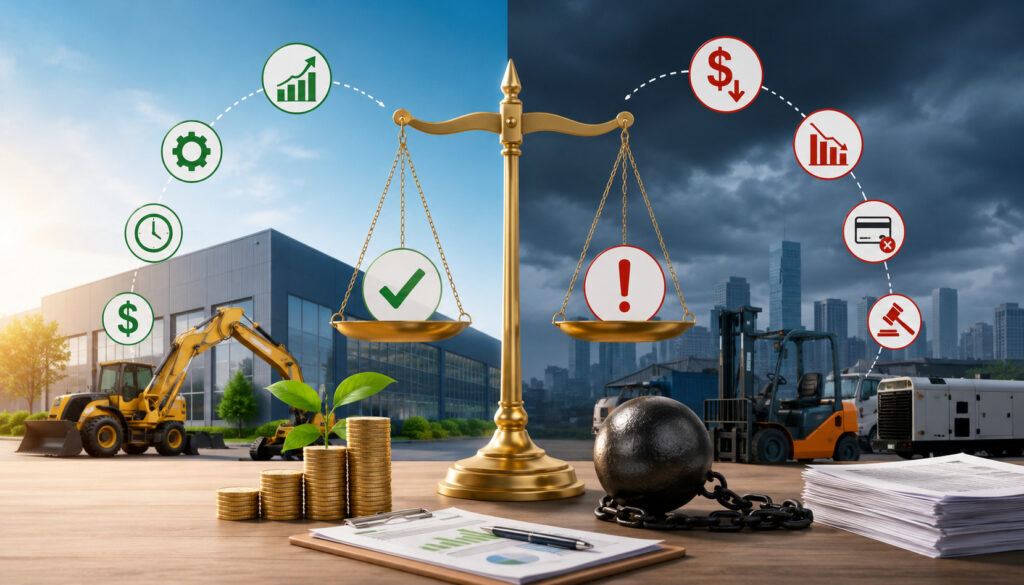
Equipment loans can help a business obtain productive assets without using all its available cash. They may support expansion, replacement, automation, safety improvements, or increased production capacity.
Financing can also create predictable payments when the rate and payment structure are fixed. The business may be able to align the repayment term with the period in which the equipment produces value.
However, every financing benefit comes with an obligation. The borrower must make payments even when demand weakens or the equipment is temporarily out of service. The asset may depreciate faster than expected, require expensive repairs, or become outdated before the loan is repaid.
Equipment financing costs also extend beyond interest. Delivery, installation, taxes, training, software, maintenance, fuel, storage, warranties, insurance, and downtime can materially affect affordability.
A balanced decision considers both the operational value of the equipment and the complete financial burden.
Benefits of Using Equipment Loans Responsibly
Used responsibly, small business equipment loans can help preserve liquidity. Rather than paying a large purchase price at once, the business can spread the expense while retaining cash for daily operations.
Financed equipment may:
- Increase production capacity
- Reduce manual labor
- Improve turnaround times
- Replace unreliable machinery
- Lower recurring repair costs
- Improve product consistency
- Support additional contracts
- Strengthen workplace safety
- Enable new services
- Improve customer experience
The strongest use case is generally an asset with a clear operational role and a reasonable connection to revenue or savings. For example, a machine that removes a recurring production bottleneck may allow more orders to be completed without proportionally increasing labor.
Certain government-backed business loan programs may permit funds to be used for machinery and equipment, but eligibility, underwriting, guarantees, collateral, and program rules vary. Businesses can review the general business loan program overview and seek qualified assistance before applying.
Risks of Taking on Equipment Loan Debt
The main risk is committing to payments that the business cannot support. This may happen because the borrower overestimates demand, underestimates expenses, or fails to account for existing debt.
Other risks include:
- Financing more equipment than needed
- Choosing an excessively long term
- Paying for obsolete equipment
- Accepting unclear fees
- Overlooking a balloon payment
- Using most available cash for the down payment
- Ignoring maintenance and insurance costs
- Pledging broader collateral than expected
- Accepting restrictive prepayment terms
- Taking several loans within a short period
Depreciation is another concern. Wear, age, deterioration, and obsolescence can reduce equipment value over time. If the balance declines more slowly than the asset’s market value, the business may owe more than the equipment could reasonably produce in a sale.
Responsible Equipment Loan Debt Management Compared
The following table highlights differences between responsible equipment financing behavior and decisions that may increase financial pressure.
| Debt Management Area | Responsible Approach | Risky Approach | Why It Matters |
| Loan amount | Borrow based on actual need | Finance more than needed | Limits unnecessary debt |
| Monthly payment | Fit the payment into a realistic budget | Focus only on approval | Reduces repayment stress |
| Loan term | Match the term to useful life | Stretch debt beyond expected use | Avoids paying for obsolete equipment |
| Total cost | Review interest, fees, and final cost | Look only at monthly payment | Shows actual affordability |
| Cash flow | Stress-test repayment | Assume best-case revenue | Prepares for slow periods |
| Documentation | Organize agreements and statements | Ignore loan records | Supports accurate planning |
| Maintenance | Budget for upkeep and repairs | Overlook operating costs | Reduces surprise expenses |
| Credit | Pay on time and monitor reports | Delay or miss payments | Protects future financing access |
| Equipment fit | Finance productive assets | Buy under pressure or impulse | Connects debt to business value |
How to Use the Table Before Borrowing
A business owner can review each row and document the proposed decision. Instead of saying that the payment “looks manageable,” the owner should compare it with average monthly free cash flow, existing debt service, and seasonal low points.
The equipment-fit row requires evidence that the asset supports operations. Useful evidence might include customer orders, project backlogs, repair histories, labor-cost estimates, production data, or vendor performance specifications.
The total-cost row should include more than the amount shown on an equipment quote. Financing charges, delivery, taxes, installation, training, warranties, maintenance, insurance, and downtime should be added to the analysis.
If several answers resemble the risky column, the business may need to reduce the purchase size, increase the down payment without exhausting cash reserves, seek different terms, choose used equipment, lease instead of buy, or postpone the purchase.
Why Responsible Debt Management Starts Before Approval
Equipment loan approval is not the beginning of responsible debt management. By the time approval is issued, important decisions about equipment selection, requested amount, vendor, down payment, and desired term may already have been made.
The most effective debt controls are applied before the financing agreement is signed. This is when the business still has flexibility to negotiate, compare alternatives, change equipment, reduce costs, or walk away.
Once documents are executed and funds are disbursed, changing the arrangement may require refinancing, restructuring, selling the equipment, or paying contractual fees.
Before applying, the owner should create a written business case covering the need, expected benefit, total cost, repayment source, risks, and fallback plan. This process turns equipment loan approval into one factor in the decision rather than the decision itself.
Step One: Decide Whether the Equipment Is Truly Needed
The first step in managing debt responsibly with equipment loans is confirming that the equipment addresses a genuine business need. Financing should not be used merely because a vendor offers a promotion or because newer equipment appears more impressive.
A need may arise when existing equipment creates excessive downtime, limits capacity, presents safety concerns, fails to meet customer requirements, or costs more to repair than replace.
The business should identify the operational problem and explain how the proposed asset will solve it. Relevant questions include:
- Is existing equipment unreliable?
- Are orders being declined because capacity is limited?
- Will the asset reduce labor or material waste?
- Is it necessary for safety or regulatory compliance?
- Does customer demand justify added capacity?
- Could the equipment be rented when needed?
- Is a used asset suitable?
- Can the purchase be postponed without harming operations?
A well-supported need does not guarantee that debt is affordable, but it prevents unnecessary borrowing from being disguised as expansion.
Separating Needs From Wants
Essential equipment directly supports core operations. A bakery cannot produce at the required volume without suitable ovens, and a contractor may be unable to complete certain projects without specific machinery.
A wanted upgrade may improve comfort, appearance, or convenience without materially increasing revenue, reducing costs, or improving risk control. Such upgrades are not always inappropriate, but using debt for them requires a stronger affordability margin.
The business can separate needs from wants by assigning measurable outcomes to the proposed purchase. The asset might need to reduce production time by a specific amount, replace documented repair expenses, satisfy a contract requirement, or add enough capacity to support confirmed demand.
Where the benefit is difficult to measure, the business should be cautious about financing the full purchase.
Estimating Revenue or Cost Savings
Revenue estimates should be based on capacity, demand, pricing, and expected utilization. A machine capable of producing 1,000 units does not create value if the business can sell only 300.
Cost savings may come from lower labor requirements, reduced waste, fewer repairs, lower energy use, or less outsourcing. These savings should be supported by recent business records rather than general assumptions.
A simple analysis can compare estimated monthly benefit with:
- Loan payment
- Maintenance
- Insurance
- Software or subscriptions
- Fuel or energy
- Added labor
- Training
- Downtime
- Storage or facility changes
The result does not need to predict the future perfectly. Its purpose is to reveal whether the equipment still appears reasonable after realistic costs and conservative utilization are considered.
Step Two: Calculate the Full Cost Before Borrowing
The purchase price is only one part of equipment loan planning. A lower-priced asset may cost more over time if it requires frequent repairs, consumes more energy, has limited warranty protection, or creates expensive downtime.
The complete calculation should include acquisition, financing, operation, maintenance, and eventual disposal or replacement.
Potential costs include:
- Down payment
- Interest
- Origination fee
- Documentation fee
- Taxes
- Shipping
- Installation
- Facility modifications
- Training
- Insurance
- Inspections
- Licensing
- Maintenance
- Replacement parts
- Fuel or energy
- Software
- Storage
- Service contracts
- Disposal costs
Some costs may be financed, while others must be paid from operating cash. The business should know which expenses are due before delivery, at closing, during installation, and throughout the asset’s life.
Total Cost of Ownership
Total cost of ownership measures the broader cost of acquiring and operating an asset. It allows the business to compare alternatives that have different purchase prices, maintenance needs, useful lives, and resale values.
A basic calculation may include:
Purchase and financing costs + operating costs + maintenance costs + downtime costs − estimated resale value
Suppose two machines perform similar work. The first costs less but requires more maintenance and consumes more energy. The second has a higher purchase price but includes a longer warranty and lower operating costs. Comparing only the purchase price could lead to the more expensive long-term choice.
Tax treatment may affect after-tax cost, but it should not replace an operational analysis. Federal guidance notes that an asset’s cost basis may include certain expenses such as sales tax, freight, installation, testing, and qualifying professional costs. Specific treatment should be reviewed with an accountant.
Hidden Costs That Can Affect Repayment
Financing documents may contain expenses that are easy to overlook. These could include late fees, returned-payment fees, documentation charges, annual administration costs, appraisal fees, inspection fees, filing costs, and prepayment penalties.
Equipment-related expenses may be equally significant. A commercial vehicle may require registration, specialized insurance, telematics, fuel, tires, and driver training. Manufacturing equipment may require electrical upgrades, ventilation, calibration, software, and scheduled service.
The borrower should request an itemized cost disclosure and read the complete agreement. Questions should be resolved in writing before signing.
A payment that appears affordable can become difficult when these additional expenses are not incorporated into the monthly budget.
Step Three: Match the Loan Term to the Equipment’s Useful Life
The loan term should reflect how long the equipment is expected to remain productive and economically useful. Useful life is influenced by physical wear, technology changes, operating intensity, maintenance quality, and industry requirements.
Longer terms can reduce monthly payments, but they may increase total repayment cost. They can also create a period in which the business continues paying after the asset becomes inefficient or obsolete.
Shorter terms may reduce total interest but create higher payments. The right balance depends on cash flow, equipment durability, resale value, and the business’s replacement cycle.
A construction machine expected to remain useful for many years may reasonably support a longer term than rapidly changing computer hardware. Similarly, high-mileage commercial vehicles may require shorter replacement planning than equipment used only occasionally.
Avoiding Long Debt on Short-Life Equipment
Paying for equipment after it has stopped producing value creates two problems. The business still owes the original debt and may need new financing for replacement equipment.
This overlap can lead to stacked payments, reduced borrowing capacity, and cash flow pressure. It may also cause the business to continue using unreliable equipment because replacing it would create another obligation.
Before accepting a term, estimate when the equipment is likely to require replacement. Consider age, usage, warranty coverage, repair history, manufacturer support, and technological change.
If the proposed loan extends beyond the realistic useful life, the business should evaluate a shorter term, lower-cost equipment, larger but affordable down payment, or lease arrangement.
Considering Resale Value and Upgrade Needs
Resale value can reduce the long-term cost of ownership, but it should be estimated conservatively. Highly specialized equipment may have a limited buyer market, while common vehicles and machinery may be easier to sell.
Trade-in policies, title requirements, liens, and payoff balances should also be considered. A lender’s lien generally must be resolved before clear ownership can transfer.
Businesses in technology-sensitive industries should consider upgrade frequency. An asset may continue working physically but become commercially outdated because customers, software platforms, safety rules, or production standards have changed.
The financing strategy should leave enough flexibility to replace or upgrade the equipment without carrying an unreasonable balance.
Step Four: Review Cash Flow Before Accepting Equipment Debt
Cash flow is one of the most important factors in business loan debt management. The question is not only whether the business can make the payment during a normal month, but whether it can continue paying during slow periods.
The review should include:
- Average monthly collections
- Seasonal revenue patterns
- Payroll
- Rent
- Inventory
- Taxes
- Insurance
- Owner distributions
- Existing debt
- Customer payment delays
- Emergency expenses
- Available cash reserves
Profit and loss statements, balance sheets, bank statements, accounts-receivable aging, and cash flow forecasts can provide different perspectives. A business may report profit while experiencing cash shortages because customers have not paid invoices.
The owner should also calculate how the new obligation changes total debt service. Debt service coverage is one measure lenders and businesses may use to compare operating cash flow with required debt payments.
Stress-Testing the Monthly Payment
Stress testing examines whether the business could continue paying under less favorable conditions. The analysis might reduce projected revenue, delay customer collections, increase repair costs, or add an unexpected expense.
Useful scenarios include:
- Revenue falls by 10% or 20%
- A major customer pays 30 days late
- The equipment is unavailable for two weeks
- Insurance premiums increase
- Material costs rise
- A seasonal slowdown lasts longer than expected
- Existing equipment needs an emergency repair
The business should identify which expenses could be reduced and how long available reserves would last. A payment that is comfortable only in the strongest scenario may be too aggressive. Responsible equipment financing leaves a reasonable margin for normal uncertainty.
Keeping Working Capital Available
A larger down payment can reduce the loan balance and monthly payment, but using too much cash may weaken daily operations. The lowest debt balance is not always the safest structure if it leaves the business unable to fund payroll, materials, or emergency repairs.
Working capital is needed to bridge timing differences between paying expenses and collecting revenue. Businesses with seasonal sales, long customer-payment cycles, or inventory requirements may need a larger liquidity buffer.
Before choosing a down payment, the owner should calculate how much unrestricted cash will remain after taxes, delivery, installation, training, and initial operating expenses. The goal is to balance lower borrowing with adequate liquidity.
Step Five: Compare Loan Offers Carefully
Financing offers can differ in rate, payment frequency, term, fees, collateral, prepayment rules, documentation requirements, and default provisions. Responsible equipment financing requires comparing the complete arrangement rather than accepting the first approval.
Request written offers that clearly identify:
- Amount financed
- Down payment
- Interest rate or pricing method
- Payment amount and frequency
- Number of payments
- Total repayment
- Fees
- Collateral
- Personal guarantees
- Prepayment conditions
- Late-payment provisions
- Funding requirements
- Insurance obligations
Businesses should compare offers using the same equipment price and financing amount. Otherwise, differences in down payment or financed costs may make one offer appear cheaper when it is not.
What to Compare Beyond the Interest Rate
The interest rate is important, but it does not reveal every cost or contractual condition. One offer may have a lower rate but a higher origination fee. Another may allow early payoff without penalty, while a competing offer charges most of the remaining finance cost.
Payment frequency also matters. Weekly payments can affect cash flow differently from monthly payments, even when the advertised cost appears similar.
Borrowers should compare total repayment, timing, flexibility, collateral scope, personal guarantees, customer-service access, and documentation obligations.
Before choosing among equipment financing options, owners should create a side-by-side worksheet and ask for clarification whenever pricing cannot be compared consistently.
Why the Lowest Payment Is Not Always Best
A low monthly payment can result from a long term, large final payment, high down payment, or payment structure that does not show the complete cost clearly.
Extending repayment may improve immediate cash flow but increase total interest. It can also keep debt outstanding after the equipment’s strongest productive years.
The better payment is the one that fits realistic cash flow while maintaining a reasonable total cost and appropriate loan term.
Borrowers should ask, “Why is this payment lower?” The answer may reveal a useful feature or a hidden tradeoff.
Step Six: Understand the Loan Agreement Before Signing
The financing agreement controls the borrower’s obligations. Sales conversations, informal explanations, and marketing materials do not replace the written contract.
The business should review the repayment schedule, total cost, collateral description, default provisions, insurance requirements, prepayment rules, maintenance responsibilities, reporting requirements, and dispute procedures.
Important terms may be located in attachments, schedules, or incorporated documents. Every document referenced in the agreement should be obtained and reviewed before signing.
No provision should be left unclear because the funding deadline is approaching. A delayed equipment purchase may be inconvenient, but an unsuitable agreement can affect the business for years.
Contract Terms That Affect Debt Management
Key provisions include:
- Payment due date: The date funds must be received.
- Grace period: Any period before a late fee or default consequence applies.
- Late fee: The charge for an overdue payment.
- Default clause: Events that allow the lender to declare a default.
- Acceleration clause: A provision that may make the remaining balance immediately due.
- Prepayment rule: Conditions for paying the debt early.
- Collateral rights: The property securing the obligation.
- Insurance requirements: Coverage and lender endorsements that must remain active.
- Financial covenants: Ratios, reporting, or operational conditions the borrower must maintain.
- Cross-default provision: A clause under which default on another obligation may affect this loan.
The borrower should also determine whether the lien is limited to the equipment or extends to other business assets.
When to Ask for Professional Review
Professional review may be appropriate when the amount is substantial, the agreement contains unfamiliar language, multiple assets secure the loan, a personal guarantee is required, or the business is refinancing existing obligations.
An attorney can review legal rights, collateral provisions, default language, and guarantees. An accountant can evaluate cash flow, financial statement effects, depreciation, and tax treatment. A financing professional may help compare structures, but potential conflicts and compensation should be understood.
Tax outcomes should never be assumed from general information. Federal depreciation rules can depend on ownership, business use, useful life, placed-in-service dates, asset classification, and other facts.
Step Seven: Create an Equipment Loan Repayment Plan
A repayment plan translates the financing agreement into monthly financial actions. It should identify due dates, payment amounts, account balances, cash sources, reserve targets, and responsible staff members.
The plan may include:
- Automatic payment enrollment
- Calendar reminders
- Monthly cash flow forecasts
- Minimum payment reserves
- Statement reviews
- Loan-balance reconciliation
- Insurance-renewal reminders
- Covenant-reporting deadlines
- Maintenance budgeting
- Annual payoff reviews
Automatic payments can reduce the risk of forgetting a due date, but the account must contain sufficient funds. The business should monitor the withdrawal and retain confirmation.
The repayment plan should be integrated with accounting records so that principal, interest, fees, and the asset balance are recorded correctly.
Building Payments Into the Monthly Budget
Equipment loan repayment should be treated as a fixed obligation. It should appear in the budget before discretionary spending, owner distributions, or optional expansion expenses.
A rolling forecast can show expected cash receipts and expenses over the next several months. This helps identify periods when the payment may conflict with taxes, annual insurance premiums, inventory purchases, or seasonal payroll.
Budgeting should include both the loan payment and the equipment’s operating costs. A business that budgets the payment but overlooks fuel, maintenance, or software may still experience financial strain.
Monthly budget reviews should compare projected and actual results. If the equipment is producing less value than expected, the issue can be addressed early.
Setting Aside Cash for Slow Periods
Seasonal businesses can build a payment reserve during stronger months. The reserve should be held separately from funds allocated for payroll, taxes, or other restricted purposes.
A contractor may experience weather-related delays. A farm may have income concentrated around harvest. A retailer may depend on peak selling periods. These businesses should not assume that average annual revenue means equal monthly cash availability.
The reserve target should reflect payment size, revenue volatility, customer concentration, and the time required to reduce expenses.
Even a modest buffer can prevent a temporary slowdown from becoming a missed payment.
Step Eight: Monitor Equipment Performance and Debt Impact
The business should track whether financed equipment delivers the value expected when the loan was approved. The purchase should not disappear into operations without further review.
Relevant measures include:
- Revenue generated
- Units produced
- Jobs completed
- Labor hours saved
- Material waste reduced
- Repair costs avoided
- Equipment utilization
- Downtime
- Maintenance expenses
- Energy use
- Customer demand
- Remaining loan balance
Performance information helps the business decide whether to continue using, replace, sell, refinance, or upgrade the asset.
It also improves future equipment financing strategy. Actual data from one purchase can make later revenue projections and cost estimates more accurate.
Measuring Equipment ROI
A practical equipment ROI review compares financial benefit with ownership and financing costs.
A simplified calculation might be:
Annual added profit or cost savings − annual loan and operating costs
The analysis should avoid counting gross revenue as if it were profit. New revenue may require materials, labor, shipping, commissions, or other variable expenses.
Downtime should also be considered. Equipment that generates strong revenue when operating may still underperform if it frequently needs repairs.
ROI should be reviewed over time rather than judged from one month. Startup periods, employee training, installation delays, and seasonal demand may temporarily affect results.
Watching for Warning Signs
Warning signs of equipment debt stress include:
- Repeated late payments
- Frequent overdrafts
- Declining equipment use
- Rising repair costs
- Difficulty funding payroll
- Missed tax payments
- Reliance on short-term borrowing
- New debt used to make old payments
- Falling credit scores
- Unplanned owner contributions
- Equipment value below the outstanding balance
One warning sign does not always mean the loan will fail, but a pattern requires attention.
The business should update its cash flow forecast, identify the cause, reduce avoidable expenses, and seek qualified assistance. Early action generally provides more options than waiting until default is imminent.
Step Nine: Avoid Taking on Too Many Equipment Loans at Once
Multiple equipment loans can support growth, but they can also create stacked payments that become difficult to manage. Each new obligation reduces available cash flow and may limit future borrowing capacity.
Rapid expansion is particularly risky when new equipment is financed before earlier purchases have demonstrated their value. Revenue may take longer to develop than expected, while every payment begins according to schedule.
Before adding another loan, the business should review:
- Total monthly debt service
- Remaining loan balances
- Equipment utilization
- Cash reserves
- Upcoming replacements
- Existing liens
- Customer demand
- Staffing capacity
- Maintenance obligations
Growth should be paced according to operational readiness and financial capacity.
Managing Multiple Equipment Loan Payments
A centralized debt schedule can help businesses manage several obligations. The schedule should list the lender, original balance, remaining balance, payment, due date, interest rate, term, collateral, maturity date, and payoff conditions.
The business should reconcile this schedule with financial statements and lender statements. It should also track which assets secure each loan and whether any agreement includes cross-collateralization.
Payment calendars and automatic transfers can reduce administrative errors, but cash flow should still be reviewed before each due date.
Where several payments occur within a short period, the business may explore whether due dates can be adjusted. Any change should be documented in writing.
Knowing When to Pause New Borrowing
A business may need to pause when existing equipment is underutilized, cash reserves are shrinking, payments are consuming an increasing share of available cash, or new debt is being considered primarily to solve problems caused by previous debt.
Pausing does not necessarily mean abandoning growth. The business can improve utilization, sell unused assets, renegotiate vendor costs, collect receivables, strengthen credit, or build a larger down payment.
Additional borrowing should resume only when the business understands how the new obligation fits with existing debt and operating needs.
Step Ten: Consider Refinancing or Restructuring When Appropriate
Refinancing replaces an existing loan with new financing. Restructuring changes certain terms of the current obligation, subject to lender approval.
Potential objectives include reducing the payment, lowering the interest rate, changing the repayment schedule, consolidating several equipment debts, or removing an unsuitable term.
However, a lower payment does not automatically mean a better outcome. Extending the term can increase total repayment and keep debt outstanding after the equipment’s useful life.
Businesses evaluating equipment loan refinancing should compare the remaining cost of the current loan with the complete cost of the proposed arrangement, including fees and payoff charges.
When Refinancing May Help
Refinancing may be worth reviewing when:
- Credit has improved
- Revenue and financial statements are stronger
- Existing financing is unusually expensive
- Several equipment payments are difficult to track
- A variable rate creates uncertainty
- The payment schedule conflicts with seasonality
- Cash flow needs have changed
- Current terms restrict early payoff or future financing
The business should request an official payoff amount and verify whether the current agreement includes prepayment costs.
It should then compare the new total payment, term, collateral, fees, and useful-life alignment with the existing obligation.
When Refinancing May Increase Risk
Refinancing may increase risk when the new term extends well beyond the equipment’s remaining useful life, fees eliminate expected savings, or additional collateral is required.
It can also be risky when the business repeatedly refinances to postpone a payment problem without addressing weak cash flow or underperforming equipment.
Consolidation may simplify several payments but can convert short remaining terms into one long obligation. The business may pay more over time even if the monthly amount decreases.
A refinancing decision should be based on total cost and long-term debt health, not only immediate payment relief.
Equipment Loan Debt Management Checklist
| Checklist Area | What to Review | Why It Matters |
| Business need | Is the equipment essential? | Prevents unnecessary debt |
| Cash flow | Can the business afford payments in slow periods? | Reduces repayment stress |
| Total cost | Interest, fees, maintenance, insurance, and operation | Shows real affordability |
| Loan term | Does it match the equipment’s useful life? | Avoids term mismatch |
| Equipment value | Productivity, condition, resale value, and utilization | Supports the borrowing decision |
| Offer comparison | Rates, fees, terms, collateral, and flexibility | Helps identify a suitable structure |
| Working capital | How much cash remains after closing? | Protects daily operations |
| Repayment plan | Due dates, budget, and payment buffer | Reduces missed-payment risk |
| Performance tracking | Revenue, savings, use, and downtime | Measures equipment value |
| Records | Agreements, statements, invoices, and maintenance logs | Supports planning and compliance |
How to Use the Checklist Before Financing
Complete the checklist in writing for every substantial equipment purchase. Assign supporting documents to each category, such as equipment quotes, bank statements, repair histories, contracts, revenue projections, and proposed financing terms.
Any unanswered question should be resolved before signing. For example, if the useful life is uncertain, the business can request manufacturer information, maintenance records, inspection reports, or an independent appraisal.
The checklist can also be used as an internal approval record. It creates a consistent process and helps prevent urgent vendor deadlines from replacing financial analysis.
Records to Keep After Taking an Equipment Loan
Businesses should retain:
- Signed financing agreements
- Payment schedules
- Equipment invoices
- Proof of down payment
- Delivery and installation records
- Serial numbers and titles
- Insurance documents
- Inspection reports
- Maintenance logs
- Warranty information
- Loan statements
- Payment confirmations
- Payoff quotes
- Lender correspondence
- Tax and depreciation records
Organized records help support accounting, insurance claims, lender inquiries, equipment sales, refinancing, and future equipment loan approval.
Retention requirements can vary by document type and applicable rules. An accountant or attorney can recommend an appropriate recordkeeping policy.
Best Practices for Managing Debt Responsibly With Equipment Loans

Responsible equipment financing can be summarized through several practical habits:
- Borrow only for equipment that supports operations.
- Calculate total cost before signing.
- Match the loan term to useful life.
- Compare multiple financing offers.
- Keep payments within realistic cash flow.
- Budget for repairs, maintenance, and insurance.
- Preserve working capital.
- Review every contract provision.
- Avoid stacking excessive loans.
- Track balances and payments monthly.
- Measure equipment performance.
- Maintain organized records.
- Communicate early when problems arise.
- Review refinancing based on total cost.
- Seek professional guidance for complex matters.
These equipment financing best practices should be applied consistently, not only when a business is under financial pressure.
Creating a Responsible Equipment Financing Policy
A written policy can establish internal rules for equipment borrowing. It may define who can propose a purchase, what financial analysis is required, who approves debt, and what records must be maintained.
The policy might require:
- A documented business need
- Multiple equipment quotes
- Multiple financing offers
- Total-cost analysis
- Cash flow stress testing
- Useful-life review
- Minimum reserve levels
- Approval from designated owners or managers
- Professional review above a stated amount
- Monthly performance reporting
A policy is especially useful for businesses with several locations, departments, vehicles, or managers. It reduces inconsistent decisions and creates accountability.
Reviewing Debt Health Regularly
Debt health should be reviewed monthly or quarterly, depending on business complexity. The review should include outstanding balances, monthly payments, upcoming maturities, liens, credit health, cash reserves, and equipment performance.
Financial statements should be compared over time. Rising debt combined with falling cash flow or declining equipment utilization may indicate that expansion is moving too quickly.
The business should also forecast upcoming replacement needs. Planning early can reduce the chance of taking expensive financing under emergency conditions.
Common Mistakes to Avoid When Managing Equipment Loan Debt
Common errors include borrowing too much, focusing only on the payment, choosing the wrong term, and failing to budget for ownership costs.
Other mistakes include:
- Applying without accurate financial records
- Assuming approval means affordability
- Using optimistic revenue forecasts
- Ignoring seasonal cash flow
- Spending all available cash on the down payment
- Overlooking lien provisions
- Missing insurance requirements
- Failing to compare offers
- Refinancing without calculating total cost
- Avoiding lender communication during difficulty
Most of these mistakes occur because the purchase is treated as an equipment decision rather than a combined equipment, debt, and cash flow decision.
Treating Equipment Loans Like Free Cash
Financing reduces the immediate cash required, but it does not reduce the underlying obligation. The business eventually repays the financed amount along with interest and applicable fees.
The loan should be used only for its intended business purpose. Financing extra accessories or upgrades because funds are available can increase the balance without producing equivalent value.
Every financed dollar should have a clear role in supporting the asset’s installation, operation, safety, or productivity.
Ignoring Early Warning Signs of Debt Stress
Late payments, overdrafts, missed tax obligations, shrinking reserves, and growing reliance on short-term credit should not be treated as isolated inconveniences.
These signs may indicate that the business’s repayment assumptions are no longer valid. The cause could be weaker sales, customer delays, higher expenses, equipment downtime, or excessive debt.
The owner should update financial projections, review expenses, contact relevant professionals, and communicate with the lender before the situation becomes more severe.
How to Choose Small Business Equipment Loans Responsibly
Choosing among small business equipment loans requires evaluating structure, affordability, flexibility, and contract clarity.
Review the:
- Loan amount
- Down payment
- Interest rate
- Total repayment
- Term length
- Payment frequency
- Fees
- Collateral
- Personal guarantee
- Prepayment rules
- Approval conditions
- Funding timeline
- Insurance requirements
- Customer support
- Default provisions
The best fit is not necessarily the offer with the fastest approval or lowest payment. It is the financing arrangement that supports the equipment purchase while protecting cash flow and long-term flexibility.
Questions to Ask Before Accepting an Equipment Loan
Before signing, ask:
- What is the total amount financed?
- What is the total repayment cost?
- Is the rate fixed or variable?
- How often are payments due?
- Are there origination or documentation fees?
- Is there a balloon payment?
- What happens if a payment is late?
- Can the loan be paid early?
- Is there a prepayment penalty?
- What collateral is required?
- Is a personal guarantee required?
- What insurance must remain active?
- Does the term match the equipment’s useful life?
- What documents are required after closing?
- How is the payoff amount calculated?
- What happens if the equipment is sold or replaced?
- Is repayment flexibility available during seasonal periods?
Answers should be documented in the agreement or written lender communication.
Comparing Long-Term Value Over Short-Term Approval Speed
Fast approval can be useful when equipment is urgently needed, but speed should not replace careful analysis. A rapid decision may still involve high fees, unsuitable payment frequency, broad collateral, or restrictive payoff terms.
Responsible equipment financing for small businesses considers how the loan will affect the company over its entire term.
A business that spends an extra day comparing terms may avoid years of unnecessary cost or inflexibility. Approval speed is one factor, not the primary measure of value.
Frequently Asked Questions
What does managing debt responsibly with equipment loans mean?
It means borrowing only for equipment that serves a valid business purpose and choosing financing the business can reasonably repay.
Responsible management includes calculating total cost, protecting working capital, matching the term to useful life, paying on time, monitoring equipment performance, and maintaining accurate loan records.
How can small businesses avoid taking on too much equipment loan debt?
Businesses can start by reviewing total existing debt and calculating the new payment under conservative cash flow assumptions.
They should avoid financing unnecessary upgrades, adding several loans at once, or borrowing based solely on the amount a lender is willing to approve. A written budget and debt schedule can reveal whether the combined obligations are becoming too large.
What are responsible ways to use equipment loans?
Responsible uses include replacing unreliable machinery, acquiring assets needed for confirmed demand, reducing recurring operating costs, improving safety, and increasing productive capacity.
The equipment should have a clear connection to operations, revenue, savings, or risk reduction. The loan should not leave the business without enough cash for daily expenses.
How should businesses calculate equipment loan affordability?
Affordability should include the monthly payment, interest, fees, down payment, maintenance, insurance, installation, taxes, fuel, software, repairs, and other operating expenses.
The business should compare these costs with realistic cash flow and test whether payments remain manageable when sales decline or customers pay late.
Why does equipment useful life matter when borrowing?
The equipment should ideally remain productive for at least as long as the repayment period. If the loan continues after the asset becomes obsolete or unreliable, the business may need to finance a replacement while still paying the original debt. Useful life also affects resale value, maintenance risk, and the suitability of a loan compared with a lease.
What are common equipment loan repayment strategies for small businesses?
Strategies include building payments into the monthly budget, using calendar reminders, monitoring automatic withdrawals, maintaining a payment reserve, saving during strong seasonal periods, and reviewing statements each month.
Businesses can also track principal balances, equipment performance, and upcoming expenses so repayment issues are identified early.
When should a business consider refinancing equipment loan debt?
Refinancing may be reviewed when credit has improved, revenue is stronger, existing financing is expensive, or several payments could be managed more efficiently.
The business should compare the remaining cost of the current loan with the complete cost of refinancing. Fees, term extension, collateral, and the equipment’s remaining useful life must be considered.
What records should businesses keep after taking an equipment loan?
Important records include the financing agreement, payment schedule, invoices, proof of down payment, insurance documents, titles, serial numbers, maintenance logs, warranties, statements, payment confirmations, payoff quotes, and lender correspondence.
Tax, depreciation, and accounting records should also be maintained according to professional guidance and applicable retention requirements.
Conclusion
Managing debt responsibly with equipment loans helps businesses acquire important assets without placing unnecessary pressure on cash flow, working capital, credit health, or future borrowing capacity.
A responsible equipment financing strategy begins by confirming that the asset is truly needed. The business should estimate its revenue contribution or cost savings, calculate total ownership and financing costs, and select a term that reflects the equipment’s useful life.
Before accepting an offer, the owner should compare rates, fees, repayment schedules, collateral, prepayment terms, and total repayment. The lowest payment or fastest equipment loan approval may not provide the strongest long-term value.
After funding, equipment loan repayment should be included in the monthly budget and supported by a realistic cash reserve. The business should track the loan balance, monitor the asset’s productivity, maintain organized records, and watch for signs of debt stress.
Responsible borrowing also means knowing when to pause. Businesses should avoid stacking multiple obligations before existing equipment has demonstrated its value and before cash flow can support additional debt.
Equipment loans can be useful tools when they finance productive assets and are supported by careful planning. Because financing, tax, accounting, and legal outcomes depend on individual circumstances, businesses should obtain qualified professional guidance before entering complex agreements, restructuring debt, or relying on specific tax treatment.