USDA Equipment Loan Programs Explained
Purchasing essential equipment can be one of the largest financial commitments a farm or rural business makes. Tractors, irrigation systems, refrigerated storage units, processing machinery, commercial vehicles, packaging equipment, and specialized production tools may improve productivity, but their upfront costs can place considerable pressure on cash reserves.
USDA equipment loan programs may provide a financing path for eligible farmers, ranchers, agricultural producers, and rural businesses. Rather than representing one universal equipment loan, the term generally refers to several agricultural and rural development programs through which equipment may be an eligible use of funds.
Some programs provide direct loans to eligible producers. Others involve loans made by participating commercial lenders and supported by a government guarantee. Eligibility, equipment uses, repayment terms, application procedures, collateral requirements, and lender standards vary considerably between programs.
Applicants should therefore begin by identifying the purpose of the equipment, the type of operation that will use it, and the program that appears to match that purpose. They should also confirm current requirements through official farm loan resources or the appropriate rural development office before making purchasing commitments.
Official guidance confirms that farm operating loans may support equipment purchases, while rural business programs may help eligible rural enterprises obtain capital for equipment and business development.
This article provides general educational information rather than financial, accounting, tax, legal, or eligibility advice. Program rules can change, and approval depends on the facts of each application.
What Are USDA Equipment Loan Programs?
USDA equipment loan programs are financing arrangements connected to agricultural production, family farming, rural economic development, or eligible rural business activity. Depending on the program, financing may be used to purchase machinery, improve productive capacity, replace outdated assets, support farm operations, or help a rural business expand.
There is no single loan officially covering every type of equipment or applicant. A farmer purchasing a tractor may need to explore a different program from a rural food processor purchasing refrigeration and packaging equipment.
Similarly, an applicant seeking a direct farm loan may follow a different application process from a rural business working with a participating commercial lender.
Common financing paths may include:
- Direct farm operating loans
- Guaranteed farm operating loans
- Farm ownership loans
- Farm microloans
- Rural business guaranteed financing
- Loans made through eligible rural intermediaries
- Certain energy, processing, or economic development programs
- Conventional equipment financing used when USDA financing does not fit
Farm operating loans can generally support normal operating costs, machinery, equipment, livestock, supplies, and certain improvements. Rural business programs may provide financial backing and technical support intended to help rural businesses obtain capital, equipment, space, and other resources.
Because program purposes differ, the first question should not be, “Can USDA finance equipment?” The better question is, “Which program, if any, covers this applicant, location, business purpose, and specific equipment purchase?”
USDA Equipment Loans vs Regular Equipment Loans
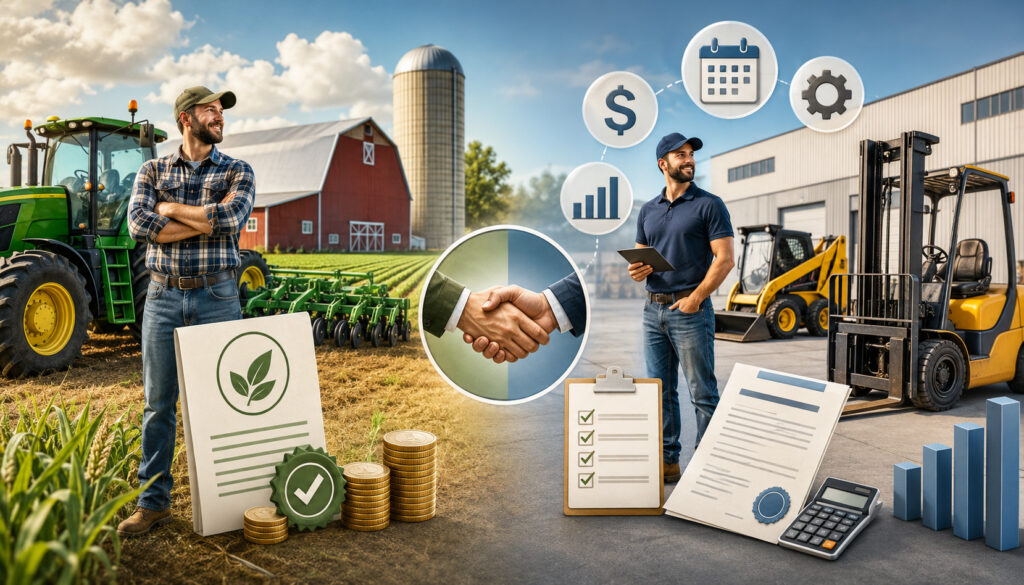
Regular equipment loans are usually offered directly by banks, credit unions, equipment finance companies, or other commercial lenders. Approval commonly depends on credit, revenue, time in business, cash flow, equipment value, and the lender’s internal underwriting standards.
USDA equipment loans may add another layer of program-specific review. Depending on the financing path, an applicant may need to demonstrate agricultural involvement, family-farm eligibility, rural location, an eligible business purpose, acceptable citizenship or legal status, inability to obtain reasonable credit elsewhere, or compliance with environmental and program requirements.
A direct loan is funded and serviced through the applicable government agency. A guaranteed loan is generally made and serviced by an approved commercial lender, while the government guarantees an eligible portion of the lender’s exposure. The guarantee supports the lender; it does not remove the borrower’s responsibility to repay the debt.
USDA-related financing may also involve more documentation and a longer review than some regular equipment loans. In return, eligible borrowers may gain access to financing structures designed specifically for farm or rural development needs.
Businesses comparing government-supported and private financing can review this guide to agricultural equipment loans, which explains common farm equipment funding sources, machinery uses, repayment considerations, and differences between government-backed and private-sector options.
Why Equipment Financing Matters for Rural and Farm Businesses
Equipment often determines how much a farm or business can produce, process, store, and deliver. A machine failure during planting, harvesting, or peak production can cause more than a repair bill. It can result in missed contracts, spoiled inventory, delayed orders, reduced yield, or lost revenue.
Financing may help an operation acquire equipment without paying the full purchase price at once. This can preserve working capital for payroll, seed, feed, fuel, repairs, packaging materials, inventory, insurance, utilities, and other operating costs.
Equipment financing may also support:
- Faster planting and harvesting
- Improved irrigation and water management
- Safer livestock handling
- Better temperature-controlled storage
- Expanded food processing capacity
- More efficient packaging
- Reliable product transportation
- Reduced dependence on rented machinery
- Lower labor requirements
- Improved workplace safety
- Replacement of inefficient equipment
- Entry into new markets or product categories
Financing does not automatically make an equipment purchase affordable. The equipment must produce enough measurable value to support loan payments, maintenance, insurance, fuel, storage, and unexpected downtime.
A useful analysis compares the expected financial benefit of the equipment with its total ownership and financing cost. Productivity improvements are valuable only when they translate into stronger cash flow, reduced costs, protected revenue, or improved operating reliability.
Who May Use USDA Equipment Loans?
Eligibility depends on the program rather than on equipment need alone. USDA equipment financing may be relevant to family farmers, ranchers, beginning producers, agricultural businesses, rural entrepreneurs, food processors, manufacturers, cooperatives, and certain community-focused organizations.
A farm-focused program may require the applicant to operate or plan to operate an eligible farm or ranch. A rural business program may focus more heavily on location, business purpose, job creation, financial feasibility, and lender participation.
Potential applicants may include:
- Crop and livestock producers
- Beginning farmers and ranchers
- Family-owned agricultural operations
- Specialty and nontraditional farms
- Rural food manufacturers
- Meat, dairy, grain, and produce processors
- Agricultural service businesses
- Rural repair and maintenance businesses
- Small manufacturers
- Commercial transportation operations
- Packaging and distribution businesses
- Cooperatives
- Certain nonprofit organizations
- Eligible public or tribal entities
- Rural businesses seeking expansion capital
Not every applicant in one of these categories will qualify. The legal structure, ownership, location, use of funds, financial condition, management experience, and ability to repay may all affect USDA loan eligibility.
Farmers, Ranchers, and Agricultural Producers
Farmers and ranchers may explore USDA farm equipment loans when they need machinery or operating assets that directly support agricultural production. Examples include tractors, planters, harvesters, balers, livestock equipment, utility vehicles, irrigation systems, and handling machinery.
Farm operating loan programs are among the most relevant paths because official program information identifies machinery and equipment as possible uses. These loans are designed to help eligible family farmers and ranchers start, maintain, or strengthen their operations.
Eligibility may involve an evaluation of:
- Farm ownership or operating arrangements
- Production history
- Relevant training or management experience
- Credit history
- Repayment ability
- Available collateral
- Farm business plans
- Projected income and expenses
- Existing debt
- Access to reasonable commercial credit
- Compliance with applicable program rules
Beginning producers should not assume that limited operating history automatically prevents consideration. Certain programs and microloan structures are designed with smaller, beginning, specialty, or nontraditional operations in mind.
Official farm loan resources describe microloans as a simplified form of operating or ownership financing with reduced paperwork for qualifying applicants.
Rural Small Businesses and Food Producers
USDA rural business loans may be relevant to eligible businesses that are not traditional farms. A rural food processor, manufacturer, repair business, packaging operation, cold-storage facility, transportation company, or agricultural service provider may need equipment to create jobs, improve efficiency, or expand local production.
Rural business financing programs often work through lenders, utilities, nonprofit intermediaries, or community organizations. The applicant may therefore need to identify both an eligible program and an institution authorized to make or facilitate the financing.
Equipment needs might include:
- Refrigeration and freezer systems
- Commercial ovens and food production machinery
- Bottling, filling, or canning equipment
- Labeling and packaging machines
- Material-handling systems
- Forklifts and loading equipment
- Welding and fabrication tools
- Commercial delivery vehicles
- Repair and diagnostic equipment
- Computer-controlled manufacturing systems
- Warehouse and inventory equipment
- Energy-efficient production assets
Location is often critical. A business may serve agricultural customers but still fail a rural eligibility test. Another business may operate in an eligible rural area but propose an equipment use that does not fit the program.
Applicants should use the official eligibility resources associated with the program and request written clarification when the location or project purpose is uncertain.
Common Types of USDA Loan Programs That May Support Equipment Needs
Several USDA loan programs may support equipment, but the correct path depends on whether the applicant is a producer, rural business, lender, cooperative, intermediary, or community organization.
Applicants should avoid treating program names as interchangeable. Farm operating financing is designed around agricultural operating needs, while rural business guarantees focus on eligible business credit and rural economic activity. Farm ownership loans primarily address farm real estate and related improvements rather than functioning as general equipment loans.
The most relevant categories include direct loans, guaranteed loans, farm operating loans, farm ownership loans, microloans, and rural business financing. Other programs may support equipment indirectly through energy improvements, community projects, revolving loan funds, or local intermediaries.
Farm Operating and Farm Ownership Loan Programs
Farm operating loans are generally the strongest USDA-related match for standalone machinery and equipment purchases. Official program information states that operating loans may be used for machinery, equipment, livestock, seed, feed, fuel, supplies, certain minor improvements, and other operating expenses.
Operating financing may be structured for short-term annual expenses or longer-term asset purchases. A seasonal operating loan may be repaid after commodities are sold, while a term loan for equipment may have a longer repayment period based on the asset and program rules.
Farm ownership loans primarily help eligible producers purchase, enlarge, improve, or develop farms and ranches. They may support buildings, soil and water conservation, closing costs, and other real-estate-related purposes. Equipment should not be assumed eligible under an ownership loan merely because it will be used on the property.
In some projects, real estate improvements and equipment are closely connected. An irrigation project, permanent storage installation, or fixed processing system may require a careful program determination. Applicants should ask whether the asset is considered equipment, a fixture, an improvement, or part of a broader farm development project.
Rural Business and Industry Financing Options
The Business and Industry Guaranteed Loan Program supports eligible rural businesses by encouraging participating commercial lenders to provide credit. It is a loan guarantee program rather than a direct equipment loan program. Its purpose is to improve rural economic health and expand access to business capital.
Depending on current requirements and lender approval, eligible loan purposes may include business acquisitions, construction, facility improvements, equipment purchases, machinery, supplies, inventory, and certain working capital needs.
The participating lender generally performs its own underwriting and remains responsible for servicing the loan. The applicant may need to satisfy both program requirements and the lender’s credit standards.
Other rural development paths may involve intermediaries. For example, certain rural economic development programs provide funds through qualifying utility organizations, which may then support local projects that create or preserve employment.
These programs are not open as direct applications from every small business, so the structure and eligible intermediary must be verified.
USDA Equipment Loan Programs Compared
The table below provides a starting framework. It does not establish eligibility or replace official program instructions.
| Program Type | Best For | Possible Equipment Use | What to Review |
| Farm operating loans | Active farm and ranch operating needs | Machinery, livestock equipment, production tools, supplies, and certain improvements | Applicant eligibility, repayment ability, loan purpose, collateral, and approved uses |
| Farm ownership loans | Farm purchase, enlargement, or development | Equipment only when allowed as part of an eligible farm ownership or improvement purpose | Program purpose, real estate connection, collateral, and project structure |
| Guaranteed farm loans | Eligible producers working through participating lenders | Farm machinery, equipment, livestock, and operating assets | Lender underwriting, guarantee rules, borrower contribution, repayment, and security |
| Rural business loans | Eligible rural business development | Commercial equipment, processing systems, vehicles, fixtures, or facility-related assets | Rural location, legal business purpose, project feasibility, and program exclusions |
| Business and industry financing | Creditworthy eligible rural businesses | Production, processing, distribution, refrigeration, manufacturing, and commercial equipment | Participating lender, collateral, equity, guarantee conditions, and documentation |
| Direct loan programs | Eligible applicants meeting direct program standards | Equipment where specifically permitted by the program | Direct application procedures, loan limits, experience, credit availability, and servicing |
| Intermediary or revolving loan programs | Rural projects supported through eligible local organizations | Equipment tied to business development or job creation | Availability in the area, intermediary participation, local terms, and project impact |
| Alternative equipment loans | Businesses that do not fit a USDA program | Equipment across many agricultural and commercial industries | Interest rate, fees, speed, down payment, flexibility, collateral, and total cost |
How to Use the Table Before Applying
Begin by matching the equipment to its primary purpose. A tractor used in crop production points toward farm operating financing. A packaging line used by a rural food manufacturer may point toward rural business financing. A permanent facility improvement may require a different analysis.
Next, review the applicant type. Determine whether the borrower is an individual producer, farm entity, cooperative, rural business, nonprofit organization, public body, or another eligible structure.
Then evaluate location. Rural business programs may use a formal geographic definition. Farm programs may focus more on the agricultural operation and applicant qualifications.
Finally, assess repayment capacity. Even when the equipment and applicant appear eligible, financing still depends on whether projected cash flow can support the proposed debt.
The table should narrow the research process rather than determine the answer. Applicants should compare official rules, speak with the appropriate office or participating lender, and request a written list of required documents.
Why Program Rules Must Be Checked Carefully
Loan programs can differ in eligible borrowers, eligible areas, approved uses, loan size, repayment structure, collateral, environmental review, lender participation, and application timing.
Rules may also be implemented through statutes, regulations, program instructions, lender guidance, and state or local offices. A summary page can be useful, but it may not address every fact relevant to an individual transaction.
Important questions include:
- Is the applicant eligible?
- Is the business or farm located in an eligible area?
- Is the equipment an approved use?
- Can used equipment qualify?
- Can equipment be purchased from a private seller?
- Is refinancing permitted?
- Is a down payment required?
- Must the equipment serve as collateral?
- Are personal guarantees required?
- Must the applicant show that other credit is unavailable?
- Does the project require an environmental review?
- Can the purchase occur before approval?
- Are there vendor or appraisal requirements?
An early eligibility conversation can prevent an applicant from preparing a lengthy USDA loan application for a project that does not fit.
What Equipment May Qualify for USDA Financing?
The range of potentially eligible equipment can be broad, but eligibility is based on program purpose rather than the item’s label. A commercial vehicle may be necessary for one rural business but unrelated to the approved activity of another.
Program staff and lenders may evaluate whether the equipment is necessary, reasonably priced, productive, properly documented, and connected to an eligible farm or business purpose.
Potential categories include:
- Farm machinery
- Irrigation systems
- Livestock handling equipment
- Refrigeration systems
- Food production machinery
- Processing and packaging equipment
- Storage and material-handling systems
- Commercial vehicles
- Manufacturing machinery
- Repair and service equipment
- Energy-related equipment
- Technology integrated into production systems
The equipment may need to be new, used, appraised, inspected, insured, or purchased from an acceptable vendor. Used machinery may require additional documentation showing condition, remaining useful life, ownership, and market value.
Farm and Agricultural Equipment Examples
USDA agricultural equipment financing may support machinery that improves farm production, reduces labor, protects crops, or increases operating efficiency.
Examples may include:
- Tractors and attachments
- Combines and harvesters
- Planters and seeders
- Balers and hay equipment
- Sprayers and applicators
- Irrigation pumps and distribution systems
- Grain handling and storage equipment
- Livestock feeders and watering systems
- Milking and dairy equipment
- Fencing and post-driving equipment
- Utility vehicles
- Refrigerated farm storage
- Wash, grade, and pack equipment
- Farm trailers
- Specialized tools for orchards, vineyards, or greenhouses
The application should explain more than the item name. It should show how the equipment relates to acreage, herd size, production plans, labor requirements, expected yield, cost savings, or market access.
For example, a producer requesting financing for a larger tractor should explain why existing machinery is inadequate and how the replacement supports projected operations. This helps establish that the purchase is practical rather than speculative.
Rural Business Equipment Examples
USDA equipment loans for small businesses may be relevant when the borrower operates in an eligible rural area and the equipment supports an approved business purpose.
Examples may include:
- Refrigeration and cold-storage units
- Commercial food preparation machinery
- Meat, dairy, produce, or grain processing equipment
- Bottling and packaging systems
- Labeling and coding machines
- Commercial delivery trucks
- Manufacturing and fabrication machinery
- Forklifts and warehouse systems
- Repair-shop lifts and diagnostic tools
- Printing and production equipment
- Recycling or material-recovery systems
- Computer-controlled production machinery
- Commercial kitchen equipment
The borrower should be prepared to demonstrate why the equipment is appropriate for the operation. A lender may compare its cost, capacity, condition, useful life, resale value, and expected financial benefit with the size and experience of the business.
USDA Loan Eligibility Factors to Review
USDA loan eligibility is not based on one credit score or revenue threshold. The review may involve applicant type, location, agricultural involvement, business purpose, management ability, credit history, repayment capacity, collateral, ownership, and access to other financing.
Common factors include:
- Eligible individual or legal entity
- Qualifying farm, ranch, or rural business activity
- Acceptable business location
- Legal and beneficial ownership information
- Satisfactory credit history
- Ability to repay from reliable cash flow
- Sufficient management experience
- Reasonable equipment cost
- Adequate collateral
- Proper insurance
- Complete financial records
- Acceptable use of loan proceeds
- Compliance with program and lender requirements
Applicants should understand that lenders and program administrators generally evaluate more than the value of the equipment. Credit history, cash flow, current debts, business experience, collateral, financial records, and the expected productive value of the asset may all influence the review.
A helpful overview of what lenders look for when approving equipment financing can help applicants understand how repayment capacity, credit, collateral value, management experience, and financial statements may affect an equipment financing decision.
Location and Business Purpose
Location can determine whether a rural business project is eligible. A mailing address that sounds rural does not necessarily satisfy the applicable program definition. Conversely, a business near a growing town may still fall within an eligible area.
Applicants should use the official program eligibility tool and confirm the result with the appropriate office. The eligibility system includes separate categories for rural business and rural development programs.
Business purpose matters just as much. The equipment should support a legitimate, documented activity covered by the program. Applicants should explain:
- What the business or farm produces
- Where operations occur
- How the equipment will be used
- Who will operate it
- Why the equipment is necessary
- Whether it replaces or expands existing capacity
- How it affects revenue or expenses
- How it contributes to repayment
An equipment purchase that is partly personal, unrelated to the business, or speculative may not qualify.
Credit, Cash Flow, and Repayment Ability
USDA involvement does not eliminate credit review. Direct program staff or participating lenders may examine payment history, outstanding debt, prior defaults, tax obligations, judgments, and the applicant’s handling of financial commitments.
Cash flow is usually more important than the equipment’s value alone. Even valuable collateral does not make an unaffordable loan sustainable.
A lender may review:
- Historical business revenue
- Farm income and production records
- Operating expenses
- Owner withdrawals
- Existing loan payments
- Seasonal cash-flow patterns
- Projected equipment income
- Maintenance and insurance costs
- Working capital
- Contingency reserves
- Debt-service coverage
- Personal financial resources
Projections should be realistic and supported by production capacity, customer demand, contracts, historical performance, or reasonable market assumptions.
Documents Needed for USDA Equipment Loan Applications
The exact document list depends on the program, lender, entity structure, and equipment. Applicants should request a written checklist before submitting the application.
Common documents may include:
- Completed application forms
- Personal identification
- Business formation documents
- Ownership and beneficial ownership records
- Farm or business plan
- Equipment quote or purchase agreement
- Vendor invoice
- Equipment specifications
- Recent tax returns
- Bank statements
- Profit and loss statements
- Balance sheets
- Cash-flow projections
- Debt schedule
- Accounts receivable and payable reports
- Production and sales records
- Property or lease documents
- Insurance information
- Environmental information
- Personal financial statements
- Authorization for credit review
- Explanation of prior credit problems
Incomplete or inconsistent documents can delay lender review. Numbers in the application, tax returns, financial statements, and projections should reconcile or include a clear explanation.
Equipment and Vendor Documents
The lender or program office needs to understand exactly what is being purchased. A vague estimate such as “approximately $150,000 for machinery” is less useful than a written quote with model numbers, options, delivery costs, taxes, warranties, and installation charges.
Equipment documentation may include:
- Manufacturer and model
- New or used condition
- Serial number, when available
- Purchase price
- Dealer or seller information
- Delivery and installation costs
- Warranty details
- Expected useful life
- Maintenance history
- Appraisal or valuation
- Ownership verification
- Photographs or inspection reports
- Proposed insurance coverage
Private-party purchases may require additional ownership and lien verification. The lender may need evidence that the seller has legal title and that existing liens will be released.
Applicants should avoid changing vendors or equipment specifications during review without notifying the lender. Material changes can affect valuation, collateral, eligibility, or approval.
Financial and Business Documents
Financial documents help reviewers determine whether the operation can repay the loan and remain stable after the purchase.
Historical records show how the applicant has performed. Projections show how the proposed equipment is expected to affect future operations. Both are necessary because projections without history may be too speculative, while history alone may not show the impact of expansion.
A strong business plan should explain:
- The business model
- Products or services
- Customers and market area
- Management experience
- Current equipment
- Proposed equipment purchase
- Use of loan proceeds
- Competitive position
- Operational risks
- Revenue assumptions
- Expense assumptions
- Repayment strategy
Startups may need more detailed owner resumes, market research, contracts, customer commitments, cost estimates, and contingency planning because they have limited historical financial data.
How to Apply for USDA Equipment Loans
The USDA loan application process varies by program, but most applicants can follow a common preparation sequence:
- Identify the exact equipment need.
- Determine the total project cost.
- Explain how the equipment supports the operation.
- Review official USDA loan program resources.
- Confirm rural or agricultural eligibility.
- Identify whether the program is direct or lender-guaranteed.
- Gather ownership and business records.
- Obtain written equipment quotes.
- Review credit reports and existing debt.
- Prepare historical financial statements.
- Build realistic cash-flow projections.
- Contact the appropriate program office or participating lender.
- Complete every required application form.
- Respond promptly to follow-up requests.
- Review the proposed interest rate, fees, collateral, and repayment term.
- Complete closing only after understanding the obligations.
- Keep all funding and equipment records organized.
Applicants should compare USDA-related programs with other available funding structures before choosing a financing path. Conventional loans, leases, lines of credit, vendor arrangements, and government-supported programs can differ significantly in cost, ownership, collateral, documentation, and funding speed.
This guide to the types of equipment financing provides additional information about common equipment funding structures and the factors businesses may consider when comparing them.
Preparing Before You Apply
Preparation begins with defining the purchase. Determine whether the equipment is essential, optional, a replacement, or part of an expansion. Obtain at least one detailed quote and consider comparing several vendors.
Next, calculate the full cost. Include:
- Purchase price
- Taxes
- Delivery
- Installation
- Training
- Required attachments
- Initial repairs
- Insurance
- Storage
- Registration
- Maintenance
- Fuel or energy consumption
Then assess affordability. Estimate the payment under several possible terms and compare it with projected cash flow. Include seasonal revenue patterns rather than assuming equal monthly income.
Applicants should also review their credit files, resolve obvious reporting errors, gather explanations for past payment problems, and update internal financial statements.
Early preparation cannot guarantee approval, but it can reduce avoidable delays and help the borrower identify whether the proposed purchase is financially reasonable.
What Happens During Review
During review, the lender or program office may evaluate program fit, eligibility, credit, repayment ability, management experience, equipment value, collateral, environmental factors, and documentation.
The reviewer may ask:
- Why is this equipment needed?
- Why was this model selected?
- Is the price reasonable?
- Can the applicant contribute funds?
- What happens if revenue is lower than projected?
- What collateral is available?
- Does the equipment have resale value?
- Is the business adequately insured?
- Are existing debts current?
- Does the borrower have relevant operating experience?
Follow-up requests are normal. Applicants should respond with complete documents and clear explanations rather than sending partial records across multiple messages.
A guaranteed application may involve both lender approval and program approval. Borrowers should ask which conditions must be satisfied before closing and whether they may order, receive, or pay for the equipment before authorization.
Costs and Terms to Review Before Accepting USDA Financing
Approval is not the final decision. Borrowers should evaluate whether the offered loan is affordable, appropriately structured, and suitable for the equipment.
Important terms include:
- Interest rate
- Fixed or variable rate
- Payment frequency
- Repayment term
- Amortization
- Down payment
- Origination or guarantee fees
- Closing costs
- Collateral requirements
- Personal guarantees
- Insurance requirements
- Late charges
- Default provisions
- Prepayment terms
- Reporting obligations
- Restrictions on selling the equipment
- Total repayment cost
Ask for a written breakdown of all costs. A quoted interest rate alone does not reveal fees, required equity, insurance, legal expenses, appraisal costs, or other closing charges.
Monthly Payment vs Total Repayment Cost
A lower monthly payment can make a loan easier to manage, but it may result from a longer repayment term and a higher total interest cost.
Borrowers should compare:
- Amount financed
- Down payment
- Monthly or seasonal payment
- Number of payments
- Total interest
- Fees
- Total amount repaid
- Equipment value at the end of the term
The repayment term should also align with the asset’s useful life. Financing technology or heavily used machinery over a period longer than its expected usefulness can leave the borrower paying for equipment that no longer produces adequate value.
Consider how quickly the asset depreciates, how often it may need major repairs, and whether replacement will be necessary before the loan is paid off.
Fees, Collateral, and Insurance Requirements
Government-backed financing may include guarantee-related fees or lender costs, depending on the program. The financed equipment may secure the loan, and additional collateral may be required when equipment value is insufficient.
A lien may restrict the borrower from selling, transferring, or replacing the equipment without approval. Personal guarantees may also expose owner assets under the loan documents.
Insurance requirements should be reviewed before closing. Coverage may need to protect the equipment against theft, fire, collision, weather damage, or other risks, with the lender identified as a loss payee.
Borrowers should include insurance premiums and compliance costs in their affordability analysis. They should also ask how insurance proceeds would be handled if the equipment were damaged beyond repair.
Benefits of USDA Equipment Loan Programs
USDA financing programs may help eligible producers and rural businesses obtain equipment that would otherwise be difficult to purchase. Their potential value comes from their agricultural or rural development focus, not from guaranteed approval or universally lower costs.
Possible benefits include:
- Access to capital for eligible applicants
- Financing designed around farm operations
- Direct lending for qualifying producers
- Commercial lender participation through guarantees
- Support for rural business development
- Financing for productive machinery
- Potentially longer repayment structures where appropriate
- Preservation of operating cash
- Support for beginning or smaller producers
- Financing connected to job creation and rural economic activity
Applicants should compare these benefits with documentation requirements, timing, restrictions, fees, collateral, and available alternatives.
Supporting Farm and Rural Business Growth
The right equipment can improve productivity, product quality, storage, transportation, and safety. A producer may harvest faster, a food processor may reduce spoilage, and a manufacturer may expand output without increasing labor at the same rate.
Equipment may also help a business:
- Serve larger customers
- Meet food-safety requirements
- Improve consistency
- Reduce waste
- Extend its selling season
- Enter wholesale markets
- Process products locally
- Reduce outsourced work
- Improve employee safety
- Replace unreliable machinery
The strongest applications connect the equipment to measurable operational outcomes. Rather than stating that a machine will “grow the business,” explain the expected increase in units, acres, storage capacity, processing volume, delivery capacity, or cost savings.
Helping Preserve Working Capital
Paying cash for equipment can eliminate loan interest, but it can also reduce liquidity. A business that spends most of its available cash on machinery may struggle to cover payroll, inventory, fuel, repairs, and seasonal expenses.
Financing spreads the cost over time while the equipment is being used. This may preserve cash for:
- Payroll
- Seed and feed
- Raw materials
- Packaging
- Repairs
- Utilities
- Marketing
- Emergency reserves
- Seasonal operating expenses
Preserving cash is useful only when the debt remains affordable. Borrowers should not finance unnecessary equipment merely because financing is available.
Limitations and Challenges to Understand
USDA equipment financing is not appropriate for every borrower. Program-specific eligibility, documentation, rural location rules, application procedures, and lender requirements can limit access.
Potential challenges include:
- Narrow applicant eligibility
- Rural or agricultural restrictions
- Detailed paperwork
- Multiple stages of review
- Longer approval timelines
- Collateral requirements
- Personal guarantees
- Environmental or property reviews
- Participating lender requirements
- Limits on loan purposes
- Restrictions on purchasing before approval
- Ongoing reporting or servicing obligations
Businesses with urgent equipment needs may find that a faster conventional loan or short-term rental is more practical, even when USDA financing could potentially offer an attractive structure.
Eligibility May Be Narrower Than Expected
A business may be rural but not meet the program’s eligible business requirements. A farmer may need equipment but fail to meet the requirements of a specific direct loan. An item may be productive but fall outside the approved use of funds.
Applicants should verify four areas early:
- Applicant eligibility
- Geographic eligibility
- Equipment eligibility
- Financial eligibility
Assumptions can be expensive. A borrower should not purchase equipment expecting reimbursement unless the program and lender have confirmed that the transaction structure is acceptable.
Eligibility determinations should come from official program staff or participating lenders rather than equipment dealers, informal online discussions, or general marketing materials.
Application Timelines and Documentation Can Take Planning
Agricultural and seasonal businesses often need equipment by a fixed date. A delayed tractor delivery can affect planting. A delayed refrigeration project can affect harvest storage. A delayed packaging line can affect a product launch.
Applicants should work backward from the required in-service date. Allow time for:
- Program research
- Eligibility confirmation
- Quote collection
- Financial statement preparation
- Application completion
- Lender underwriting
- Program review
- Appraisal or inspection
- Environmental review
- Insurance arrangements
- Legal documentation
- Closing
- Equipment delivery and installation
A backup plan may include repairing existing equipment, renting temporarily, negotiating a later delivery date, or comparing conventional financing.
USDA Equipment Loans vs Other Equipment Financing Options
USDA-related financing is one part of a larger equipment funding market. Alternatives include conventional equipment loans, leases, lines of credit, vendor financing, term loans, and other government-supported business financing.
A comparison should consider:
| Financing Option | Potential Strength | Potential Limitation |
| USDA-related financing | Agricultural or rural focus and government support | Program eligibility and documentation |
| Conventional equipment loan | Direct asset financing and potentially faster processing | Credit, down payment, and lender requirements |
| Equipment lease | Lower initial cash need and easier equipment replacement | No immediate ownership and potentially higher long-term cost |
| Line of credit | Flexible access for smaller or recurring needs | Variable rates and shorter repayment expectations |
| Vendor financing | Convenient purchase and financing process | Limited comparison and possible promotional conditions |
| General business term loan | Flexible use of funds | May cost more than secured equipment financing |
| Cash purchase | No loan interest or lien | Reduces liquidity and working capital |
When USDA Financing May Be Worth Exploring
USDA financing may deserve consideration when:
- The applicant is an eligible farmer or rancher.
- The business operates in an eligible rural area.
- The equipment directly supports an approved farm or business purpose.
- Conventional credit is unavailable on reasonable terms.
- The project can support a detailed application process.
- The equipment need is not immediate.
- Cash flow supports repayment.
- The borrower can satisfy collateral and insurance requirements.
A government-backed structure may encourage lender participation, but the applicant must still demonstrate a sound project and repayment ability.
When Other Equipment Financing May Fit Better
Conventional business equipment financing may be more suitable when:
- The business is outside an eligible rural area.
- The applicant does not meet agricultural program requirements.
- Funding is needed urgently.
- The equipment use is not covered.
- The borrower wants a simpler application.
- The purchase involves rapidly changing technology.
- Leasing provides better operational flexibility.
- A vendor offers competitive financing.
- The business has strong credit and can obtain favorable commercial terms.
The best financing is not automatically the program with the lowest estimated payment. It is the option that balances cost, approval timing, flexibility, risk, and long-term affordability.
Responsible Borrowing With USDA Equipment Loan Programs
Responsible borrowing starts with purchasing equipment that the operation actually needs. Financing should support a workable business plan rather than substitute for one.
Before borrowing, calculate:
- Total equipment cost
- Expected useful life
- Down payment
- Payment schedule
- Total financing cost
- Maintenance and repair expenses
- Insurance
- Fuel or energy costs
- Storage
- Operator training
- Expected revenue or cost savings
- Break-even period
- Emergency reserve after closing
Borrowers should avoid using optimistic projections as the only basis for repayment. Equipment performance, weather, commodity prices, customer demand, supply costs, and mechanical failures can all affect results.
Matching Loan Terms to Equipment Lifespan
The repayment term should generally reflect the equipment’s expected productive life. A durable tractor may support a longer term than a computer-controlled system likely to become outdated quickly.
Borrowers should consider:
- Physical useful life
- Technological obsolescence
- Warranty period
- Expected annual usage
- Maintenance schedule
- Resale value
- Replacement cycle
- Industry changes
A term that is too short may create payments the business cannot comfortably support. A term that is too long may leave debt outstanding after the equipment becomes unreliable or obsolete.
Seasonal businesses should also ask whether payments can align with revenue cycles. The payment schedule must still be reviewed carefully because seasonal structures may involve larger periodic payments.
Budgeting for Maintenance and Operating Costs
The purchase price is only one part of equipment ownership. Repairs, insurance, fuel, electricity, parts, tires, software, inspections, storage, and downtime can substantially increase the cost.
Create an annual equipment budget that includes:
- Preventive maintenance
- Expected repairs
- Replacement parts
- Insurance premiums
- Fuel or power
- Registration and licensing
- Operator training
- Storage or shelter
- Technology subscriptions
- Emergency rental costs
A maintenance reserve can reduce the likelihood that an unexpected repair causes a missed loan payment. Maintenance records may also protect resale value and support insurance claims.
Common Mistakes to Avoid With USDA Equipment Loans
Applicants can waste time or accept unsuitable financing when they focus only on obtaining approval.
Common mistakes include:
- Applying before confirming eligibility
- Assuming all equipment qualifies
- Purchasing before receiving authorization
- Submitting incomplete records
- Using unrealistic revenue projections
- Ignoring seasonal cash flow
- Underestimating maintenance
- Borrowing more than needed
- Choosing an excessively long term
- Comparing only monthly payments
- Failing to examine collateral requirements
- Not considering alternative financing
- Signing without understanding default provisions
- Missing application or project deadlines
- Failing to keep post-closing records
Applying Before Confirming Program Fit
A borrower may spend weeks preparing financial statements only to discover that the location, applicant type, or equipment use does not qualify.
Before completing a full application, ask the program office or lender:
- Does my type of operation qualify?
- Is my location eligible?
- Is this equipment an approved use?
- Is this a direct or guaranteed program?
- Who submits the application?
- Can I purchase the equipment before closing?
- What documents are required?
- What expenses are not eligible?
Document the answers and retain copies of official guidance or correspondence. Early screening is not final approval, but it can identify obvious conflicts.
Not Comparing USDA Financing With Other Options
An applicant may assume government-supported financing is always the least expensive. Actual cost depends on interest, fees, down payment, repayment term, insurance, collateral, and closing expenses.
Compare at least the following:
- Amount financed
- Cash required at closing
- Interest structure
- Fees
- Monthly or seasonal payments
- Total repayment
- Approval timeline
- Collateral
- Personal guarantees
- Prepayment conditions
- Reporting requirements
- Flexibility to sell or replace the equipment
A conventional equipment loan, lease, or vendor arrangement may offer better timing or flexibility. USDA financing may offer a better agricultural or rural fit. The correct answer depends on the full transaction.
USDA Equipment Loan Application Checklist
| Checklist Area | What to Prepare | Why It Matters |
| Equipment need | Equipment type, capacity, cost, specifications, and vendor quote | Establishes the financing purpose |
| Program fit | Potential loan type and preliminary eligibility information | Reduces time spent on an unsuitable program |
| Location | Farm address, business address, and rural eligibility result | May determine program qualification |
| Business purpose | Explanation of how the asset supports production or operations | Connects the equipment to an approved use |
| Financial records | Tax returns, bank statements, profit and loss statements, balance sheets, and projections | Supports repayment analysis |
| Credit profile | Business and owner credit information with explanations where needed | Helps reviewers evaluate payment history |
| Collateral | Equipment value, existing liens, and other available assets | Supports loan security |
| Business plan | Operations, market, management, use of funds, risks, and repayment strategy | Demonstrates project feasibility |
| Costs | Down payment, fees, maintenance, insurance, delivery, and installation | Shows true affordability |
| Records | Application forms, supporting documents, communications, and final agreements | Supports efficient review and future compliance |
How to Use the Checklist Before Applying
Create a folder for each checklist area. Use clear file names and maintain a master list showing which documents are complete, outdated, or still needed.
Review every document for consistency. Confirm that:
- Business names match across records.
- Ownership percentages are accurate.
- Revenue totals reconcile.
- Debt balances are current.
- Equipment prices match quotes.
- Projected payments appear in cash-flow forecasts.
- Down payment funds are documented.
- Explanations accompany unusual transactions or credit issues.
Applicants may also use an equipment financing checklist to organize common lender documents before contacting a program office.
Records to Keep After Approval
Borrowers should retain:
- Signed loan agreements
- Promissory notes
- Security agreements
- Payment schedules
- Closing statements
- Equipment invoices
- Proof of payment
- Titles and ownership records
- Insurance policies
- Maintenance logs
- Inspection reports
- Warranty documents
- Lender correspondence
- Program approvals
- Financial reports
- Tax records
Loan documents should state how long records must be retained and what reporting is required. Borrowers should also track whether the equipment is producing the expected financial benefit.
Best Practices for Reviewing USDA Financing Programs
Applicants can improve the quality of their financing decision by following a disciplined process:
- Verify official program requirements early.
- Confirm that the applicant and location are eligible.
- Ask whether the equipment is an approved use.
- Obtain written quotes.
- Prepare current financial statements.
- Build realistic cash-flow projections.
- Compare multiple financing options.
- Calculate the total repayment cost.
- Budget for insurance and maintenance.
- Match the term to useful life.
- Ask about collateral and liens.
- Review prepayment and default provisions.
- Plan around seasonal deadlines.
- Avoid borrowing more than needed.
- Keep complete application records.
- Seek qualified guidance for complex tax, accounting, legal, or contract questions.
Creating a USDA Equipment Financing Plan
A practical financing plan can fit on several pages and include:
- Equipment need: What is being purchased and why?
- Operational impact: How will it improve production, reduce costs, or protect revenue?
- Program fit: Which USDA loan programs appear relevant?
- Eligibility: Does the applicant, location, and purpose appear to qualify?
- Documentation: Which records are ready, and which are missing?
- Cost comparison: How does USDA financing compare with other options?
- Cash flow: Can the operation make payments under conservative assumptions?
- Timeline: When must the equipment be ordered and operational?
- Repayment strategy: What revenue will support the debt?
- Contingency plan: What happens if approval is delayed or revenue falls?
This plan helps the applicant ask focused questions and identify risks before committing to the purchase.
Reviewing the Loan After Funding
Loan management continues after closing. Borrowers should monitor:
- Payment history
- Equipment utilization
- Revenue generated
- Cost savings
- Maintenance expenses
- Insurance coverage
- Loan balance
- Compliance requirements
- Financial covenant performance
- Equipment condition
Compare actual results with the projections used in the application. If the equipment is underused or costs more to operate than expected, management may need to adjust production, pricing, scheduling, or maintenance.
Borrowers experiencing financial difficulty should review their documents and communicate with the lender or servicing office promptly. Ignoring payment problems generally reduces available options.
How to Choose the Right USDA Equipment Loan Program
Choosing the right program requires more than identifying one that permits equipment. The financing must fit the applicant, project, schedule, cash flow, and long-term business plan.
Evaluate:
- Applicant eligibility
- Rural or agricultural requirements
- Approved use of funds
- Direct or guaranteed structure
- Participating lender availability
- Application complexity
- Funding timeline
- Interest structure
- Fees
- Down payment
- Collateral
- Personal guarantees
- Repayment term
- Reporting requirements
- Ability to sell or replace equipment
- Total cost
- Long-term operational value
Official rural development resources describe numerous financial assistance programs, so applicants should identify the specific program rather than relying on the general phrase “USDA financing.”
Questions to Ask Before Applying
Ask the program office or participating lender:
- Is my farm, business, or legal entity eligible?
- Is my location eligible?
- Is the proposed equipment an approved use?
- Can the loan finance used equipment?
- Can I purchase from a private seller?
- Is an appraisal or inspection required?
- What documents are needed?
- What is the available loan amount?
- How is the interest rate determined?
- What fees apply?
- Is a down payment required?
- What collateral is required?
- Are personal guarantees required?
- What insurance must be maintained?
- What is the expected approval process?
- Can I order equipment before closing?
- What reporting is required after funding?
- Are there restrictions on selling the asset?
- Are prepayments permitted?
- What alternatives should I compare?
Request written disclosures and read the full loan documents before signing.
Comparing Long-Term Value Over Short-Term Funding Needs
Urgency can cause borrowers to focus on approval speed rather than long-term value. A machine may be needed immediately, but an unaffordable loan can create years of cash-flow pressure.
Consider whether the equipment will:
- Produce sufficient revenue
- Reduce measurable costs
- Improve reliability
- Remain useful through the loan term
- Retain reasonable resale value
- Require expensive maintenance
- Support the business’s strategic direction
- Create additional staffing or facility costs
The right financing should support stability as well as acquisition. A lower payment is not helpful if it results from an excessive term, substantial fees, or debt lasting beyond the asset’s usefulness.
Frequently Asked Questions
What are USDA equipment loan programs?
USDA equipment loan programs are agricultural and rural development financing programs under which equipment may be an eligible use of funds. They can include farm operating loans, guaranteed farm loans, microloans, rural business guarantees, and certain intermediary programs.
They are not one universal equipment loan. Each program has its own applicant, location, use-of-funds, credit, collateral, and repayment requirements.
Can USDA loans be used to buy equipment?
Certain USDA loan programs can be used to buy equipment. Farm operating loans specifically identify machinery and equipment among possible eligible uses. Rural business financing may also support machinery or commercial equipment when the project and borrower satisfy the applicable requirements.
Applicants should obtain confirmation for the specific item before purchasing it. Eligibility may depend on how the equipment will be used and whether the purchase occurs before or after approval.
Who may qualify for USDA equipment loans?
Potential applicants include eligible family farmers, ranchers, agricultural producers, rural businesses, food processors, cooperatives, manufacturers, and certain other rural entities.
Qualification may depend on applicant status, location, business purpose, management experience, credit history, repayment ability, collateral, and the availability of other financing. Meeting one eligibility factor does not guarantee approval.
What equipment may qualify for USDA financing?
Potentially eligible equipment may include tractors, harvesters, irrigation systems, livestock equipment, storage systems, refrigeration units, food processing machinery, packaging equipment, manufacturing tools, and commercial vehicles.
The equipment must support an approved purpose under the selected program. Its cost, condition, useful life, vendor, valuation, and contribution to the operation may also be reviewed.
What documents are needed for a USDA equipment loan application?
Applicants may need tax returns, bank statements, financial statements, debt schedules, ownership records, farm records, production history, a business plan, equipment quotes, vendor information, cash-flow projections, and collateral details.
The exact checklist depends on the program and lender. Applicants should request a current written list rather than relying only on a general online summary.
How do USDA equipment loans compare with regular equipment loans?
USDA-related financing may include agricultural or rural eligibility rules and may involve direct government lending or a loan guarantee. Regular equipment loans are generally based on the lender’s commercial underwriting requirements without USDA program approval.
Conventional loans may offer faster processing and broader equipment eligibility. USDA programs may provide a better fit for qualifying farm and rural development projects. Borrowers should compare total cost, timing, collateral, flexibility, and documentation.
Are USDA equipment loans only for farms?
No. Some programs primarily serve eligible farmers and ranchers, while rural business programs may assist qualifying nonfarm businesses in eligible areas.
Food processors, manufacturers, commercial service businesses, cooperatives, and other rural enterprises may have financing paths. However, a rural address alone does not establish eligibility.
What should applicants review before accepting USDA financing?
Applicants should review the interest rate, repayment term, fees, down payment, collateral, personal guarantees, insurance, payment schedule, reporting obligations, prepayment conditions, default provisions, and total repayment cost.
They should also confirm that the equipment’s expected useful life and financial contribution support the proposed debt.
Conclusion
USDA equipment loan programs can provide valuable financing paths for eligible farms, ranches, agricultural producers, food businesses, manufacturers, and rural enterprises. Depending on the program, financing may support tractors, irrigation systems, livestock equipment, refrigeration, processing machinery, packaging systems, commercial vehicles, and other productive assets.
However, USDA equipment financing is not a single product with universal rules. Applicants must identify the correct program, verify applicant and location eligibility, confirm that the equipment is an approved use, and determine whether the financing is direct or made through a participating lender.
Preparation is essential. A strong application usually includes complete financial records, realistic cash-flow projections, equipment quotes, ownership documents, a clear business plan, and a practical explanation of how the asset will support repayment.
Borrowers should compare USDA financing with conventional equipment loans, leases, lines of credit, vendor financing, and other business funding. The comparison should include the total repayment cost, cash required at closing, approval timing, collateral, insurance, maintenance, restrictions, and long-term flexibility.
Most importantly, the equipment should solve a genuine operational need without creating an unsustainable repayment obligation. Borrow only what the operation can reasonably support, match the term to the asset’s useful life, maintain adequate working capital, and budget for repairs, insurance, fuel, storage, and downtime.
Official program resources and qualified professionals should be consulted for current eligibility, financing, accounting, tax, and contract questions. A careful, documented review helps ensure that equipment financing supports productive growth rather than adding avoidable financial pressure.