
Understanding Balloon Payments in Equipment Loans
Balloon payments in equipment loans can make monthly payments look more manageable, but they also create a larger payoff obligation at the end of the term.
For businesses buying machinery, vehicles, technology, restaurant equipment, medical devices, or other revenue-producing assets, that final lump-sum payment can affect cash flow, refinancing plans, equipment resale decisions, and overall repayment risk.
A balloon structure may help a borrower conserve working capital during the early part of the loan. That can be useful when the equipment is expected to generate revenue before the largest payment comes due.
But the same structure can become difficult if revenue falls short, the equipment loses value faster than expected, or refinancing is not available when needed.
Understanding balloon payments in equipment loans means looking beyond the monthly payment. A borrower should review the full equipment loan structure, the final balance, the equipment’s expected value, the total borrowing cost, and the available exit strategies before signing.
A balloon payment is generally a larger one-time payment due at the end of a loan term, and earlier payments may be lower because a portion of the balance is deferred. The Consumer Financial Protection Bureau notes that balloon loans can be risky because the borrower may owe a large amount at the end and refinancing may not always be available.
What Are Balloon Payments in Equipment Loans?
Balloon payments in equipment loans are repayment structures where the borrower makes smaller scheduled payments during most of the loan term and then pays a larger remaining balance at the end.
That larger ending amount is the balloon payment. In business equipment financing, this structure may be used when a borrower wants lower payments upfront, expects future revenue growth, or plans to sell, trade in, refinance, or pay off the equipment later.
An equipment loan balloon payment explained simply works like this: instead of fully paying down the loan through equal monthly principal-and-interest payments, the borrower pays only part of the principal during the regular repayment period.
The rest remains due at maturity. That ending balance may be a set dollar amount, a percentage of the original equipment cost, or a balance calculated under the contract’s amortization terms.
This differs from a fully amortized equipment loan, where every scheduled payment gradually reduces the balance until it reaches zero by the end of the term. In a balloon structure, the loan does not fully amortize through regular payments alone. The borrower must be ready for the final lump-sum payment.
For example, a business might finance equipment with payments calculated as if the loan were spread over a longer period, but the actual term ends sooner. This can lower the required monthly payment, but it leaves a remaining balance due at the end. That is why borrowers should not judge affordability only by the monthly payment.
Balloon payments in equipment financing can be useful, but they require planning. The borrower should know:
- How much the final payment will be
- When it is due
- Whether interest continues to accrue on the deferred balance
- Whether early principal payments are allowed
- Whether refinancing is permitted
- What happens if the equipment value is lower than expected
How Equipment Financing With Balloon Payment Works
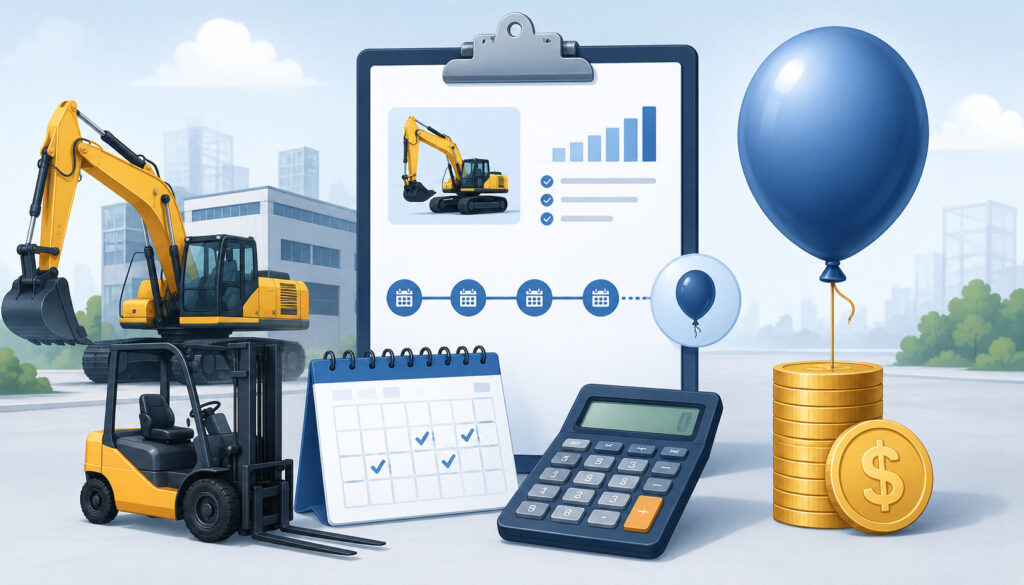
Equipment financing with balloon payment terms starts with the same basic purpose as other equipment loans: the borrower obtains funds to buy or refinance business equipment, then repays the lender over time.
The equipment often serves as collateral, meaning the lender may have a security interest in the asset until the loan is satisfied. Equipment Loans Guide notes that equipment loans commonly involve review of both the borrower and the equipment, including the asset’s value, condition, age, and useful life.
The key difference is the equipment loan structure. Instead of dividing repayment evenly so the balance reaches zero by the final scheduled payment, the lender and borrower agree that a meaningful balance will remain due at the end. Regular payments may cover interest plus some principal, or in some structures, mostly interest with limited principal reduction.
The payment schedule should identify the amount due each month, the interest rate or pricing method, fees, late payment rules, and the final lump-sum payment. Borrowers should also confirm whether the balloon amount is fixed or variable.
A fixed balloon is easier to plan for because the borrower knows the exact amount due. A variable ending balance can be harder to manage if interest, fees, or missed payments change the final payoff.
Because equipment often depreciates, the collateral value matters. A lender may be more comfortable offering commercial equipment loan balloon payments when the asset has a strong resale market, predictable useful life, and documented condition.
A borrower should be equally focused on whether the equipment will still be productive and valuable when the balloon payment comes due.
| Loan Feature | How It Works | What Borrowers Should Consider |
| Monthly payment | Usually lower than a fully amortized loan because part of the balance is deferred | Lower payments can help cash flow, but they do not eliminate the debt |
| Final lump-sum payment | A larger balance is due at the end of the term | The business needs a payoff, refinance, trade-in, or sale plan |
| Interest cost | Interest may accrue on the outstanding balance throughout the term | Lower monthly payments may increase total equipment financing costs |
| Equipment collateral | The financed asset may secure the loan | Depreciation can affect refinance and resale options |
| Repayment term | The contract sets the payment schedule and maturity date | Borrowers should match the term to equipment life and revenue use |
| Refinancing option | The borrower may seek a new loan before maturity | Approval is not guaranteed and may depend on credit, cash flow, and asset value |
| Default risk | Missing the balloon payment can trigger collection actions | The final balance should be planned well before the due date |
Smaller Monthly Payments
Smaller monthly payments are one of the main reasons borrowers consider balloon payments in equipment loans. Because part of the principal is delayed until the end, the required monthly payment may be lower than it would be under a fully amortized loan. This can help a business preserve cash for payroll, inventory, insurance, marketing, repairs, or other operating needs.
That flexibility can be valuable when the equipment is expected to increase revenue gradually. For instance, a business may need time to train staff, install machinery, win contracts, or ramp up production before the equipment reaches full earning potential. A lower payment during that ramp-up period can make the purchase easier to manage.
However, lower monthly payments do not mean the equipment is cheaper. They often mean repayment is being shifted. Borrowers should compare the full cost, not just the monthly amount. If the loan carries interest on a larger outstanding balance for longer, the total cost may be higher.
Final Lump-Sum Payment
The final lump-sum payment is the defining feature of equipment financing with balloon payment terms. It is the amount the borrower must pay at the end of the term to satisfy the loan. This amount may be manageable if the business has planned for it, but it can become a serious cash flow problem if it arrives unexpectedly.
A final balloon can create pressure because it usually comes due all at once. The business may need to use cash reserves, refinance the balance, sell the equipment, trade it in, or use another funding source. Each option depends on timing, credit conditions, equipment value, and business performance.
The risk is not only the size of the payment. It is also the lack of flexibility if the business waits too long. A company that begins planning shortly before maturity may have fewer choices, especially if revenue has declined or the equipment needs repairs.
Borrowers should treat the balloon date as a major financial deadline. That means tracking it on internal calendars, reviewing payoff estimates regularly, and starting discussions with lenders well before the payment is due.
Equipment Value and Resale Risk
Equipment value plays a major role in commercial equipment loan balloon payments because the borrower may rely on the asset to support refinancing, resale, or trade-in. If the equipment holds value well, it may provide more options at the end of the term. If it depreciates faster than expected, the borrower may owe more than the equipment is worth.
Depreciation can happen for many reasons. Equipment may become outdated, heavily used, damaged, expensive to maintain, or less desirable in the resale market. A specialized asset may also have fewer buyers, which can make resale slower or less predictable.
This matters because a borrower might assume the equipment can be sold to cover the balloon payment. That may not work if market value falls below the final balance. It may also fail if the equipment is essential to operations and selling it would reduce revenue.
Before accepting balloon payments in equipment financing, borrowers should research resale demand, expected useful life, maintenance costs, and upgrade cycles. For used assets, inspection records and maintenance history are especially important because lenders may evaluate the remaining life of the equipment closely. This guide to used equipment financing explains why condition, documentation, and resale value matter in equipment-based lending.
Why Businesses Use Balloon Payments in Equipment Financing

Businesses use balloon payments in equipment financing for several practical reasons. The biggest is cash flow flexibility. Equipment can be expensive, and paying for it through a standard fully amortized loan may create monthly payments that are too high for the business’s current budget. A balloon structure may reduce the near-term payment burden while the equipment is put to work.
This can be useful for businesses with seasonal revenue. A company that earns most of its income during certain months may prefer lower fixed monthly obligations during slower periods. If the business expects stronger cash flow later, it may plan to cover the balloon payment from accumulated profits, a seasonal surge, or a planned refinancing.
Growth planning is another reason. Some businesses buy equipment before the revenue increase has fully materialized. A manufacturer might add machinery to increase output. A contractor might finance a vehicle or heavy equipment to take on larger jobs.
A restaurant might buy kitchen equipment before expanding service capacity. In each case, the equipment is expected to help generate the cash needed to handle future repayment.
Balloon structures may also fit short-term equipment needs. If a business expects to use an asset for a limited project or trade it in before the term ends, it may prefer lower monthly payments and a planned exit. However, this only works if the borrower has a realistic end-of-term strategy.
Small business equipment loans with balloon payments can also appeal to owners who want to preserve working capital. Cash reserves can be critical for emergencies, supplier payments, staffing, and growth opportunities. Still, preserving cash today should not come at the expense of creating an unmanageable obligation later.
Common reasons businesses consider balloon structures include:
- Lower initial monthly payments
- Better short-term liquidity
- Seasonal cash flow management
- Expected revenue growth
- Planned equipment replacement
- Anticipated refinancing
- Short-term project use
- Desire to preserve cash reserves
Risks of Commercial Equipment Loan Balloon Payments
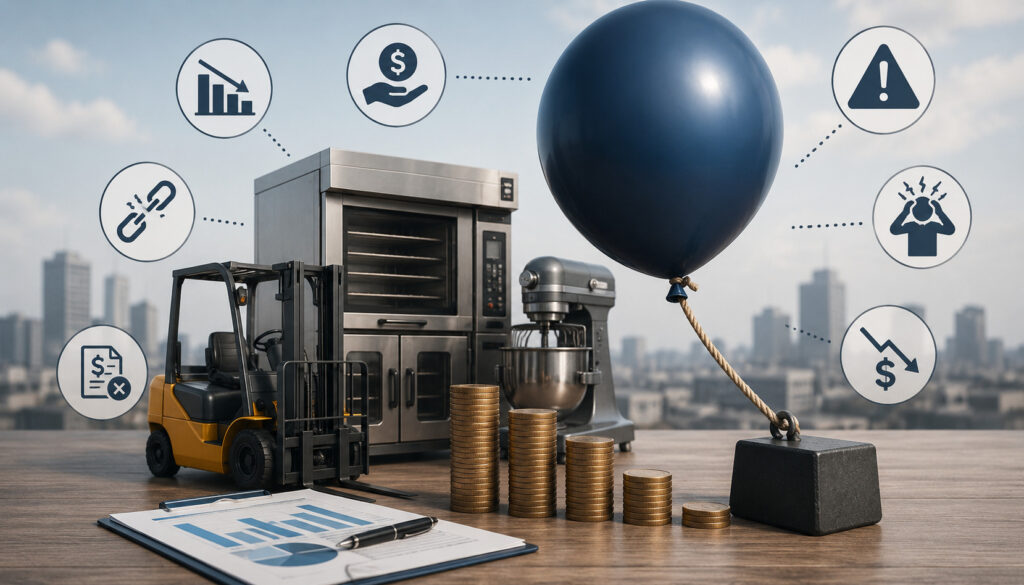
Commercial equipment loan balloon payments carry several risks that borrowers should take seriously. The most obvious is repayment pressure. A business may handle the smaller monthly payments comfortably but struggle when the large final balance comes due. This can create a liquidity problem at exactly the wrong time.
Refinancing uncertainty is another major risk. Many borrowers assume they can refinance the balloon payment before maturity. That may be possible, but it is not guaranteed.
Refinancing depends on lender appetite, credit profile, revenue trends, existing debt, interest rates, equipment value, and the remaining useful life of the asset. If any of those factors weaken, refinancing may become more expensive or unavailable.
Higher total cost is also possible. Since balloon structures defer principal, the borrower may pay interest on a larger outstanding balance for longer. Even if the monthly payment is lower, the total equipment financing costs can exceed the cost of a fully amortized loan. Fees, documentation charges, prepayment rules, and refinance costs can add to the expense.
Depreciation adds another layer of risk. If the equipment loses value faster than expected, the borrower may not be able to sell it or refinance it enough to cover the balloon. This is especially important for technology, vehicles, specialized machines, and assets subject to heavy wear.
Unexpected cash flow problems can make the final payment harder to manage. A slow sales period, major repair, customer loss, supplier price increase, or delayed receivable can reduce available cash. Because the balloon payment is usually contractual, the lender may not be obligated to extend the deadline.
Borrowers should also review default consequences. If the business cannot pay, the lender may charge late fees, restructure the debt, pursue collection, report delinquency, or repossess collateral, depending on the agreement and applicable rules.
The CFPB warns that balloon loans can create serious risk when borrowers cannot make the large final payment or refinance before it comes due.
Balloon Payment vs Fully Amortized Equipment Loan
A balloon payment loan and a fully amortized equipment loan can both help a business acquire equipment, but they manage repayment differently. A fully amortized loan spreads principal and interest across the term so the balance reaches zero with the final scheduled payment. A balloon loan leaves a larger balance due at the end.
The main advantage of a fully amortized structure is predictability. The borrower knows that making each scheduled payment will retire the debt by maturity. There is no separate final lump-sum payment to plan for. This can make budgeting easier and reduce end-of-term uncertainty.
The tradeoff is that monthly payments are usually higher than they would be with a balloon structure. For some businesses, that higher monthly obligation may strain working capital. However, the borrower may pay down principal faster and reduce the risk of owing more than the equipment is worth.
A balloon structure may fit borrowers who have strong confidence in future cash flow, a planned equipment sale, or a refinancing strategy. It may also fit assets that are expected to generate revenue before the large final payment is due. But it requires discipline, because the borrower must actively manage the ending balance.
A fully amortized loan may fit businesses that want simpler repayment, stronger debt reduction, and less reliance on future refinancing. It may also be better for equipment the business plans to keep for a long time.
Here is the practical comparison:
- Balloon payment loan: Lower monthly payments, larger final payment, more end-of-term planning.
- Fully amortized loan: Higher monthly payments, no balloon balance, more predictable payoff.
- Balloon structure fit: Strong cash flow forecast, planned sale, short-term use, or expected refinance.
- Fully amortized fit: Long-term ownership, stable budgeting, and lower repayment uncertainty.
Corporate Finance Institute describes a balloon loan as a stream of regular payments followed by a large payment at the end, while a fully amortized loan is repaid through payments over the life of the loan.
How to Prepare for a Balloon Payment
Preparing for a balloon payment starts before the loan is signed. The borrower should understand the full repayment schedule, the exact or estimated final balance, and the assumptions behind the structure. If the lender provides only the monthly payment, ask for more detail.
The first step is to estimate the final balance. This should include the balloon amount, any remaining interest, fees, taxes, documentation charges, payoff fees, or other contractual costs. A borrower should also ask whether extra principal payments reduce the balloon and whether prepayment penalties apply.
Next, create a savings plan. A business can set aside money monthly or seasonally in a dedicated reserve account. Even if the full balloon will be refinanced later, building reserves reduces dependence on lender approval. It also gives the business more negotiating power.
Cash flow review is essential. The business should compare projected income and expenses against the balloon due date. If revenue is seasonal, the borrower should plan around low and high cash periods. If the balloon comes due during a historically slower month, the business may need to save earlier.
Tracking equipment value is another important step. The borrower should monitor maintenance records, market value, resale demand, and useful life. If the equipment is declining faster than expected, the borrower may need to adjust the payoff plan.
Borrowers should also consider equipment loan refinancing early. Waiting until the last moment can reduce options. Starting early gives time to compare lenders, correct documentation gaps, improve financial statements, and evaluate whether refinancing makes sense. Equipment Loans Guide emphasizes that lenders commonly review financial health, bank activity, borrower records, and asset details during approval. See the equipment loan approval process guide.
Helpful preparation steps include:
- Request the amortization schedule
- Confirm the exact balloon due date
- Build a payoff reserve
- Track equipment condition and market value
- Review cash flow quarterly
- Compare refinancing options early
- Understand prepayment and default terms
- Keep financial documents updated
- Maintain insurance and service records
- Avoid using balloon savings for unrelated expenses
Common Mistakes to Avoid
One common mistake is ignoring the final payment. Borrowers may focus on the attractive monthly payment and pay too little attention to the maturity date. This can lead to panic when the balloon balance becomes due. The final payment should be reviewed as carefully as the rate, term, and monthly amount.
Another mistake is assuming refinancing is guaranteed. Equipment loan refinancing may be available, but it depends on conditions at the time of application. If the business has weaker revenue, higher debt, damaged equipment, or limited collateral value, refinancing may be harder than expected.
Choosing low payments without reviewing total cost is also risky. A balloon structure can make a loan look affordable while increasing total equipment financing costs. Borrowers should compare total payments, fees, interest, and ending balance across multiple options.
Overlooking depreciation can create problems. Equipment value may decline faster than the loan balance, especially if the asset is used heavily or becomes outdated. If the borrower planned to sell or trade the equipment to cover the balloon, depreciation can disrupt that plan.
Not comparing loan structures is another costly mistake. A business should evaluate balloon payment loans, fully amortized loans, lease options, and other business equipment financing choices. Leasing may fit some situations, while ownership may fit others. This guide to equipment leasing can help compare lease-related considerations with loan structures.
Borrowers should also avoid vague contract terms. Every important detail should be documented, including the balloon amount, due date, interest calculation, prepayment rules, collateral rights, late fees, and default consequences.
Mistakes to avoid include:
- Focusing only on monthly payment
- Forgetting the maturity date
- Assuming refinancing will be easy
- Underestimating the final lump-sum payment
- Ignoring equipment depreciation
- Skipping total-cost comparisons
- Failing to read repayment terms
- Not saving throughout the term
- Waiting too long to discuss options
- Financing equipment without a clear revenue purpose
What are balloon payments in equipment loans?
Balloon payments in equipment loans are larger final payments due at the end of a financing term. The borrower usually makes smaller payments during the loan period, then pays the remaining balance in one final lump-sum payment.
This structure can lower monthly payments, but it does not erase the debt. It delays part of repayment. That is why borrowers need a clear plan for the final balance before accepting the loan.
Why do equipment loans have balloon payments?
Equipment loans may have balloon payments to reduce the borrower’s monthly payment, match payments to expected revenue growth, or support short-term use of an asset. Some businesses choose this structure when they expect the equipment to generate more income over time.
Lenders may also use balloon structures when the equipment has a projected residual value. The loan may be designed around the assumption that the asset can be refinanced, sold, traded in, or paid off at maturity.
Are balloon payments risky?
Yes, they can be risky. The main risk is that the business may not have enough cash to make the final lump-sum payment. If refinancing is unavailable or the equipment value has dropped, the borrower may face financial pressure.
Balloon payment risk is higher when the borrower does not track the maturity date, fails to save, overestimates future revenue, or assumes the equipment will hold value. The structure can work, but only with careful planning.
Can a balloon payment be refinanced?
A balloon payment can often be refinanced, but approval is not guaranteed. Lenders may review the business’s revenue, credit profile, debt levels, cash flow, equipment value, and payment history.
Borrowers should start exploring equipment loan refinancing well before the balloon due date. Early planning allows time to compare offers, update financial records, and consider alternatives if refinancing terms are not attractive.
Is a balloon payment cheaper than a regular loan?
Not always. A balloon payment loan may have lower monthly payments, but the total cost can be higher if interest accrues on a larger balance for longer. Fees and refinancing costs can also increase the overall expense.
The only way to compare accurately is to review the full repayment schedule. Borrowers should compare total payments, interest, fees, balloon balance, and payoff options against a fully amortized loan.
What happens if a business cannot pay the balloon payment?
If a business cannot pay the balloon payment, the outcome depends on the loan agreement and lender policies. Possible consequences may include late fees, loan restructuring, refinancing attempts, collection activity, collateral repossession, or legal action.
The best step is to contact the lender before the payment is due. Waiting until after default may reduce options. A borrower should also review the contract and consult qualified financial or legal professionals when needed.
How should businesses prepare for a balloon payment?
Businesses should prepare by calculating the final balance, setting aside funds, reviewing cash flow, tracking equipment value, and exploring refinancing early. They should also keep financial statements, bank records, tax documents, and equipment maintenance records organized.
A good preparation plan includes multiple options. The business should know whether it can pay cash, refinance, sell the equipment, trade it in, or restructure the loan if conditions change.
Should small businesses choose equipment financing with a balloon payment?
Small businesses should choose equipment financing with a balloon payment only when the structure fits their cash flow, equipment use, and repayment plan. It may be helpful when lower monthly payments support growth and the business has a realistic strategy for the final balance.
However, it may not be suitable if cash flow is uncertain, the equipment depreciates quickly, or the business is relying entirely on future refinancing. Small business equipment loans should be reviewed for total cost, repayment risk, and long-term affordability.
Conclusion
Balloon payments in equipment loans can be useful when a business needs lower monthly payments, wants to preserve working capital, or expects the financed equipment to generate stronger future cash flow. The structure can support growth, seasonal planning, and short-term equipment strategies.
But the lower monthly payment comes with a tradeoff: a final lump-sum payment that must be handled on time. Borrowers should review the full equipment loan repayment terms, total equipment financing costs, equipment value, depreciation risk, and refinancing options before signing.
A balloon payment can be manageable when it is planned from the beginning. It can become risky when it is ignored, misunderstood, or treated as a problem for later. The best approach is to compare structures, ask detailed questions, track the asset’s value, and create a realistic payoff plan.
Disclaimer: This article is for informational purposes only and is not financial advice. Businesses should review loan documents carefully and consult qualified professionals before making financing decisions.